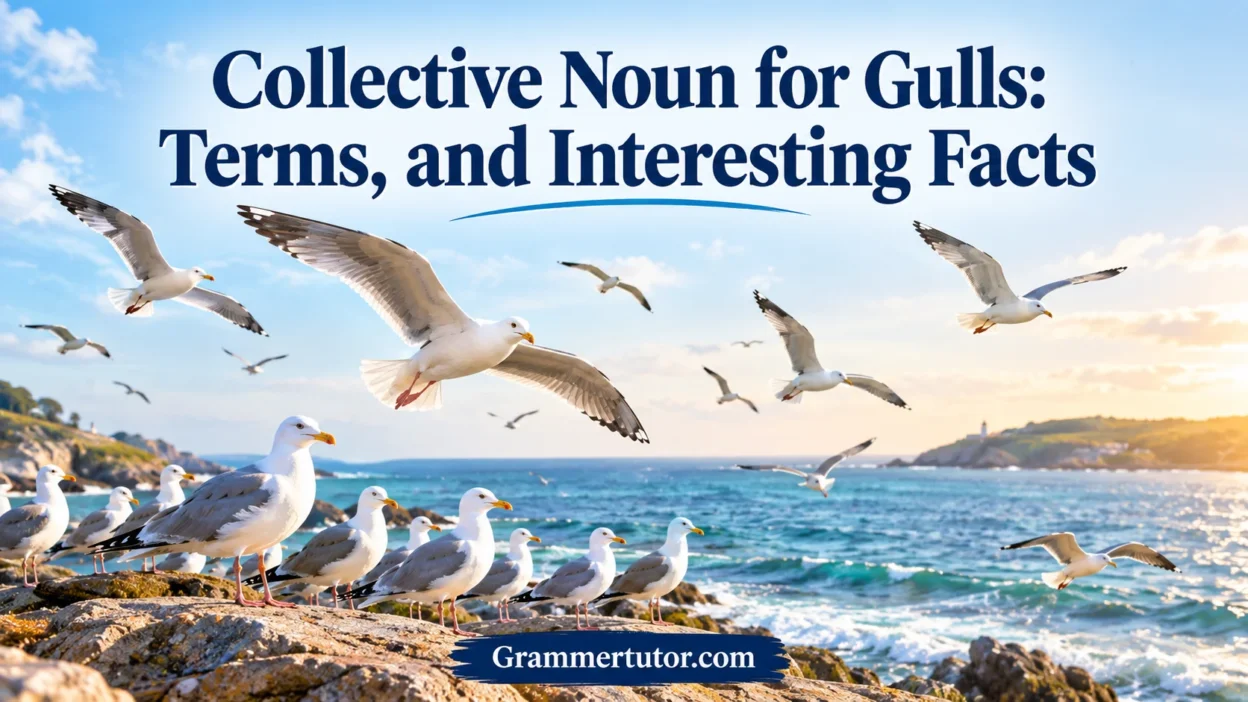
A collective noun for gulls helps describe several birds as one group, especially when they are gathering near beaches, lakes, rivers, harbors, or other coastal areas. In everyday English vocabulary, flock is a common expression for gulls that are flying, resting, or moving together. When you see several individuals staying close together near the water, saying “a flock of gulls” is a clear and natural way to describe the scene.
The word colony can be more suitable when gulls live or nest together in the same area. A flock, however, is a more general term and focuses on gulls being together while flying, resting, or moving. The use of these terms can vary according to the situation. You may also come across traditional terms in lists of animal group names, although some expressions are less common in everyday English.
Learning these group terms can make your writing more descriptive and help you explain the natural behavior of gulls more clearly. Whether you are describing birds near the water, improving your vocabulary, or simply talking about what you see, knowing these expressions gives you more precise language. For practical English, flock is often an easy choice when gulls are gathered together, while a colony works well when the birds live or nest in the same place.
Why Do We Use Collective Nouns for Gulls?
Gulls are highly visible birds that frequently gather in groups. They may congregate where food is plentiful, rest together on beaches or rocks, or nest close to one another during the breeding season.
Because several gulls can behave as a group, English uses collective expressions to describe them. A flock of gulls is a simple and natural way to describe gulls flying or moving together.
When the focus is on gulls living and nesting in the same place, a colony of gulls can be more descriptive. The appropriate expression therefore depends partly on what the gulls are doing.
These group terms make sentences more precise and allow writers to describe both the appearance and behavior of gulls in an engaging way.
Collective Nouns for Gulls
| Collective Noun | Used For | Simple Example |
| Flock | Gulls flying or moving together | A flock of gulls flew over the beach. |
| Colony | Gulls living or nesting together | A colony of gulls nested on the island. |
| Group | A general gathering of gulls | A group of gulls rested near the shore. |
| Flight | Gulls flying together | A flight of gulls crossed the sky. |
| Flock | Several gulls gathered together | A flock of gulls gathered near the harbor. |
Flock of Gulls
A flock of gulls is one of the easiest expressions to use when several gulls are together. It works especially well when the birds are flying, feeding, resting, or moving from one location to another.
The word flock is a familiar collective term for birds, so it is easy for readers to understand. It can be used in both everyday descriptions and general wildlife writing.
Examples of “Flock of Gulls”
- A flock of gulls flew above the beach.
- We watched a flock of gulls near the harbor.
- A flock of gulls gathered around the fishing boats.
- The flock of gulls moved across the shoreline.
- A flock of gulls circled above the water.
- The children saw a flock of gulls on the beach.
- A flock of gulls landed near the pier.
- The flock of gulls flew toward the island.
- We noticed a flock of gulls feeding near the shore.
- A flock of gulls disappeared over the waves.
Colony of Gulls
A colony of gulls describes gulls that live or nest together in the same area. This expression is particularly useful when discussing breeding sites or places where many gulls regularly stay.
Gulls may establish nesting areas on islands, cliffs, coastal rocks, rooftops, and other suitable locations. In this context, a colony emphasizes the shared living or nesting environment.
Examples of “Colony of Gulls”
- A colony of gulls nested on the rocky island.
- We discovered a colony of gulls near the coast.
- The colony of gulls returned to the island each year.
- A large colony of gulls lived near the cliffs.
- Researchers studied the colony of gulls.
- The colony of gulls gathered around the nesting area.
- A colony of gulls occupied the coastal rocks.
- The island provided shelter for a colony of gulls.
- We watched the colony of gulls from a distance.
- The colony of gulls became active during the breeding season.
Group of Gulls
A group of gulls is a straightforward expression for several gulls considered together. Unlike some specialized collective terms, it does not suggest a particular behavior or living arrangement.
It can be useful when you simply want to describe several gulls without focusing on whether they are flying, nesting, feeding, or resting.
Examples of “Group of Gulls”
- A group of gulls rested near the water.
- We saw a group of gulls beside the harbor.
- A group of gulls gathered on the beach.
- The group of gulls moved toward the fishing boats.
- A group of gulls stood on the rocks.
- We watched a group of gulls near the pier.
- The group of gulls flew over the shoreline.
- A group of gulls searched for food.
- The group of gulls gathered near the dock.
- A group of gulls landed beside the lake.
Flight of Gulls
A flight of gulls is a descriptive expression that focuses on gulls moving through the air. It can be useful in literary, descriptive, or wildlife writing when the movement of the birds is the main focus.
The expression creates a strong visual image of several gulls traveling together across the sky.
Examples of “Flight of Gulls”
- A flight of gulls crossed the morning sky.
- We watched a flight of gulls above the ocean.
- A flight of gulls moved toward the coast.
- The flight of gulls passed over the harbor.
- A flight of gulls rose from the beach.
- The photographer captured a flight of gulls in the distance.
- A flight of gulls circled above the waves.
- The flight of gulls disappeared beyond the cliffs.
- We noticed a flight of gulls near the lighthouse.
- A flight of gulls traveled across the open water.
Types of Gulls and Their Characteristics
Gulls belong to the Laridae family and include many different species found across coastal and inland environments. Although people often use the general word “seagull,” this is not a formal scientific group name for all gull species. Different gulls can vary in size, coloring, habitat, and feeding behavior.
Many gulls have strong wings, webbed feet, and sturdy bills. Their bodies are generally well suited to life around water, although many species also live far from the sea. Some gulls can be found around lakes, rivers, farmland, cities, rubbish sites, and other places where food is available.
Gulls are also known for their adaptability. They can take advantage of a wide variety of food sources and may interact closely with human environments.
Examples of Gull Characteristics
- Gulls are members of the Laridae family.
- Many gulls have webbed feet.
- Gulls have strong wings for sustained flight.
- Different gull species vary in size.
- Some gulls live far inland.
- Gulls can inhabit coastal and freshwater environments.
- Many gulls are highly adaptable birds.
- Gulls have strong bills suited to different foods.
- Some gull species form nesting colonies.
- Gulls can travel considerable distances while searching for food.
Interesting Facts About Gulls
Gulls are fascinating birds with impressive abilities and adaptable lifestyles. Their longevity varies among species, but some gulls can live for many years when environmental conditions are favorable. Their ability to survive in different habitats contributes to their success across coastal and inland regions.
One of the most noticeable physiological features of gulls is their combination of strong wings, webbed feet, and sturdy bills. Their wings allow them to glide efficiently over water and land, while their webbed feet help them move across shorelines and floating surfaces. Their bills are useful for handling a wide range of food.
Gulls also have varied dietary habits. Depending on the species and available resources, they may eat fish, insects, marine animals, worms, eggs, small animals, fruits, and food found around human settlements. Their flexible diets allow them to make use of changing food sources.
Their social behavior is another reason collective nouns are useful. Gulls frequently gather in groups around reliable food sources, resting places, and nesting sites. During breeding periods, some species form colonies in suitable coastal or inland locations. These gatherings make expressions such as flock and colony useful when describing gulls.
READ MORE: Collective Noun for Lizards: A Complete Guide with Examples
Conclusion
The most common collective noun for gulls is flock, especially when several gulls are flying, resting, or moving together. Colony is also useful when gulls live or nest together in the same area. Understanding these terms makes your English more natural and helps you describe groups of gulls clearly in different situations.
FAQs
Q1. What is the collective noun for gulls?
The most common collective noun for gulls is flock. You can say “a flock of gulls” when several gulls are together.
Q2. What is a group of gulls called?
A group of gulls is commonly called a flock. This term works well when the gulls are flying, resting, or moving together.
Q3. Can you use “colony” for gulls?
Yes. Colonies can describe gulls that live or nest together in the same area.
Q4. Is “flock of gulls” grammatically correct?
Yes, “flock of gulls” is grammatically correct and is a natural expression in English.
Q5. What is the difference between a flock and a colony of gulls?
Flock generally describes gulls that are together, while colony is more closely associated with gulls living or nesting together in one area.
Q6. Can “flock” be used for gulls flying together?
Yes. Flock is commonly used when gulls are flying together.
Q7. Can “flock” describe gulls resting together?
Yes. You can use flock when gulls are resting together, including around beaches, lakes, rivers, harbors, and coastal areas.
Q8. Why are gulls often seen in groups?
Gulls may gather in groups around places where they can find food, rest, or suitable nesting areas. Their natural behavior can therefore bring many birds together.
Q9. Are there other collective nouns for gulls?
Other traditional group terms may appear in animal-name lists, but their use can vary. Flock and colony are useful, familiar choices for different situations.
Q10. How do I use the collective noun for gulls in a sentence?
You can say, “A flock of gulls was flying over the water.” If the birds are living or nesting together, you could say, “A colony of gulls nested along the coast.”