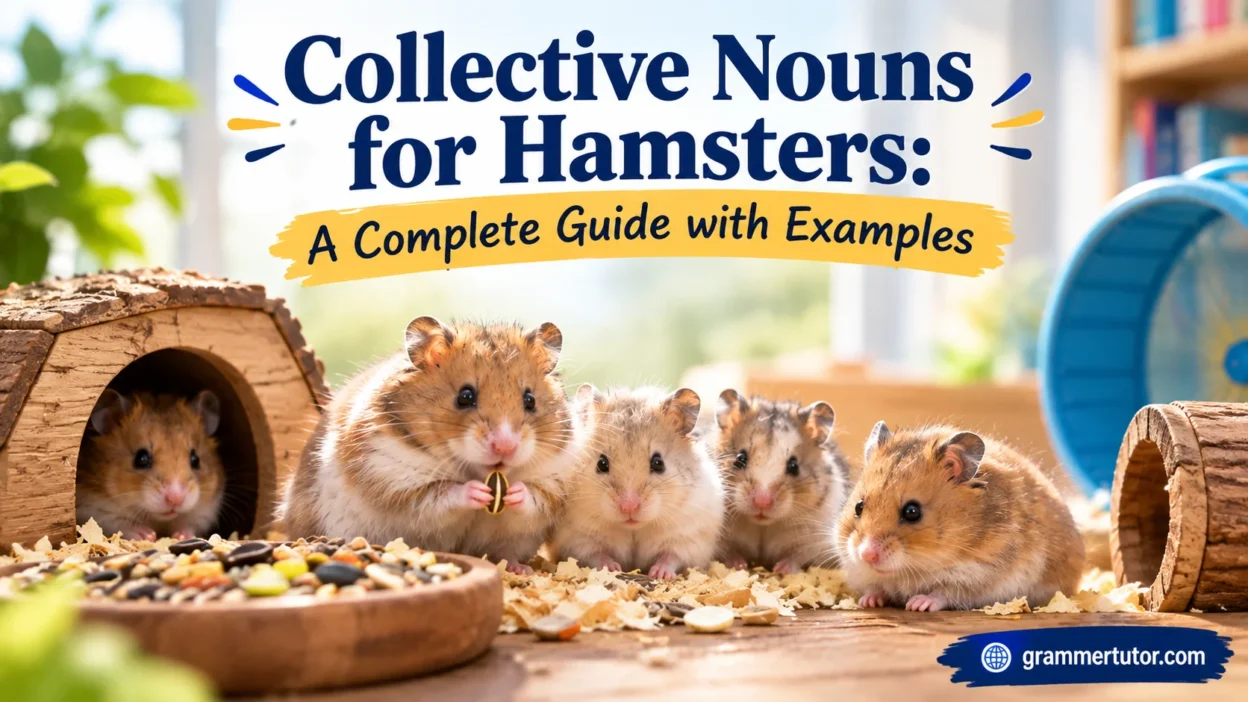
The collective noun for hamsters is a simple way to describe these small, adorable rodents when they appear together in a group. Hamsters are tiny mammals with round bodies, fluffy cheeks, short tails, and active personalities. As an English learner or pet owner, you may wonder whether hamsters have a special animal group name. Unlike animals with one famous collective noun, hamsters don’t have a single universally established traditional group name. In everyday English usage, a group of hamsters is a clear and useful general expression. You can also use horde as a creative word for a large number of hamsters, especially in playful animal stories. This makes learning collective nouns an enjoyable way to improve your animal vocabulary and understand how English speakers describe pets.
Hamsters are often kept as pets, and many species prefer to live alone rather than in groups. However, some species can live in compatible groups, depending on their needs and behavior. When several hamsters are together, you can use the common expression group of hamsters without confusion. For example, “A group of hamsters was exploring the enclosure” is a natural sentence. In a playful story, you might write, “A horde of hamsters rushed toward the food.” The word horde adds a fun and creative touch, while common English expressions are usually better for clear communication. Understanding this difference between a familiar collective expression and a playful animal group name helps you choose the right word for your sentence. It also makes English grammar, noun phrases, and proper usage easier to understand.
When learning about hamsters, it is useful to explore more than just their group names. These interesting facts about animal behavior, lifespan, body features, and dietary habits can help you build stronger English sentences. For example, you can describe a hamster’s fluffy cheeks, short tail, or active personality while practicing descriptive language. You can also learn how animal terminology, group expression, and collective noun usage work in everyday English. Whether you’re writing about pet hamsters, studying English vocabulary, or learning about animal classification, choosing familiar words makes your writing clear and natural. A simple expression such as a group of hamsters is often the best choice when you want your meaning to be easy for every reader to understand.
Why Collective Nouns Are Used for Hamsters
Collective nouns give us a convenient way to describe several animals as one group. Instead of repeating “a group of hamsters,” you can choose an expression that fits the situation.
Hamsters are small, active rodents that spend much of their time exploring, gathering food, burrowing, and resting. Their behavior can inspire descriptive expressions in English, especially in creative writing and casual conversation.
For example, if several hamsters are exploring a play area, you might say a group of hamsters. If you’re writing a humorous story about many energetic hamsters, a playful phrase such as a horde of hamsters can create a fun image.
However, it’s important to remember that not every creative expression is a standard zoological collective noun. The safest choice for formal writing is a group of hamsters.
Collective Nouns for Hamsters
The following table shows useful expressions for describing hamsters. Some are general terms, while others are informal or creative.
| Collective Noun | Used For | Simple Example |
| Group | Several hamsters together | A group of hamsters explored the enclosure. |
| Horde | A large or playful gathering | A horde of hamsters rushed toward the food. |
| Colony | Hamsters living together in a shared setting | A colony of hamsters lived in the research facility. |
| Clowder | A creative, informal expression | A clowder of hamsters played together. |
| Huddle | Hamsters gathered closely | A huddle of hamsters rested together. |
| Nest | Hamsters resting in a shared nest | A nest of hamsters slept quietly. |
Note: Group is the safest general expression. Colony may be appropriate in certain research or breeding contexts, but many pet hamsters are solitary. The other terms are playful or descriptive rather than universally accepted traditional collective nouns.
Group of Hamsters
A group is the simplest and most reliable expression for several hamsters together. It works in everyday conversation, school assignments, animal descriptions, and general English writing.
Unlike specialized collective nouns, group doesn’t suggest a particular behavior. You can use it whether the hamsters are playing, eating, resting, or exploring.
Examples of “Group of Hamsters”
- A group of hamsters explored the enclosure.
- We watched a group of hamsters playing together.
- The group of hamsters searched for food.
- A group of hamsters rested in the bedding.
- The children observed a group of hamsters.
- A group of hamsters moved around the play area.
- The group of hamsters gathered near the food bowl.
- A group of hamsters explored the tunnels.
- The group of hamsters became active in the evening.
- A group of hamsters rested inside the shelter.
Horde of Hamsters
A horde of hamsters is a playful and informal expression for a large number of hamsters. The word horde creates an image of many small animals moving together with energy and excitement.
This term is especially suitable for humorous stories, creative writing, and fun descriptions. It isn’t the standard scientific collective noun for hamsters.
Examples of “Horde of Hamsters”
- A horde of hamsters rushed toward the food.
- We watched a horde of hamsters exploring the play area.
- A horde of hamsters filled the enclosure.
- The horde of hamsters moved through the tunnels.
- A horde of hamsters gathered around the treats.
- The children laughed at the playful horde of hamsters.
- A horde of hamsters scurried across the bedding.
- The horde of hamsters explored every corner.
- A horde of hamsters created a lively scene.
- The horde of hamsters returned to their shelters.
Colony of Hamsters
A colony describes animals living together in a shared environment. The term can be used for hamsters in certain research, breeding, or housing contexts, but it isn’t a universal name for every group of hamsters.
Many commonly kept hamster species, including Syrian hamsters, are solitary by nature. Therefore, you should not assume that a colony is appropriate for all hamsters.
Examples of “Colony of Hamsters”
- A colony of hamsters lived in the research facility.
- The researchers observed a colony of hamsters.
- A colony of hamsters was kept for scientific study.
- The colony of hamsters received regular care.
- Scientists monitored the colony of hamsters.
- A colony of hamsters lived in a carefully managed environment.
- The researchers studied the behavior of the colony.
- The colony of hamsters was observed throughout the experiment.
- A colony of hamsters lived in the breeding facility.
- The staff cared for the colony of hamsters.
Clowder of Hamsters
A clowder is traditionally associated with cats, but it can be used humorously for hamsters in creative writing. The word gives a playful feeling to a group of small, furry animals.
It isn’t a standard or widely accepted collective noun for hamsters. If you’re writing a formal article or answering an English vocabulary question, group is a better choice.
Examples of “Clowder of Hamsters”
- A clowder of hamsters played in the enclosure.
- We watched a clowder of hamsters exploring the room.
- The clowder of hamsters gathered around the toys.
- A clowder of hamsters scurried through the tunnels.
- The children enjoyed watching the clowder of hamsters.
- A clowder of hamsters searched for hidden treats.
- The clowder of hamsters rested in the soft bedding.
- A clowder of hamsters created a cheerful scene.
- The clowder of hamsters explored the playhouse.
- We photographed the playful clowder of hamsters.
Huddle of Hamsters
A huddle describes a group of hamsters gathered closely together. It focuses on their physical arrangement rather than acting as a traditional animal collective noun.
Hamsters may gather closely while resting, depending on their species and social compatibility. However, many pet hamsters prefer to live alone, so this expression should be used only when the animals are actually huddled together.
Examples of “Huddle of Hamsters”
- A huddle of hamsters rested in the bedding.
- We saw a huddle of hamsters near the shelter.
- The huddle of hamsters stayed warm.
- A huddle of hamsters slept quietly.
- The children watched the huddle of hamsters.
- A huddle of hamsters gathered in the nest.
- The huddle of hamsters remained close together.
- A huddle of hamsters rested after playing.
- The caretaker observed the huddle of hamsters.
- A huddle of hamsters settled inside the shelter.
Nest of Hamsters
A nest of hamsters is a descriptive expression for hamsters resting in a nest or sheltered bedding area. It can also suggest a group of young hamsters in a nest, depending on the context.
This term focuses on the place where the hamsters rest. It isn’t a standard collective noun for all hamsters, but it can be useful in storytelling and animal descriptions.
Examples of “Nest of Hamsters”
- A nest of hamsters slept in the soft bedding.
- We found a nest of hamsters inside the shelter.
- The nest of hamsters remained quiet during the day.
- A nest of hamsters rested beneath the bedding.
- The caretaker checked the nest of hamsters.
- A nest of hamsters stayed close to the mother.
- The nest of hamsters became active in the evening.
- We watched the nest of hamsters from a distance.
- The nest of hamsters remained warm and comfortable.
- A nest of hamsters rested inside the wooden house.
Interesting Facts About Hamsters
Hamsters are small mammals belonging to the rodent family Cricetidae. They are popular pets because of their compact size, curious behavior, and ability to adapt to carefully managed home environments. Hamsters have different lifespans depending on their species, genetics, nutrition, and healthcare. Many pet hamsters live for around 1.5 to 3 years, although some individuals may live longer. Syrian hamsters and dwarf hamsters can differ in their average lifespan, so it’s important to consider the species when discussing longevity.
One of the most recognizable physiological features of hamsters is their expandable cheek pouches. These pouches allow hamsters to carry food from one place to another. A hamster may fill its cheeks with seeds or other food and transport the food back to its nest or storage area. Hamsters also have strong front teeth that continue growing throughout life. They need to chew suitable materials to help keep their teeth worn down.
Hamsters are generally omnivores, which means they can consume both plant and animal-based foods. Their diet commonly includes grains, seeds, vegetables, and specially formulated hamster food. Some hamsters may also eat small amounts of suitable protein sources, such as mealworms, depending on their dietary needs. Fresh water should always be available, and food choices should be appropriate for the hamster’s species and health.
Hamsters are also known for their burrowing behavior. In the wild, many species create tunnels and underground shelters where they sleep, store food, and raise young. Their natural activity patterns often make them more active during the evening or night. This is one reason why pet hamsters may seem sleepy during the day but become energetic after sunset.
Another interesting feature is their ability to store food. Hamsters gather food in their cheek pouches and carry it to a safe location. This behavior is useful in natural environments where food may not always be available. Their strong sense of smell and active whiskers also help them explore their surroundings.
Hamsters can be social or solitary depending on the species. Syrian hamsters are generally solitary, while some dwarf hamster species may tolerate living with compatible companions under suitable conditions. Even when hamsters live near one another, they need enough space, food, shelter, and appropriate care to avoid stress and conflict.
Quick Hamster Facts
- Hamsters are small rodents.
- They belong to the family Cricetidae.
- A general group can be called a group of hamsters.
- Hamsters have expandable cheek pouches.
- Their front teeth grow continuously.
- Hamsters are generally omnivores.
- Seeds and grains are common parts of their diet.
- Hamsters often store food in their nests.
- Many hamsters are active during the evening or night.
- Hamsters naturally create burrows and tunnels.
- Many pet hamsters live around 1.5 to 3 years.
- Syrian hamsters are generally solitary.
- Some dwarf hamsters may live with compatible companions.
- Hamsters use their whiskers to explore their surroundings.
READ MORE: Collective Noun for Snails: Names, Examples, and Interesting Facts
Conclusion
The collective noun for hamsters does not have one universally accepted traditional group name. In most situations, a group of hamsters is the clearest and most natural expression. Horde can also be used creatively when describing a large number of hamsters, especially in humorous or playful writing. Understanding these expressions helps you use animal vocabulary, collective nouns, and English usage more confidently.
FAQs
Q1. What is the collective noun for hamsters?
The most common expression is a group of hamsters. There is no single universally established traditional collective noun specifically for hamsters.
Q2. Can I use “horde” for a group of hamsters?
Yes. Horde can be used creatively to describe a large number of hamsters, particularly in humorous, informal, or playful writing.
Q3. Is “a group of hamsters” grammatically correct?
Yes. A group of hamsters is grammatically correct and is a clear, natural way to describe several hamsters together.
Q4. Do hamsters have a special collective noun?
Unlike some animals, hamsters do not have one widely recognized traditional collective noun. A group of hamsters is therefore the safest general expression.
Q5. What do you call several hamsters together?
You can simply call them a group of hamsters. This expression is easy to understand and works well in everyday English.
Q6. Are hamsters social animals?
It depends on the species. Many hamsters prefer to live alone, while some species may be able to live in compatible groups under suitable conditions.
Q7. Can “horde of hamsters” be used in a sentence?
Yes. For example: “A horde of hamsters rushed toward the food.” Here, horde gives the sentence a playful and exaggerated tone.
Q8. Is “horde” a formal collective noun for hamsters?
No. Horde is better understood as a creative expression rather than an established traditional collective noun for hamsters.
Q9. Why is “a group of hamsters” a good choice?
It is clear, natural, and widely understandable. When a specific traditional collective noun is not established, a simple group expression avoids confusion.
Q10. What are hamsters known for?
Hamsters are small mammals known for their round bodies, fluffy cheeks, short tails, and active personalities. They are also commonly kept as pets.