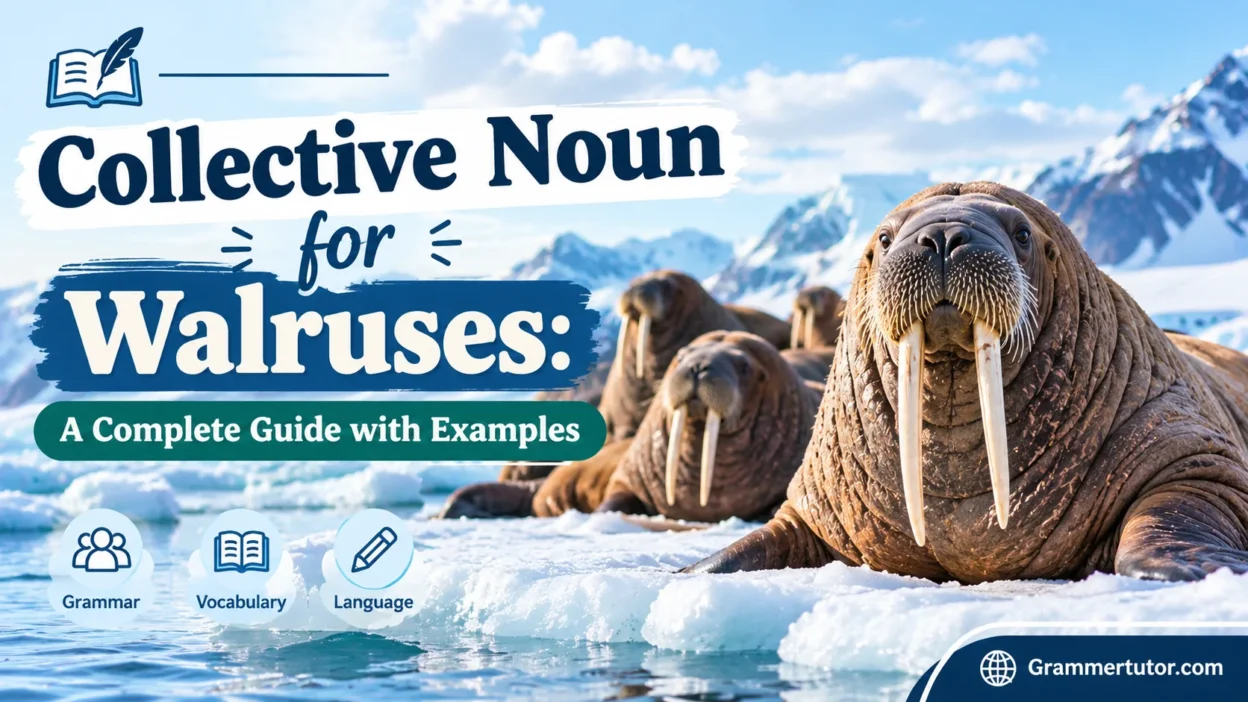
The collective noun for walruses is most commonly heard, especially when these marine mammals gather in large numbers. You may also see pods or colonies in wildlife writing and descriptions. These expressions help readers understand that walruses are highly social animals that often stay close to one another while resting on beaches, floating nearby, or gathering on sea ice.
The term haul-out has a slightly different meaning because it can refer to the place where they gather, particularly when walruses leave the water to rest. Their usage depends on the context and whether the writer wants to focus on the animals or their gathering place. Walruses have enormous bodies, long tusks, whiskers, and thick skin, giving them a highly recognizable appearance and showing their remarkable ability to survive in cold Arctic and sub-Arctic environments.
In wildlife writing, choosing the right term makes descriptions more vivid and precise. Herd is a natural choice for a social group of walruses, while colony can describe a larger gathering, and haul-out emphasizes the place where they gather. Pod may also appear in descriptions, although herd remains the most familiar term for these distinctive marine mammals.
Why Collective Nouns Are Used for Walruses
Walruses frequently gather in groups, especially when they come ashore or rest on sea ice. Large gatherings can contain many individuals packed closely together, creating a striking sight along a coastline or ice-covered habitat.
Using a collective noun makes it easier to describe these gatherings without repeatedly saying a group of walruses. The word herd is particularly useful for a general group, while other expressions may be used when describing particular situations.
These terms also make English more expressive. A sentence about a herd of walruses resting on the ice immediately gives the reader a clearer picture of the animals and their surroundings.
Collective Nouns for Walruses
| Collective Noun | Used For | Simple Example |
| Herd | A general group of walruses | A herd of walruses rested on the ice. |
| Pod | Walruses gathered or moving together | A pod of walruses moved through the water. |
| Colony | A large gathering in one location | A colony of walruses occupied the shore. |
| Haul-out | Walruses gathered on land or ice | The walruses formed a large haul-out. |
| Group | A general description | A group of walruses rested near the coast. |
Herd of Walruses
A herd is the most familiar general collective noun for walruses. It describes several walruses gathered together, whether they are resting, swimming nearby, or occupying the same area.
Walruses are naturally social, and large gatherings are common during resting periods. A herd can include animals of different ages and sexes.
Examples of “Herd of Walruses”
- A herd of walruses rested on the sea ice.
- We watched a herd of walruses along the Arctic coast.
- The herd of walruses gathered near the shore.
- A large herd of walruses occupied the beach.
- The herd of walruses moved toward the water.
- Researchers observed a herd of walruses from a distance.
- A herd of walruses rested beside the ice floe.
- The herd of walruses became active in the afternoon.
- A herd of walruses gathered around the rocky shore.
- The herd of walruses slowly entered the water.
Pod of Walruses
Pod is a term commonly associated with marine mammals, especially whales and dolphins. It can sometimes be used more broadly for groups of marine animals, including walruses, but herd is the more familiar general expression for walruses.
When the emphasis is on animals traveling or moving through water together, pod can provide a useful descriptive expression.
Examples of “Pod of Walruses”
- A pod of walruses moved through the cold water.
- We spotted a pod of walruses near the ice.
- The pod of walruses traveled along the coastline.
- A pod of walruses surfaced near the boat.
- The pod of walruses moved toward the shore.
- Researchers observed a pod of walruses from afar.
- A pod of walruses disappeared beneath the waves.
- The pod of walruses gathered near an ice floe.
- A pod of walruses swam through the Arctic waters.
- The pod of walruses followed the coastline.
Colony of Walruses
A colony can describe a large gathering of walruses occupying the same location, particularly when many animals gather on a beach or other resting site.
The term focuses more on the concentration of animals in one place than on their movement. Large walrus gatherings can contain hundreds or even thousands of animals.
Examples of “Colony of Walruses”
- A colony of walruses covered the beach.
- Researchers observed a colony of walruses from a safe distance.
- The colony of walruses rested along the coastline.
- A large colony of walruses gathered on the shore.
- The colony of walruses occupied the rocky beach.
- Scientists monitored the colony of walruses.
- A colony of walruses gathered near the sea ice.
- The colony of walruses remained close to the water.
- Rangers protected the colony of walruses.
- The colony of walruses slowly moved toward the sea.
Haul-Out of Walruses
A haul-out is a particularly useful term when talking about walruses gathered on land or sea ice. In marine biology, haul-out refers to a situation or location where marine mammals leave the water to rest.
Walruses regularly haul out onto beaches, rocks, and sea ice. These sites can become crowded when many animals gather together to rest.
Examples of “Haul-Out of Walruses”
- A large haul-out of walruses formed on the beach.
- Scientists studied the walrus haul-out from a distance.
- The haul-out contained hundreds of walruses.
- The walruses gathered at the coastal haul-out.
- Researchers monitored the haul-out throughout the summer.
- The haul-out became crowded during the afternoon.
- Walruses returned to the same haul-out.
- The coastal haul-out provided a resting place.
- The haul-out stretched along the rocky shore.
- Scientists protected the walrus haul-out from disturbance.
Group of Walruses
A group of walruses is a simple and completely understandable expression. Unlike some specialized animal collective nouns, group can be used in almost any situation without suggesting a particular behavior.
If you’re unsure which specialized term fits your sentence, a group of walruses is always a clear option.
Examples of “Group of Walruses”
- A group of walruses rested on the beach.
- We saw a group of walruses near the ice.
- The group of walruses entered the water.
- A group of walruses gathered along the shore.
- Researchers photographed a group of walruses.
- The group of walruses rested together.
- A group of walruses moved across the ice.
- The group of walruses stayed close to the coastline.
- A group of walruses surfaced near the boat.
- The group of walruses returned to the beach.
Walrus Behavior and Social Life
Walruses are highly social marine mammals, and their tendency to gather together is one reason collective nouns are useful when describing them. They often rest in groups on sea ice, beaches, and rocky coastal areas.
Large gatherings can become extremely crowded. Walruses may lie close together while resting, with individuals sometimes using their tusks and flippers to help position themselves or move around. Their social behavior can also involve vocal communication and physical contact.
Walruses spend considerable time in the water searching for food, but they also need resting periods on land or ice. These resting areas are known as haul-outs. A suitable haul-out can become an important gathering site for large numbers of walruses.
Walruses communicate using a variety of sounds. They can produce grunts, bell-like sounds, clicks, and other vocalizations. These sounds can help individuals interact with one another, especially in crowded groups.
Their social nature is particularly noticeable when they gather in large numbers. Seeing hundreds of walruses resting together demonstrates why terms such as herd, group, and haul-out can be useful when describing these impressive animals.
Examples of Walrus Behavior
- Walruses often gather in large groups.
- Walruses rest on beaches and sea ice.
- Large gatherings can become very crowded.
- Walruses communicate using different sounds.
- Walruses spend time both on land and in water.
- A haul-out provides a resting location.
- Walruses can gather around suitable resting areas.
- Walruses use their flippers for movement.
- Walruses often remain close to other members of their group.
- Large walrus gatherings can contain hundreds of animals.
Interesting Facts About Walruses
Walruses are large marine mammals belonging to the family Odobenidae. They are best known for their enormous bodies, prominent tusks, sensitive whiskers, and thick skin. Walruses can live for several decades, with individuals commonly reaching around 40 years in the wild. Their relatively long lifespan gives them plenty of time to grow, reproduce, and develop strong social relationships.
One of their most distinctive physiological features is their pair of long tusks. Both males and females have tusks, which are enlarged canine teeth. Walruses can use these tusks for several purposes, including helping them climb onto ice, establishing dominance, and displaying during social interactions. Their whiskers, called vibrissae, are also highly sensitive and help them locate food on the seafloor.
Walruses have thick layers of blubber beneath their skin. This fat provides insulation in extremely cold Arctic and sub-Arctic waters and also serves as an energy reserve. Their large bodies and specialized circulatory adaptations help them cope with cold environments.
Walruses are primarily benthic feeders, meaning they search for food along the ocean floor. Their diet consists mainly of clams and other mollusks, but they may also eat worms, snails, sea cucumbers, shrimp, and other marine organisms. Their sensitive whiskers help them detect prey hidden beneath sediment.
Walruses use their mouths and powerful suction to obtain many of their prey items. Their feeding behavior allows them to locate food in muddy or sandy seafloors where visibility may be limited. This specialized feeding strategy is one of the most interesting aspects of their biology.
Walruses are also strongly connected to sea ice and coastal habitats. They use ice and land for resting between feeding trips. Changes in sea-ice conditions can therefore affect where and how walruses gather.
Examples of Walrus Facts
- Walruses are marine mammals.
- Both males and females have tusks.
- Walrus tusks are enlarged canine teeth.
- Walruses can live for several decades.
- Their whiskers are highly sensitive.
- Walruses have thick layers of blubber.
- They are mainly benthic feeders.
- Clams and other mollusks are important foods.
- Walruses often rest on sea ice or land.
- Large walrus gatherings can occur at haul-outs.
READ MORE: Collective Noun for Hogs: A Complete Guide with Examples
Conclusion
The most common and familiar collective noun for walruses is herd. Other terms, including pod, colony, and haul-out, may appear depending on the context and what the writer wants to emphasize. Herd is generally the clearest choice when referring to a group of walruses, while haul-out is particularly useful when discussing the place where they gather to rest.
FAQs
Q1. What is the collective noun for walruses?
The most familiar collective noun for walruses is herd. You can say, “A herd of walruses gathered on the sea ice.”
Q2. Can you say a herd of walruses?
Yes. A herd of walruses is a natural and widely understandable expression for a group of walruses.
Q3. Is “pod” a collective noun for walruses?
Pod can appear in descriptions of walruses, but herd is generally the more familiar collective term.
Q4. Can “colony” describe a group of walruses?
Yes. Colony may be used when the emphasis is on a large gathering of walruses, although herd is more familiar in general usage.
Q5. What does “haul-out” mean for walruses?
A haul-out refers to a place or situation where walruses leave the water and gather on land, beaches, or sea ice to rest.
Q6. Why do walruses gather in large numbers?
Walruses are highly social animals and commonly gather in large numbers, particularly when they are resting.
Q7. Where do groups of walruses gather?
Walruses may gather on beaches, sea ice, and other suitable resting areas in their Arctic and sub-Arctic environments.
Q8. What makes walruses easy to recognize?
Their enormous bodies, long tusks, whiskers, and thick skin make walruses among the most recognizable marine mammals.
Q9. Which term is best for formal wildlife writing?
Herd is usually the safest and clearest choice when you simply mean a group of walruses. Haul-out is more specific when discussing their resting location.
Q10. What is the best way to describe many walruses together?
You can simply say “a herd of walruses.” If the context focuses on their resting location, “a walrus haul-out” may provide a more specific description.