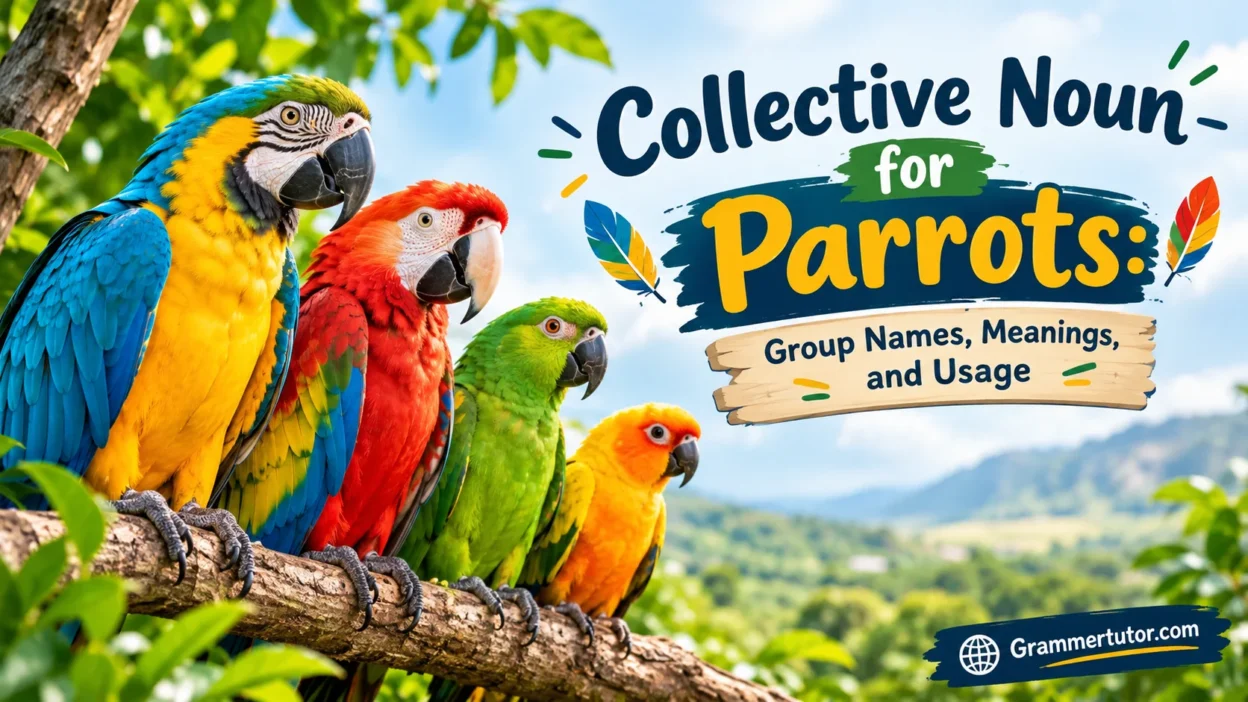
A collective noun for parrots helps you describe a group of parrots clearly, adding variety and color to the English language when intelligent, colorful birds gather together.The most familiar expression is a flock of parrots, but company, pandemonium, and congregation are also useful terms.
A flock can describe social birds moving together, while a company may describe parrots staying together.Pandemonium can suit a loud gathering because parrots produce a wide range of sounds through their ability to communicate. Congregation often has a more traditional usage or descriptive usage, so the best choice depends on what the parrots are doing and the kind of description you want.
Parrots are known for bright feathers, curved beaks, strong feet, and intelligence, which makes them fascinating birds to describe.Learning these collective nouns gives you useful vocabulary and can help you explain how parrots live and interact. Using flock, company, pandemonium, or congregation naturally makes your description more precise while keeping the focus on the birds and their behavior.
Why Collective Nouns Are Used for Parrots
Parrots often gather in groups to feed, travel, communicate, roost, and protect one another. Some species can form large groups, especially when food is plentiful or when they return to communal roosting areas. Their noisy calls and active movements can make a group of parrots an impressive sight.
Because parrots behave socially, English has several expressions for describing them. Flock is the most useful general term, while more unusual expressions can add a creative or traditional feel to writing.
Collective nouns make descriptions more vivid. Saying a flock of parrots flew over the trees immediately gives the reader an image of several colorful birds moving together through the sky.
Collective Nouns for Parrots
| Collective Noun | Used For | Simple Example |
| Flock | A group of parrots | A flock of parrots flew over the trees. |
| Company | A group of parrots | A company of parrots gathered in the forest. |
| Pandemonium | A noisy group of parrots | A pandemonium of parrots filled the trees with calls. |
| Congregation | Parrots gathered together | A congregation of parrots rested in the trees. |
| Group | A general group of parrots | A group of parrots gathered near the garden. |
Flock of Parrots
A flock is the most common and practical collective noun for parrots. It describes parrots traveling, feeding, resting, or flying together.
Parrots often use flock behavior to stay connected with other members of their species. A flock may become especially active during feeding or when birds move between different areas.
Examples of “Flock of Parrots”
- A flock of parrots flew across the sky.
- We watched a flock of parrots in the trees.
- The flock of parrots searched for food.
- A colorful flock of parrots landed in the garden.
- The flock of parrots became noisy at sunrise.
- A flock of parrots crossed the valley.
- The parrots returned to the forest in a flock.
- A flock of parrots rested on the branches.
- The flock of parrots disappeared behind the trees.
- A large flock of parrots gathered near the fruit trees.
Company of Parrots
A company of parrots is a traditional and descriptive expression that can be used for a group of parrots. It gives the group a sense of togetherness and is particularly suitable for literary or creative descriptions.
Although flock is more common in everyday English, companies can make wildlife writing sound more colorful.
Examples of “Company of Parrots”
- A company of parrots gathered in the forest.
- We saw a company of parrots near the river.
- The company of parrots flew toward the trees.
- A company of parrots settled on the branches.
- The company of parrots searched for fruit.
- A company of parrots filled the garden with color.
- The company of parrots moved through the forest.
- A company of parrots rested in the tall trees.
- The company of parrots became active at dawn.
- A company of parrots flew over the village.
Pandemonium of Parrots
A pandemonium of parrots is a colorful expression that highlights the noise and lively activity of a group of parrots. Parrots can be very vocal, and a large group calling at the same time can create a remarkable amount of sound.
The term is especially effective in descriptive and playful writing because it focuses on the noisy nature of parrots rather than simply their number.
Examples of “Pandemonium of Parrots”
- A pandemonium of parrots filled the trees with sound.
- We heard a pandemonium of parrots at sunrise.
- The pandemonium of parrots became louder at dawn.
- A pandemonium of parrots gathered in the forest.
- The trees echoed with a pandemonium of parrots.
- A pandemonium of parrots flew between the branches.
- The pandemonium of parrots attracted everyone’s attention.
- We watched the pandemonium of parrots from a distance.
- A pandemonium of parrots filled the garden with calls.
- The pandemonium of parrots disappeared into the forest.
Congregation of Parrots
A congregation of parrots can describe parrots gathered together in one place. The word congregation generally means a gathering or assembly, so it can provide a formal or descriptive way to refer to a group.
This expression is less common in everyday conversation than flock, but it can work well in creative or literary descriptions.
Examples of “Congregation of Parrots”
- A congregation of parrots gathered in the trees.
- We noticed a congregation of parrots near the forest.
- The congregation of parrots rested on the branches.
- A congregation of parrots gathered around the fruit trees.
- The congregation of parrots flew across the valley.
- A congregation of parrots filled the trees with color.
- The congregation of parrots became active in the morning.
- A congregation of parrots moved toward the feeding area.
- We watched the congregation of parrots from afar.
- The congregation of parrots returned to the forest.
Group of Parrots
A group of parrots is a simple general expression rather than a distinctive traditional collective noun. It’s completely correct when you simply want to describe several parrots together.
If you want the most natural everyday collective noun, flock is usually the better choice. However, the group works in almost any context and is easy for every reader to understand.
Examples of “Group of Parrots”
- A group of parrots gathered near the trees.
- We saw a group of parrots in the garden.
- The group of parrots searched for food.
- A group of parrots flew over the forest.
- The group of parrots rested on the branches.
- A group of parrots landed near the river.
- The group of parrots became noisy at sunrise.
- A group of parrots moved through the trees.
- The children watched a group of parrots.
- The group of parrots returned to the forest.
Parrot Behavior and Social Life
Parrots are generally social birds, although their social behavior varies among species. Many parrots spend time in pairs, family groups, or larger flocks. They may feed together, travel together, communicate through calls, and gather at communal roosts.
Communication is particularly important in parrot societies. Parrots use vocalizations and body language to maintain contact with other birds. Their calls can help members of a group stay together while moving through dense vegetation or searching for food.
Parrots also use their strong curved beaks and feet for climbing, handling food, and interacting with their surroundings. Their zygodactyl feet have two toes pointing forward and two pointing backward, which help them grip branches and manipulate objects.
Many parrots have impressive learning abilities. Some species can imitate sounds, solve problems, and learn associations between sounds and objects. Their intelligence contributes to the complex social interactions seen in many species.
Examples of Parrot Behavior
- Parrots often communicate through vocal calls.
- Many parrots live in social groups.
- Parrots can travel together in flocks.
- Parrots use their beaks to handle food.
- Their feet help them grip branches.
- Some parrots gather at communal roosts.
- Parrots can form strong pair bonds.
- Many species spend time foraging together.
- Some parrots can imitate sounds.
- Parrots use body language as well as vocalizations.
Interesting Facts About Parrots
Parrots are among the most recognizable birds in the world, with more than 400 species belonging to the order Psittaciformes. They occur mainly in tropical and subtropical regions, although some species have adapted to cooler environments. Their lifespans vary widely. Smaller parrots may live for many years, while some larger species, particularly macaws and cockatoos, can live for several decades when properly cared for. This relatively long lifespan is one reason parrots can form long-lasting social relationships.
Parrots have several unique physiological features. Their powerful, curved beaks are designed for cracking seeds, opening nuts, climbing, and manipulating food. Their feet are also highly specialized, with two toes pointing forward and two pointing backward. This arrangement, known as zygodactyly, gives parrots an excellent grip and allows them to hold food with their feet while using their beaks.
Their feathers are another remarkable feature. Many parrots have bright colors created by pigments and the microscopic structure of their feathers. Some species display vivid green, blue, red, yellow, or combinations of these colors. Parrots also have strong wings that allow many species to fly efficiently between feeding and roosting areas.
Parrot diets vary between species, but many feed on seeds, nuts, fruits, flowers, nectar, buds, and other plant material. Some species also consume insects or other small food items. Their strong beaks allow them to open hard-shelled foods that many other birds can’t easily access.
Parrots also play important ecological roles. Fruit-eating species can help disperse seeds, while nectar-feeding species can contribute to pollination. Their feeding habits connect them closely with the plants and forests where they live.
Their intelligence and social behavior make parrots especially fascinating. Some species can learn complex vocal patterns, recognize individuals, solve problems, and imitate sounds from their surroundings. In the wild, communication helps parrots maintain relationships and coordinate their activities within groups.
Examples of Parrot Facts
- Parrots belong to the order Psittaciformes.
- There are more than 400 parrot species.
- Many parrots are highly social birds.
- Some parrots can live for several decades.
- Parrots have strong, curved beaks.
- Their feet have a zygodactyl arrangement.
- Many parrots eat seeds, nuts, and fruits.
- Some parrots consume nectar and flowers.
- Fruit-eating parrots can disperse seeds.
- Some parrots are excellent vocal learners.
- Parrots can use their feet to hold food.
- Many parrots have brightly colored feathers.
READ MORE: Collective Nouns for Quail: What Do You Call a Group of Quail?
Conclusion
Understanding the collective noun for parrots makes your English more precise and interesting. Flock is the most familiar choice, while company, pandemonium, and congregation can add different meanings depending on the situation. Choosing the right term helps you describe these social birds and their behavior naturally.
FAQs
Q1. What is the most common collective noun for parrots?
The most common collective noun is flock. You can say “a flock of parrots” when several parrots are together.
Q2. What do you call a group of parrots?
A group of parrots is commonly called a flock of parrots. Other terms include company, pandemonium, and congregation.
Q3. Is “flock of parrots” grammatically correct?
Yes. Flock of parrots is a natural and widely understood expression for describing parrots gathered together.
Q4. Can “company” be used for parrots?
Yes. A company can describe a group of parrots, particularly when you want to emphasize the birds being together.
Q5. What does “pandemonium” mean when used for parrots?
Pandemonium suggests a noisy or chaotic gathering. It can suit parrots because they are social birds that communicate using many sounds.
Q6. Is “congregation” a collective noun for parrots?
Yes. Congregation can be used as a descriptive or traditional term for a group of parrots.
Q7. Why are parrots called social birds?
Parrots are considered social birds because they often live and interact with other parrots and communicate through different sounds.
Q8. What makes parrots easy to recognize?
Parrots are known for their bright feathers, curved beaks, strong feet, and intelligence.
Q9. Which collective noun should I use for parrots?
Flock is usually the safest and most familiar choice. Other terms can be selected when they better match the behavior or description.
Q10. Why should I learn collective nouns for parrots?
Learning collective nouns gives you useful vocabulary and helps you describe groups of parrots more clearly and naturally.