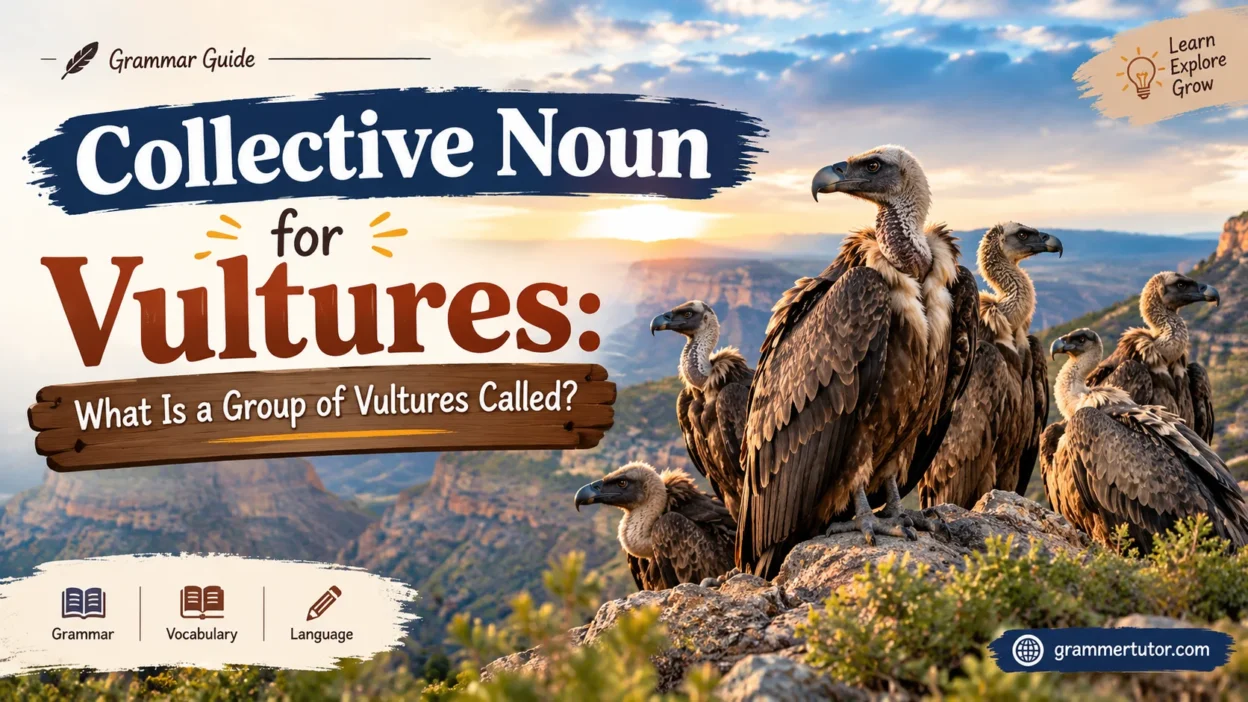
The collective noun for vultures can help you describe these birds clearly when they gather, fly together, or search for food. Vultures are large scavenging birds that often gather together around a food source. While the general phrase group of vultures is simple and widely understood, English also has several expressions that add more detail. The most familiar collective expression is committee of vultures, while kettle, wake, and venue may also be used for groups of vultures in different situations.
These terms become more useful when you consider what the birds are doing or where they are gathered. A kettle, for example, can describe vultures during their circling flight, while their feeding behavior may explain why they are seen gathering around food. These specific descriptions make a sentence more vivid and give readers a clearer picture of the fascinating world of vultures. Learning these expressions can also make your colorful English more interesting because each term connects the birds with a particular situation or action.
For anyone interested in animal vocabulary or wildlife, these terms provide useful words for everyday writing and conversation. They can also help you improve English by showing how language uses special terms to describe animals and their behavior. Remembering committee, kettle, wake, and venue gives you memorable words to add to your vocabulary, especially when you want to describe vultures without repeatedly using the same general phrase.
Why Collective Nouns Are Used for Vultures
Vultures are often seen gathering in noticeable groups. They may circle high above the ground while searching for food, gather around a carcass, or rest together in suitable locations. Their distinctive behavior has inspired several colorful collective expressions.
Different nouns can describe different situations. A kettle of vultures is associated with vultures soaring and circling in the air, while a wake of vultures describes vultures gathered around or following a food source. Committee is another traditional expression used for a group of vultures.
These terms help writers describe not only the number of birds but also their movement and behavior.
Collective Nouns for Vultures
| Collective Noun | Used For | Simple Example |
| Committee | A group of vultures | A committee of vultures rested on the rocks. |
| Kettle | Vultures circling in flight | A kettle of vultures circled overhead. |
| Wake | Vultures gathered around food | A wake of vultures gathered near the carcass. |
| Venue | A group of vultures | A venue of vultures gathered nearby. |
| Group | A general group of vultures | A group of vultures stood in the field. |
Committee of Vultures
A committee of vultures is one of the traditional collective expressions used for a group of vultures. The word committee gives the phrase a memorable and somewhat humorous character.
It can be used when several vultures are gathered together, particularly when they’re resting or waiting around a feeding area.
Examples of “Committee of Vultures”
- A committee of vultures rested on the rocky hill.
- We noticed a committee of vultures near the field.
- The committee of vultures waited for an opportunity to feed.
- A large committee of vultures gathered in the distance.
- The committee of vultures moved toward the carcass.
- A committee of vultures stood near the trees.
- Wildlife researchers observed a committee of vultures.
- The committee of vultures remained together for several hours.
- A committee of vultures gathered near the open grassland.
- The committee of vultures eventually flew away.
Kettle of Vultures
A kettle of vultures is a vivid term used for vultures circling together in the air. Vultures often soar in rising columns of warm air called thermals, allowing them to gain height while using relatively little energy.
From the ground, a group of circling vultures can look like a swirling pattern in the sky, which makes kettle an especially descriptive expression.
Examples of “Kettle of Vultures”
- A kettle of vultures circled high above the valley.
- We spotted a kettle of vultures in the afternoon sky.
- The kettle of vultures slowly gained altitude.
- A large kettle of vultures appeared over the grassland.
- The kettle of vultures moved toward the mountain.
- A kettle of vultures soared above the forest.
- The photographer captured a kettle of vultures overhead.
- The kettle of vultures disappeared into the clouds.
- A kettle of vultures circled above the open field.
- We watched the kettle of vultures from below.
Wake of Vultures
A wake of vultures is another traditional expression for a group of vultures, especially when they’re gathered around a carcass or food source.
The term wake creates an image of vultures arriving at a feeding site. Vultures are scavengers, so finding and consuming carrion is an important part of their ecological role.
Examples of “Wake of Vultures”
- A wake of vultures gathered around the carcass.
- We saw a wake of vultures in the grassland.
- The wake of vultures waited near the food source.
- A large wake of vultures descended on the area.
- The wake of vultures attracted the attention of other birds.
- A wake of vultures gathered before sunset.
- Wildlife observers photographed the wake of vultures.
- The wake of vultures moved across the field.
- A wake of vultures surrounded the carcass.
- The wake of vultures eventually scattered.
Venue of Vultures
A venue of vultures is a less commonly encountered collective expression. It can be used as a descriptive term for a gathering of vultures, although committee, kettle, and wake are more useful in specific contexts.
When writing naturally about vultures, it’s usually better to select the collective noun according to what the birds are actually doing.
Examples of “Venue of Vultures”
- A venue of vultures gathered near the rocks.
- We observed a venue of vultures in the distance.
- The venue of vultures rested on the hillside.
- A venue of vultures appeared above the valley.
- The venue of vultures gathered near the feeding area.
- Wildlife researchers observed the venue of vultures.
- A venue of vultures moved across the grassland.
- The venue of vultures remained near the trees.
- We watched a venue of vultures from afar.
- The venue of vultures eventually flew away.
Group of Vultures
A group of vultures is a simple general expression that works in almost any situation. Unlike traditional collective nouns, it doesn’t add a special description of the birds’ behavior, but it is clear and completely understandable.
If you’re unsure which traditional term fits your sentence, a group of vultures is always a safe choice.
Examples of “Group of Vultures”
- A group of vultures gathered near the field.
- We saw a group of vultures above the valley.
- The group of vultures searched for food.
- A group of vultures rested on the rocks.
- The group of vultures flew toward the carcass.
- A group of vultures circled above the grassland.
- Researchers observed a group of vultures.
- The group of vultures moved across the open land.
- A group of vultures gathered near the trees.
- The group of vultures disappeared into the distance.
Vulture Behavior and Feeding Habits
Vultures are best known as scavengers. They feed primarily on carrion, which means the bodies of animals that have already died. By consuming carcasses, vultures help remove decaying organic matter from the environment and can reduce the spread of certain pathogens.
Their excellent vision helps many vultures locate potential food from considerable distances. Some species soar high above the ground while searching for signs of carrion. When one vulture discovers a food source, other vultures may notice its behavior and descend toward the same location.
Their feeding behavior can sometimes produce large gatherings. Several vultures may arrive at the same carcass, creating a wake of vultures. Meanwhile, vultures soaring in circles overhead can be described as a kettle of vultures.
Vultures also use their physical adaptations to feed efficiently. Many species have relatively bare heads and necks, which can help reduce the amount of feathers that become contaminated while feeding on carcasses.
Examples of Vulture Behavior
- Vultures often search for carrion.
- A kettle of vultures circled above the field.
- Vultures can soar for long periods.
- A wake of vultures gathered around a carcass.
- Vultures help remove animal remains from ecosystems.
- Their sharp eyesight helps them locate food.
- Vultures may gather in large numbers around food.
- Some vultures use thermals to gain altitude.
- Vultures play an important role as scavengers.
- A group of vultures may rest together between feeding periods.
Interesting Facts About Vultures
Vultures are fascinating birds of prey and scavengers that play an important role in natural ecosystems. Although they are often associated with death because they feed on carrion, their ecological role is extremely valuable. By consuming dead animals, vultures help clean up landscapes and reduce the amount of decaying material that could otherwise support harmful microorganisms. Different vulture species have different lifespans, but many can live for many years in suitable conditions.
Vultures have several remarkable physiological features that help them survive on carrion. Many species have broad wings that allow them to soar efficiently for long periods. Instead of constantly flapping, they can use rising warm air called thermals to gain altitude and travel while conserving energy. Their strong beaks are adapted for tearing flesh, although different species have different feeding specializations.
Their dietary habits are especially distinctive. Most vultures primarily consume carrion rather than hunting healthy animals. Their digestive systems are adapted to handle food that could be dangerous to many other animals. Some species can consume carcasses containing harmful bacteria and other microorganisms without becoming ill, making them highly effective natural scavengers.
Vultures also have excellent senses for finding food. Many species rely heavily on vision to identify carcasses from the air. Some New World vultures have an especially strong sense of smell and can locate carrion that may be hidden beneath vegetation. Their ability to find dead animals and quickly consume them makes them an important part of the food chain.
Vultures can also form impressive gatherings. A group soaring in circles may create a kettle of vultures, while birds gathered around a carcass may be described as a wake of vultures. These behaviors explain why vulture collective nouns are particularly colorful and closely connected with what the birds do.
Examples of Vulture Facts
- Vultures are important scavengers.
- They primarily feed on carrion.
- Many vultures have broad wings suited for soaring.
- Vultures can use thermals to gain altitude.
- Their beaks are adapted for tearing flesh.
- Many species have excellent eyesight.
- Some vultures have a strong sense of smell.
- Vultures help remove dead animals from ecosystems.
- Some species can consume food containing harmful microorganisms.
- Vultures can gather in large numbers around food.
READ MORE: Collective Noun for Shrimps: Terms, Meanings, and Examples
Conclusion
Understanding the collective noun for vultures makes your English more descriptive and interesting. Committee of vultures is the most familiar expression, while kettle, wake, and venue can also appear in different contexts. Knowing these terms helps you describe these fascinating scavenging birds more clearly and expand your animal-related vocabulary.
FAQs
Q1. What is the collective noun for vultures?
The most familiar collective noun for vultures is committee. You can say a committee of vultures.
Q2. What is a group of vultures called?
A group of vultures can be called a committee of vultures. Other terms, including kettle, wake, and venue, may also be used.
Q3. Is “committee of vultures” correct?
Yes. Committee of vultures is a recognized collective expression and is commonly given as the standard answer.
Q4. What does “kettle of vultures” mean?
A kettle of vultures refers to vultures flying in circles, usually while using rising warm air to gain height with little effort.
Q5. Can I say “a group of vultures”?
Yes. A group of vultures is completely understandable and grammatically correct. It’s simply more general than a specific collective noun.
Q6. What is a wake of vultures?
Wake of vultures is another collective expression associated with vultures. Its use is less common in everyday English than committee of vultures.
Q7. What is a venue of vultures?
Venue of vultures is a less familiar collective expression that can be found in lists of terms for groups of vultures.
Q8. Why are collective nouns used for vultures?
Collective nouns make language more specific and vivid. They can describe vultures according to their behavior, movement, or gathering.
Q9. Which collective noun for vultures should I use in everyday writing?
Committee of vultures is the safest choice when you specifically want a traditional collective noun. A group of vultures works well when you want simple, natural English.
Q10. Are collective nouns for vultures always used in modern English?
Not necessarily. Some traditional collective terms are uncommon in everyday conversation. In ordinary writing, a group of vultures is often more natural, while specialized terms can add variety when appropriate.