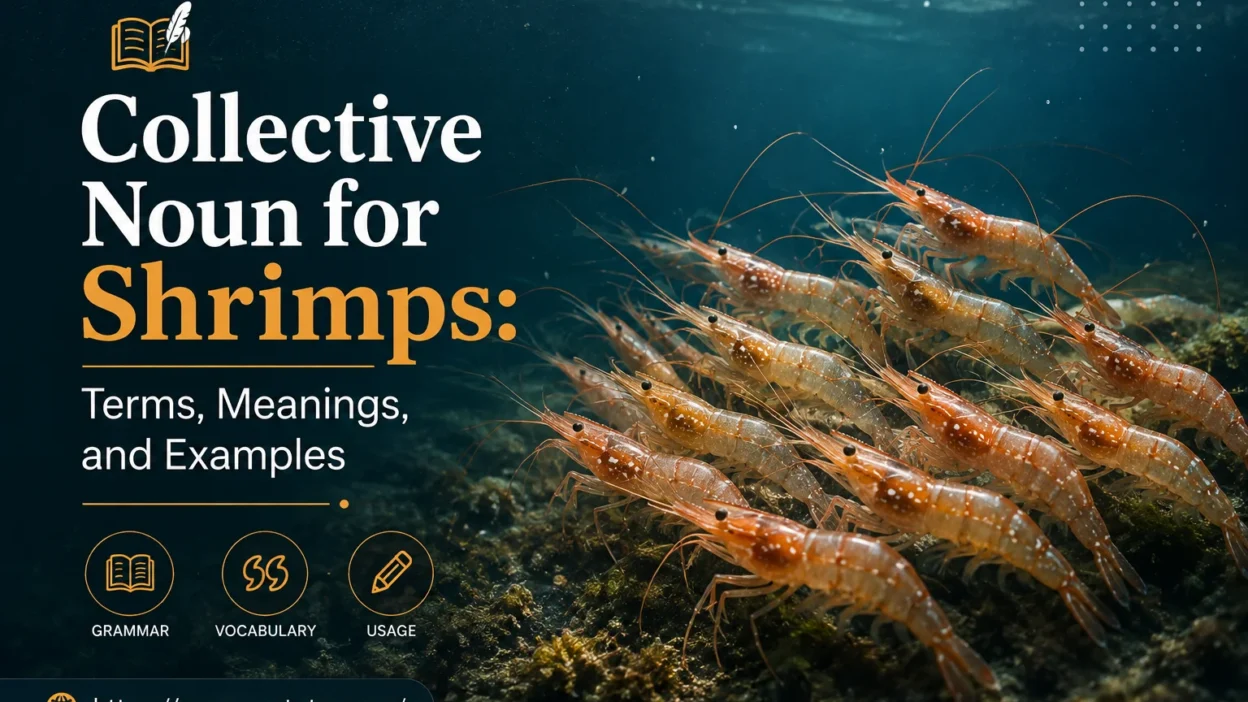
The Collective Noun for Shrimps helps you describe these small aquatic animals clearly when they gather together in natural groups. English offers several expressions for describing shrimps according to their movement, habitat, and way of gathering. Using the right collective noun can make your descriptions more colorful and precise, especially when talking about aquatic animals and their groups.
These terms are helpful when discussing marine life, aquariums, fishing, and underwater ecosystems. Some expressions focus on shrimps moving through the water, while others describe them gathering closely in one place. Their movement patterns and gathering behavior can vary according to their surroundings. This makes the topic useful for describing different marine environments and understanding how shrimps behave within their aquatic habitats.
Shrimps are fascinating creatures with complex behaviors and impressive adaptations. Different species can live in oceans, rivers, lakes, and other aquatic environments. Many stay close to one another, search for food in the same areas, or gather around suitable shelter. Their food search, shelter, and relationship with the surrounding ecosystem connect the English language with the natural world and give us useful ways to describe groups of shrimps.
Why Collective Nouns Are Used for Shrimps
Shrimps can be found in groups, particularly in areas where food, shelter, or suitable environmental conditions are available. Their small bodies and aquatic lifestyles make groups of shrimps an interesting sight, especially when many individuals move through the water at the same time.
English uses different expressions to describe groups of animals, and some terms associated with shrimps emphasize movement, numbers, or physical closeness. The word colony may be suitable when shrimps live together in a shared habitat, while school can describe shrimps moving together in some informal or descriptive contexts.
These expressions help readers imagine what the animals are doing instead of simply stating that several shrimps are present.
Collective Nouns for Shrimps
| Collective Noun | Used For | Simple Example |
| Colony | Shrimps living together in one area | A colony of shrimps lived among the rocks. |
| School | Shrimps moving together | A school of shrimps moved through the water. |
| Swarm | A large number of shrimps gathered together | A swarm of shrimps covered the seabed. |
| Group | A general gathering of shrimps | A group of shrimps gathered near the reef. |
| Cluster | Shrimps gathered closely together | A cluster of shrimps hid beneath the rocks. |
Colony of Shrimps
A colony can describe shrimps living together in a particular area or shared habitat. This term is especially useful for species that stay around reefs, rocks, underwater structures, or other suitable environments.
A colony emphasizes the idea of shrimps occupying the same environment rather than simply passing through an area.
Examples of “Colony of Shrimps”
- A colony of shrimps lived among the rocks.
- We discovered a colony of shrimps near the reef.
- The colony of shrimps stayed close to the seabed.
- Scientists observed a colony of shrimps underwater.
- A large colony of shrimps gathered near the coral.
- The colony of shrimps searched for food.
- Divers noticed a colony of shrimps inside the reef.
- The colony of shrimps remained hidden during the day.
- Researchers studied the colony of shrimps.
- The colony of shrimps moved between the rocks.
School of Shrimps
A school of shrimps can be used descriptively for shrimps moving together through the water. The word school is much more strongly associated with fish, so it isn’t the most established term for shrimps, but it can appear in informal or creative descriptions.
This expression focuses on movement, especially when many shrimps travel in the same direction.
Examples of “School of Shrimps”
- A school of shrimps moved through the water.
- We watched a school of shrimps near the reef.
- The school of shrimps disappeared into the rocks.
- A school of shrimps crossed the sandy seabed.
- The school of shrimps moved with the current.
- Divers observed a school of shrimps underwater.
- A school of shrimps gathered near the coral.
- The school of shrimps scattered suddenly.
- A school of shrimps traveled across the reef.
- The school of shrimps searched for food.
Swarm of Shrimps
A swarm can describe a large number of shrimps gathered or moving closely together. The word emphasizes their large numbers and collective movement.
Although swarm is commonly associated with insects, it can be used descriptively for large groups of aquatic animals when they move in dense numbers.
Examples of “Swarm of Shrimps”
- A swarm of shrimps covered the seabed.
- We noticed a swarm of shrimps near the reef.
- The swarm of shrimps moved through the water.
- A large swarm of shrimps gathered near the rocks.
- The swarm of shrimps searched for food.
- Divers watched the swarm of shrimps.
- A swarm of shrimps moved with the current.
- The swarm of shrimps disappeared beneath the rocks.
- Scientists observed a swarm of shrimps underwater.
- A swarm of shrimps surrounded the coral.
Group of Shrimps
A group of shrimps is the simplest general expression. Unlike specialized collective terms, group doesn’t suggest a particular behavior or habitat.
You can use it whenever several shrimps are together and you don’t need to describe exactly how they are gathered.
Examples of “Group of Shrimps”
- A group of shrimps gathered near the rocks.
- We saw a group of shrimps in the aquarium.
- The group of shrimps moved along the seabed.
- A group of shrimps hid beneath the coral.
- The group of shrimps searched for food.
- Divers spotted a group of shrimps near the reef.
- A group of shrimps moved through the water.
- The group of shrimps remained close together.
- A group of shrimps gathered around the plants.
- The group of shrimps disappeared into the sand.
Cluster of Shrimps
A cluster of shrimps describes shrimps gathered closely together in a particular spot. The term emphasizes their close physical arrangement rather than a formal social group.
It can be useful when describing shrimps hiding among rocks, coral, plants, or other underwater structures.
Examples of “Cluster of Shrimps”
- A cluster of shrimps hid beneath the rocks.
- We found a cluster of shrimps near the coral.
- The cluster of shrimps remained close together.
- A cluster of shrimps gathered on the seabed.
- The divers photographed a cluster of shrimps.
- A cluster of shrimps sheltered among the plants.
- The cluster of shrimps moved into a narrow opening.
- A cluster of shrimps stayed near the reef.
- Scientists observed a cluster of shrimps underwater.
- The cluster of shrimps disappeared into the rocks.
Shoal of Shrimps
A shoal is a general term for a group of aquatic animals that gather or move together. It is most commonly associated with fish, but it can be used more broadly in descriptions of aquatic animals.
When used for shrimps, shoal emphasizes a group moving or gathering in the same aquatic environment.
Examples of “Shoal of Shrimps”
- A shoal of shrimps moved across the seabed.
- We observed a shoal of shrimps near the reef.
- The shoal of shrimps followed the current.
- A shoal of shrimps gathered near the rocks.
- Divers spotted a shoal of shrimps underwater.
- The shoal of shrimps moved toward the coral.
- A shoal of shrimps scattered among the plants.
- The shoal of shrimps searched for food.
- The shoal of shrimps disappeared into deeper water.
- Researchers photographed the shoal of shrimps.
Interesting Facts About Shrimps
Shrimps are diverse aquatic crustaceans found in marine and freshwater environments around the world. They belong to groups of animals related to crabs, lobsters, and other crustaceans. Their lifespan varies considerably among species, with some living only a relatively short time and others surviving for several years under suitable conditions. Their size, habitat, reproduction, and lifespan can differ greatly between species.
One of the most interesting physiological features of shrimps is their exoskeleton. This hard outer covering provides protection and structural support, but it cannot expand continuously as the shrimp grows. As a result, shrimps must periodically shed their old exoskeleton through a process called molting. After molting, the new outer covering gradually becomes harder.
Shrimps also have specialized appendages that help them survive underwater. Their antennae are important sensory structures that help them detect their surroundings. Their legs and other appendages can assist with walking, feeding, swimming, and handling food. Some species have specialized claws or structures that they use to capture food or defend themselves.
Shrimp diets vary according to species and habitat. Many shrimps are omnivorous or opportunistic feeders, consuming algae, plant material, plankton, microorganisms, detritus, and small aquatic organisms. Some species act as scavengers and help recycle organic material within aquatic ecosystems. Their feeding habits can therefore contribute to nutrient cycling and the health of their habitats.
Some shrimps have developed remarkable relationships with other marine organisms. Cleaner shrimp, for example, can remove parasites and dead tissue from fish. In return, the shrimp gains access to food. These relationships demonstrate how small aquatic animals can play important roles within larger ecosystems.
Shrimps also display impressive defensive adaptations. Some species rely on camouflage, hiding among rocks, sand, plants, or coral. Others can move rapidly backward by flexing their abdomen and tail. Certain species have highly specialized structures that allow them to produce powerful sounds or strikes.
Examples of Shrimp Facts
- Shrimps are aquatic crustaceans.
- They are related to crabs and lobsters.
- Shrimps have a protective exoskeleton.
- Shrimps must molt as they grow.
- Their antennae help them sense their surroundings.
- Many shrimps are omnivorous or opportunistic feeders.
- Some shrimps eat algae and plant material.
- Some feed on plankton and microorganisms.
- Certain shrimps act as scavengers.
- Cleaner shrimp can remove parasites from fish.
- Many shrimp species use camouflage.
- Shrimps can contribute to aquatic ecosystem health.
READ MORE: Collective Noun for Seahorses: Names, Examples, and Fascinating Facts
Conclusion
Understanding the collective noun for shrimps gives you a simple way to describe these fascinating aquatic animals in natural English. Whether you’re writing about marine life, aquariums, fishing, or underwater ecosystems, choosing a suitable group expression can make your descriptions clearer and more engaging.
FAQs
Q1. What is the collective noun for shrimps?
Common expressions for a group of shrimps include group, colony, and other terms depending on their behavior and setting.
Q2. Can I say “a group of shrimps”?
Yes. A group of shrimps is clear, natural, and widely understandable in everyday English.
Q3. What do you call a large group of shrimps?
You can describe a large gathering simply as a group of shrimps. The exact expression may depend on the context.
Q4. Is “colony” a collective noun for shrimps?
Colony can be used when describing shrimps that live together in an organized or shared environment, although group is more general.
Q5. What is a group of shrimp called in an aquarium?
In an aquarium, you can simply call them a group of shrimp or a shrimp group.
Q6. Is “swarm” used for shrimps?
Swarm can sometimes describe a large number of small animals moving together, but it isn’t the most standard everyday term for shrimps.
Q7. What is the plural of shrimp?
Both shrimp and shrimps can be used. Shrimp is especially common when referring to the animal as a species or to multiple shrimp collectively.
Q8. Why are collective nouns for shrimps useful?
They help you describe movement, gathering, habitat, and behavior more specifically instead of repeatedly saying “a group of shrimps.”
Q9. Where do shrimps live?
Shrimps live in various aquatic environments, including oceans, rivers, lakes, and other water-based habitats.
Q10. How should I use a collective noun for shrimps in a sentence?
Use the expression according to the situation. For example, you might write, “A group of shrimps gathered near the shelter.”