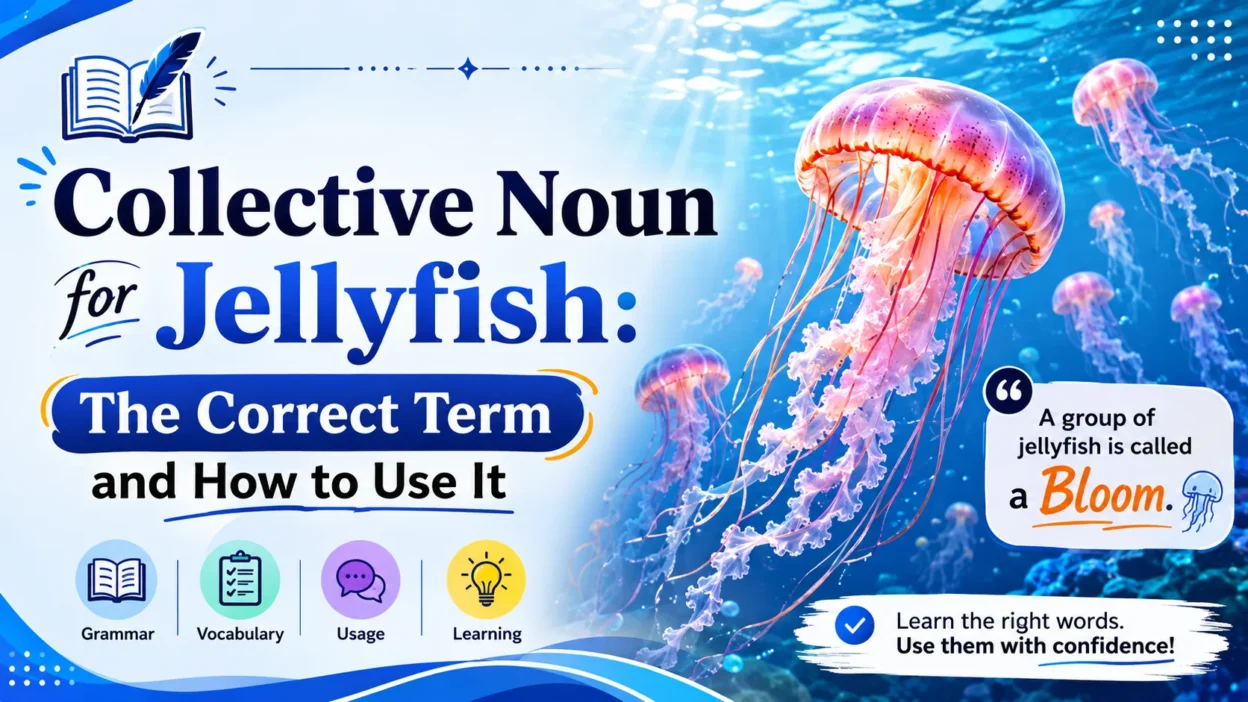
The collective noun for jellyfish helps students and writers describe these marine animals in a more vivid way. Instead of using only a group of jellyfish, you can choose animal group names that create a clearer image. A smack of jellyfish, bloom of jellyfish, or swarm of jellyfish can describe jellyfish gathered together in the ocean. These descriptive expressions make everyday English more engaging while helping you understand how fascinating creatures are described.
Each term can create a slightly different picture, depending on the scene you want to describe. A bloom can suggest many jellyfish appearing together in one area, while a swarm can suggest a large, moving group. When learning these expressions, I find it easier to connect each word with how jellyfish move, feed, and survive. This makes the English language more memorable and helps you use the right collective noun more naturally.
For marine-life enthusiasts, these expressions offer an interesting way to talk about unusual animals without repeating the same phrase. They are also useful in writing because a well-chosen collective noun can make a description more precise and vivid. Rather than simply saying that jellyfish are together, you can select an expression that matches the scene and gives readers a stronger sense of what is happening in the ocean.
Why Collective Nouns Are Used for Jellyfish
Jellyfish can gather in large numbers, particularly when ocean conditions provide suitable food and environmental conditions. Large concentrations of jellyfish can sometimes cover substantial areas of water, creating an impressive sight.
Because jellyfish often appear together, English uses several collective expressions to describe them. Smack is one of the traditional collective nouns associated with jellyfish, while bloom is especially useful when describing a large increase or concentration of jellyfish in the water.
These terms make descriptions more colorful and can help readers visualize jellyfish drifting together through the ocean.
Collective Nouns for Jellyfish
| Collective Noun | Used For | Simple Example |
| Smack | A group of jellyfish | A smack of jellyfish floated near the shore. |
| Bloom | A large concentration of jellyfish | A bloom of jellyfish appeared in the bay. |
| Swarm | Many jellyfish gathered together | A swarm of jellyfish moved through the water. |
| Cluster | Jellyfish gathered closely together | A cluster of jellyfish drifted near the reef. |
| Group | A general group of jellyfish | A group of jellyfish floated in the ocean. |
Smack of Jellyfish
A smack is a traditional collective noun for jellyfish. The expression a smack of jellyfish can describe a group of these animals drifting together in the water.
It is one of the most interesting animal group names in English and is particularly useful when you’re discussing jellyfish as a group.
Examples of “Smack of Jellyfish”
- A smack of jellyfish floated near the shore.
- We saw a smack of jellyfish in the clear water.
- The smack of jellyfish drifted with the current.
- A large smack of jellyfish appeared offshore.
- The divers noticed a smack of jellyfish nearby.
- A smack of jellyfish moved through the bay.
- The smack of jellyfish disappeared into deeper water.
- We watched a smack of jellyfish from the boat.
- A smack of jellyfish gathered near the surface.
- The smack of jellyfish moved slowly with the tide.
Bloom of Jellyfish
A bloom of jellyfish refers to a large concentration of jellyfish in a particular area of water. The word bloom is commonly used in marine science and environmental discussions when jellyfish numbers become unusually high.
A jellyfish bloom can occur when environmental conditions provide favorable conditions for jellyfish reproduction, growth, or survival.
Examples of “Bloom of Jellyfish”
- A bloom of jellyfish appeared in the bay.
- Scientists observed a large bloom of jellyfish.
- The bloom of jellyfish covered part of the coastline.
- A bloom of jellyfish moved toward the shore.
- Researchers studied the jellyfish bloom carefully.
- The bloom of jellyfish attracted marine scientists.
- A large bloom of jellyfish was visible from the boat.
- The bloom of jellyfish changed the appearance of the water.
- Scientists monitored the bloom throughout the summer.
- The bloom of jellyfish eventually moved offshore.
Swarm of Jellyfish
A swarm of jellyfish can describe many jellyfish moving or drifting together. Although swarm is more commonly associated with insects, it can be used descriptively for large numbers of jellyfish.
The expression emphasizes the large number of animals gathered in one area.
Examples of “Swarm of Jellyfish”
- A swarm of jellyfish moved through the water.
- We spotted a swarm of jellyfish near the coast.
- The swarm of jellyfish drifted with the current.
- A large swarm of jellyfish appeared offshore.
- Divers encountered a swarm of jellyfish.
- The swarm of jellyfish moved toward deeper water.
- A swarm of jellyfish floated near the surface.
- The boat passed through a swarm of jellyfish.
- The swarm of jellyfish disappeared beneath the waves.
- Scientists photographed the swarm of jellyfish.
Cluster of Jellyfish
A cluster of jellyfish is a simple descriptive expression for jellyfish gathered relatively close together. It focuses on their physical arrangement rather than suggesting a particular biological group structure.
This expression can be useful when describing a smaller concentration of jellyfish.
Examples of “Cluster of Jellyfish”
- A cluster of jellyfish floated near the reef.
- We noticed a cluster of jellyfish in the water.
- The cluster of jellyfish drifted toward the shore.
- A cluster of jellyfish appeared beneath the boat.
- Divers photographed the cluster of jellyfish.
- The cluster of jellyfish moved with the current.
- A small cluster of jellyfish floated near the surface.
- The cluster of jellyfish disappeared into deeper water.
- We carefully avoided the cluster of jellyfish.
- The cluster of jellyfish remained near the reef.
Group of Jellyfish
A group of jellyfish is a general expression that can be used whenever several jellyfish are together. It isn’t a specialized collective noun, but it’s clear, natural, and easy to understand.
When you want a traditional animal collective noun, smack is the more distinctive choice.
Examples of “Group of Jellyfish”
- A group of jellyfish floated near the beach.
- We saw a group of jellyfish in the ocean.
- The group of jellyfish drifted with the current.
- A group of jellyfish gathered near the surface.
- Divers observed a group of jellyfish.
- The group of jellyfish moved toward the reef.
- A group of jellyfish appeared near the boat.
- The group of jellyfish slowly disappeared.
- We photographed a group of jellyfish.
- A group of jellyfish floated peacefully in the water.
Jellyfish Behavior and Movement
Jellyfish have a fascinating way of moving through the ocean. Unlike fish, they don’t rely on fins and a backbone to swim. Their bell-shaped bodies contract and relax, allowing them to produce gentle movements through the water. However, ocean currents also play an important role in carrying many jellyfish from one location to another.
Jellyfish can occur individually or in large concentrations. When food is abundant and environmental conditions are favorable, large numbers may gather in the same area. These concentrations are often called blooms.
Jellyfish also have specialized tentacles containing cells called cnidocytes. These cells can release structures that help jellyfish capture prey and defend themselves. Different species have different levels of sting strength, and not every jellyfish poses the same risk to humans.
Examples of Jellyfish Behavior
- Jellyfish drift with ocean currents.
- Jellyfish can move by contracting their bells.
- Some jellyfish gather in large concentrations.
- Jellyfish use tentacles to capture prey.
- Jellyfish can respond to environmental conditions.
- Large jellyfish blooms can occur in suitable conditions.
- Jellyfish may move vertically through the water.
- Jellyfish don’t have a backbone.
- Some jellyfish are transparent.
- Jellyfish have specialized stinging cells.
Interesting Facts About Jellyfish
Jellyfish are ancient marine animals belonging to the phylum Cnidaria. They have existed in Earth’s oceans for hundreds of millions of years, making them far older than many modern animal groups. Unlike mammals, birds, or fish, jellyfish don’t have bones, a brain, or a complex centralized nervous system. Their simple body design allows them to survive in a wide variety of marine environments.
One of their most distinctive physiological features is their gelatinous body. A jellyfish’s body is largely made of water and contains a structure called the mesoglea, which gives the animal its soft, jelly-like appearance. They have a bell, tentacles, and specialized tissues that help them move, sense their surroundings, capture food, and defend themselves.
Jellyfish have unusual feeding habits. They are generally carnivorous and can feed on plankton, small fish, fish eggs, crustaceans, and other small marine organisms. Their tentacles help capture prey, while specialized cells called cnidocytes deliver stinging structures that immobilize prey. The prey can then be brought toward the jellyfish’s mouth.
Jellyfish also have fascinating life cycles. Many species alternate between different stages, including a polyp stage attached to a surface and a free-swimming medusa stage. Some jellyfish species have particularly unusual life cycles, and the famous Turritopsis dohrnii has attracted scientific interest because of its ability to revert from its adult stage to an earlier developmental stage under certain conditions.
Although jellyfish don’t have a brain, they aren’t completely without sensory abilities. Their nerve nets help coordinate movement and responses to their surroundings. Some species also have structures that help them detect light, gravity, and movement.
Examples of Jellyfish Facts
- Jellyfish are cnidarians.
- Jellyfish have existed for hundreds of millions of years.
- Their bodies are largely made of water.
- Jellyfish don’t have bones.
- Jellyfish don’t have a centralized brain.
- Many jellyfish are carnivorous.
- Jellyfish eat plankton and other small marine animals.
- Jellyfish have specialized cnidocytes.
- Ocean currents influence jellyfish movement.
- Some jellyfish form large blooms.
- Some species have complex life cycles.
- Jellyfish live in oceans around the world.
Conclusion
Understanding the collective noun for jellyfish makes your English more descriptive and interesting. Terms such as smack, bloom, and swarm can help you describe a group of jellyfish in different ways. Learning these expressions also gives you a better understanding of how collective nouns add variety and detail to everyday writing.
FAQs
Q1. What is the collective noun for jellyfish?
Common expressions include a smack of jellyfish, a bloom of jellyfish, and a swarm of jellyfish.
Q2. What is the most common collective noun for jellyfish?
A smack of jellyfish is one of the most commonly recognized collective expressions for jellyfish.
Q3. Is “a bloom of jellyfish” correct?
Yes. A bloom of jellyfish is used when describing a large number of jellyfish gathered in an area.
Q4. Can I say “a swarm of jellyfish”?
Yes. A swarm of jellyfish can describe jellyfish moving or gathering together, especially in large numbers.
Q5. Why do jellyfish have collective nouns?
Collective nouns provide a concise and descriptive way to refer to groups of animals.
Q6. What does “smack of jellyfish” mean?
Smack of jellyfish refers to a group of jellyfish. It’s a traditional collective expression rather than a description of their behavior.
Q7. Which collective noun should I use in formal writing?
For clear formal writing, a group of jellyfish is always understandable. You can use a bloom of jellyfish when the context supports it.
Q8. Are collective nouns for jellyfish officially fixed?
Not completely. Animal collective nouns can vary by source and context, so several expressions may be used.
Q9. Can collective nouns make writing better?
Yes. They can make descriptions more specific, varied, and vivid, particularly when writing about animals and nature.
Q10. What is the easiest way to remember jellyfish collective nouns?
Remember the three useful expressions smack, bloom, and swarm. Connecting each term with an image of jellyfish gathered in the ocean can make them easier to recall.