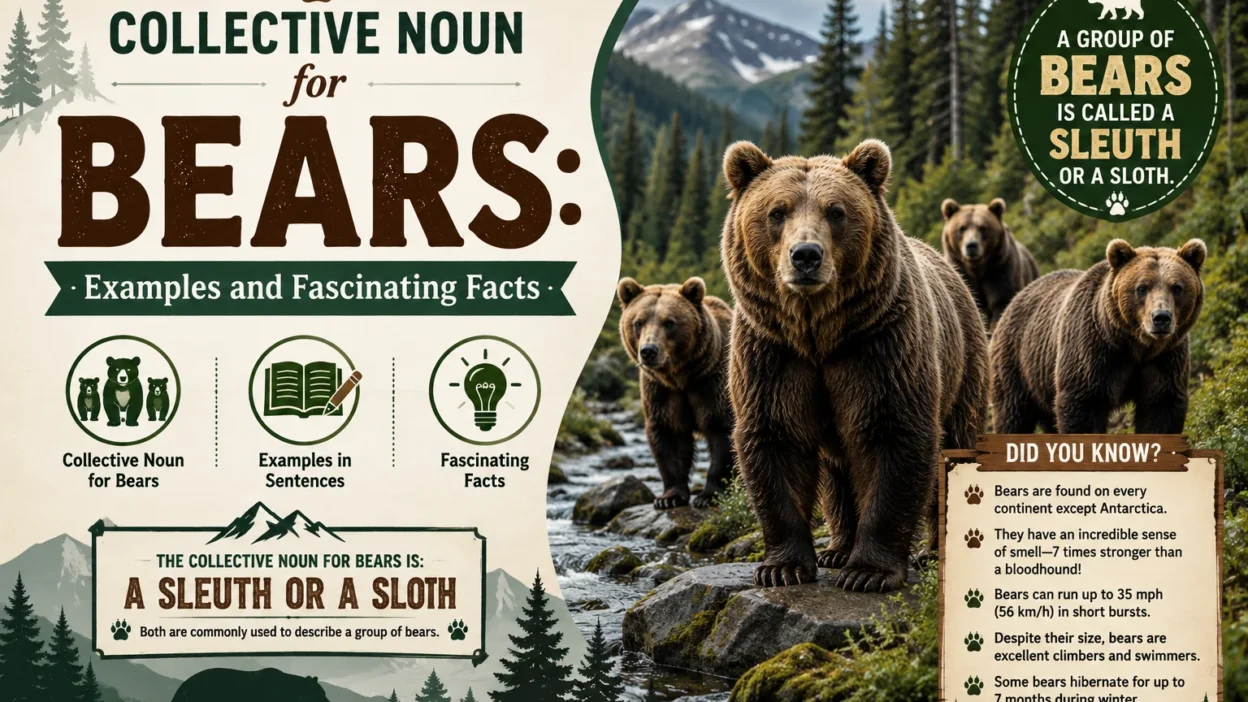
The collective noun for bears is sloth, a traditional English term used for a group of bears gathered together. Although adult bears are often solitary and spend much of their time alone, they can form temporary gatherings when conditions are favorable. For example, food can bring several bears together around salmon-filled rivers, berry patches, or other rich feeding areas. A mother and her cubs also form a family group during their early lives, showing that bears can have important social connections even without living in permanent social groups.
The word sloth creates a memorable phrase and expression, similar to flock for birds, pack for wolves, and herd for cattle and deer. These traditional animal collective nouns add colorful and memorable terms to vocabulary, especially for English learners and wildlife enthusiasts. However, a collective noun doesn’t always describe a permanent social structure. In the case of bears, their biology, behavior, environment, diet, and seasonal activities help determine when they come together and when they return to living independently in the wild.
Learning collective nouns can improve language skills, sentence formation, and communication while making the English language more enjoyable to study. Understanding the collective noun for bears also gives you useful vocabulary development for writing, speaking, essay writing, essay writing processes, and speaking activities. You can examine these options in daily life, use them to express yourself more fluently, and achieve the best results in your language practice. For many learners, connecting words with real animals and animal groups makes learning easier and more practical.
What Is the Collective Noun for Bears?
The traditional collective noun most commonly associated with bears is sloth.
A Sloth of Bears
The standard traditional expression is “a sloth of bears.” The word sloth in this expression is a collective noun. It doesn’t refer to the slow-moving mammal that also has the name sloth.
A sloth of bears can refer to several bears gathered in the same area. The expression is especially useful in general English, wildlife writing, and discussions about unusual animal group names.
| Type | Simple Example |
| Collective noun | Sloth |
| Animal | Bears |
| Complete phrase | A sloth of bears |
| Singular example | A bear is walking through the forest. |
| Plural example | Several bears are near the river. |
| Collective example | A sloth of bears gathered near the river. |
The word bears remains plural after of, while sloth identifies the group. The expression follows the same basic pattern as phrases such as a herd of deer or a pack of wolves.
Simple Example Sentences
- A sloth of bears gathered near the river.
- We watched a sloth of bears from a safe distance.
- A sloth of bears moved through the forest.
- The photographer saw a sloth of bears near the lake.
- A sloth of bears appeared at the edge of the woodland.
- The guide noticed a sloth of bears feeding nearby.
- A sloth of bears gathered where food was plentiful.
- The sloth of bears slowly moved toward the trees.
- A sloth of bears was visible from the observation point.
- The researchers observed a sloth of bears from a distance.
How to Use “A Sloth of Bears” Correctly
Using a sloth of bears is straightforward. The basic structure is:
a sloth + of + bears
For example:
A sloth of bears gathered near the river.
Here, sloth is the collective noun, while bears identify the animals belonging to the group.
When the entire group is treated as one unit, the collective noun normally takes a singular verb in American English.
Example:
A sloth of bears is moving through the forest.
You can also focus on the individual bears rather than the group.
Example:
The bears are moving through the forest.
The first sentence emphasizes the group as a unit. The second emphasizes the individual animals.
Simple Example Sentences
- A sloth of bears is moving through the forest.
- The bears are searching for food.
- A sloth of bears was seen near the lake.
- The bears were walking along the river.
- A sloth of bears is resting near the feeding area.
- The bears are exploring their surroundings.
- A sloth of bears was observed at dawn.
- The bears were moving toward the woodland.
- A sloth of bears is gathering around a food source.
- The bears are staying close to their mother.
Can You Say “A Sleuth of Bears”?
You may encounter “a sleuth of bears” in some animal collective-noun lists and informal references. The word sleuth normally means a detective or investigator, which makes the expression a playful way to describe bears searching and investigating their surroundings.
However, it is important not to treat every colorful animal-group expression as equally standard. A sloth of bears is the traditional expression most commonly associated with bears, while sleuth of bears is much less established and is better treated as a playful or alternative expression.
Bears are particularly good candidates for such wordplay because they have an exceptional sense of smell and spend considerable time investigating their surroundings while looking for food.
Simple Example Sentences
- A sleuth of bears searched the area for food.
- The children learned the playful phrase “sleuth of bears.”
- A sleuth of bears investigated the smell near the campsite.
- The writer used “sleuth” as a humorous expression.
- Some animal-word lists mention a sleuth of bears.
- The bears seemed like a sleuth while searching for food.
- The article explained that “sloth” is the better-known expression.
- A sleuth of bears is an unusual phrase.
- The guide explained the difference between the two expressions.
- “A sloth of bears” remains the safer traditional choice.
Sloth of Bears vs. Other Expressions
Not every phrase used to describe several bears is a specialized collective noun. You can also use ordinary expressions such as a group of bears, several bears, a family of bears, or a mother bear and her cubs.
The distinction is important because some expressions are simply descriptive rather than established animal collective nouns.
| Expression | Meaning | Simple Example |
| A sloth of bears | Traditional collective expression | A sloth of bears gathered near the river. |
| A group of bears | General description | A group of bears stood near the lake. |
| Several bears | Simple plural expression | Several bears were feeding nearby. |
| A family of bears | Usually a mother and her offspring | A family of bears moved through the forest. |
| A mother bear and her cubs | Specific family relationship | A mother bear and her cubs entered the woods. |
| A litter of bear cubs | Young from the same mother | A litter of bear cubs rested in the den. |
| A sleuth of bears | Less common, playful expression | A sleuth of bears searched for food. |
For formal educational or wildlife writing, a sloth of bears is the traditional collective expression, while a group of bears is often the clearest general description.
Simple Example Sentences
- A group of bears gathered near the river.
- Several bears were feeding on berries.
- A family of bears moved through the forest.
- A mother bear and her cubs stayed near the den.
- A litter of bear cubs rested inside the den.
- A sloth of bears appeared near the water.
- Several bears searched for food.
- The family of bears disappeared into the trees.
- A group of bears gathered where food was abundant.
- The mother bear stayed close to her cubs.
Bear Behavior and Why “Sloth” Is Useful
The expression a sloth of bears can be misleading if it makes you imagine that bears always live together. In reality, many bear species are largely solitary, especially adult individuals. Bears may establish and use individual home ranges and often spend much of their active lives searching for food independently.
Temporary gatherings can nevertheless occur. Food is one of the strongest reasons. When a river contains large numbers of spawning salmon, for example, several bears may gather in the same area because the food source is valuable. Similar gatherings can occur around berries, fruit, carrion, agricultural crops, or other concentrated sources of food.
Mother bears and cubs provide another important example of bear social behavior. Cubs remain dependent on their mother during their early development. The mother protects them, helps them learn about their surroundings, and teaches them behaviors that improve their chances of survival.
Male bears generally do not remain with cubs as family groups. In many species, adult males lead relatively solitary lives and may travel across large areas in search of food and mating opportunities.
The collective noun therefore describes bears that are together, but it doesn’t necessarily mean they have a permanent social organization. This is an important distinction when using traditional collective nouns in wildlife writing.
Simple Example Sentences
- Bears often spend much of their time alone.
- Several bears may gather where food is abundant.
- A mother bear stays close to her cubs.
- Bears can gather around productive rivers.
- The bears moved toward a rich feeding area.
- A group of bears gathered near the salmon stream.
- The mother protected her cubs from danger.
- Adult bears often search for food independently.
- The animals separated after the food source became scarce.
- Bear behavior can change according to the season and available food.
Interesting Facts About Bears
Bears have remarkable biological characteristics that make them much more than simply an example of an unusual collective noun. Their longevity varies considerably between species and between wild and captive populations, but many bears can live for decades under favorable conditions. Factors such as food availability, disease, injuries, predators, habitat quality, and human activity can affect how long a wild bear survives. Their relatively long lives allow them to develop strong knowledge of their surroundings and seasonal food sources.
Bears also possess several unique physiological features. One of the most impressive is their extremely powerful sense of smell. Their highly developed olfactory systems allow them to detect food and investigate scents that may be difficult for humans to notice. Bears also have strong limbs, large paws, powerful claws, and muscular bodies that help them dig, climb, forage, and move across challenging terrain. Different species have developed specialized adaptations for their particular environments. Polar bears, for example, have adaptations that help them survive in Arctic conditions, while other species are suited to forests, mountains, grasslands, or wetlands.
Their dietary habits are equally fascinating. Most bear species are omnivores, meaning their diets can contain both plant and animal foods. Depending on the species, season, and habitat, bears may eat berries, nuts, roots, grasses, insects, fish, small animals, carrion, and other available foods. Bears are often opportunistic feeders, taking advantage of whatever nutritious food is easiest to obtain. The giant panda is a notable exception because bamboo makes up the overwhelming majority of its diet, although pandas are still members of the bear family.
Bears also have fascinating seasonal adaptations. Some species consume large amounts of food before winter and undergo substantial physiological changes during periods of winter inactivity. Brown bears and American black bears, for example, can experience major reductions in activity, heart rate, and metabolic processes while sheltering through winter. These adaptations allow them to survive periods when food is limited. Polar bears have their own distinctive seasonal patterns, particularly females that den during reproduction.
Reproduction also creates important social relationships. Female bears generally provide extensive care to their young. Cubs are born small and dependent, and they spend an important part of their early development with their mother. During this time, they learn how to move through their habitat, locate food, respond to danger, and eventually become more independent.
Quick Bear Facts
- Bears belong to the mammalian family Ursidae.
- Most bear species are omnivorous, although diets differ considerably.
- Bears have an exceptionally powerful sense of smell.
- Many adult bears are primarily solitary.
- Food abundance can cause bears to gather temporarily.
- Female bears provide important care for their cubs.
- Bears have powerful claws and muscular limbs.
- Different bear species are adapted to very different habitats.
- The giant panda’s diet is dominated by bamboo.
- A sloth of bears is the best-known traditional collective expression associated with bears.
Conclusion
The collective noun for bears is traditionally sloth, giving us the phrase a sloth of bears. While bears are often solitary, they may gather temporarily when food is plentiful or when a mother stays with her cubs. Learning this term adds useful vocabulary to your English and helps you understand the connection between language and animal behavior.
FAQs
Q1. What is the collective noun for bears?
The traditional collective noun for bears is sloth. The common phrase is a sloth of bears.
Q2. Why are bears called a sloth?
Sloth is a traditional collective term used for bears. It refers to several bears considered together as a group.
Q3. Do bears usually live in groups?
No. Most adult bears are generally solitary. They usually live and search for food alone.
Q4. When do bears gather together?
Bears may gather when food is abundant, particularly around salmon-filled rivers, berry patches, and other rich feeding areas.
Q5. What is a group of bear cubs called?
There isn’t a separate widely accepted collective noun specifically for bear cubs. A group of cubs can simply be described as bear cubs.
Q6. Is “sloth of bears” grammatically correct?
Yes. A sloth of bears is a recognized traditional expression for a group of bears.
Q7. Are collective nouns for animals always scientifically accurate?
Not necessarily. Many traditional collective nouns are colorful language expressions rather than descriptions of permanent social behavior.
Q8. What are some other animal collective nouns?
Examples include a flock of birds, a pack of wolves, and a herd of cattle or deer.
Q9. Why should English learners learn collective nouns?
Collective nouns can expand your vocabulary, improve sentence variety, and help you describe groups of people, animals, and things more naturally.
Q10. Can bears form family groups?
Yes. A mother bear and her cubs form a natural family group during the cubs’ early lives, although adult bears generally become more independent as they mature.