The collective noun for newspapers depends on how printed papers are grouped, arranged, carried, or stored together. A stack of newspapers usually means papers placed neatly on top of one another, while a pile of newspapers describes papers gathered in a less organised way.
You can also use a bundle of newspapers when several copies are tied together for carrying or delivery. Similarly, a heap of newspapers refers to a large number of papers placed together, often without a particular order. A collection of newspapers is suitable when referring to different editions or publications gathered over time.
In everyday English, these expressions make your sentences clearer and more natural. For example, a stack may sit on a reading table, a bundle may be ready for delivery, and a collection may be kept in a library for future reference. The best word depends on the situation, so choose the expression that describes how the newspapers are actually grouped.
Why Do Newspapers Have Collective Nouns?
Newspapers are printed publications that contain information about current events, business, entertainment, sports, politics, and other subjects. People often purchase, distribute, collect, and store several copies together. Describing every individual newspaper separately can make sentences unnecessarily long.
Collective expressions provide a simpler alternative. For example, instead of saying several newspapers were placed one above another, you can write a stack of newspapers was placed on the table.
The choice of expression usually depends on the arrangement of the publications. A bundle suggests newspapers tied or grouped together, while a pile describes copies placed on top of one another without necessarily being organised.
These terms are particularly helpful in everyday conversations, classroom exercises, journalism-related writing, and descriptions of libraries or newsstands.
Seven Collective Nouns for Newspapers

| Type | Simple Example |
| Stack | A stack of newspapers rested on the desk. |
| Pile | A pile of newspapers covered the corner. |
| Bundle | A bundle of newspapers arrived at the shop. |
| Collection | A collection of newspapers filled the cabinet. |
| Heap | A heap of newspapers lay beside the doorway. |
| Assortment | An assortment of newspapers was displayed in the store. |
| Batch | A batch of newspapers was delivered early. |
Note: These are general group expressions rather than seven officially established traditional collective nouns. Their suitability depends on the context.
Stack of Newspapers
A stack of newspapers describes several printed publications arranged neatly on top of one another. The word stack is particularly useful when copies are placed in an orderly formation, with their edges approximately aligned.
You might encounter this arrangement in libraries, offices, newspaper agencies, reading rooms, and shops. Newspapers are often stacked after delivery to make distribution easier and keep working spaces organised.
This expression is also common in everyday English because it immediately helps readers imagine a group of publications arranged vertically.
Examples of “Stack of Newspapers”
- A stack of newspapers rested beside the reception desk.
- The librarian arranged a stack of newspapers near the reading area.
- A stack of newspapers arrived at the local bookstore.
- My grandfather kept a stack of newspapers in his study.
- The shopkeeper placed a stack of newspapers beside the entrance.
- A stack of newspapers occupied the wooden counter.
- The assistant organised a stack of newspapers before opening the shop.
- We found a stack of newspapers inside the storage cupboard.
- A stack of newspapers remained untouched throughout the afternoon.
- The delivery worker carried a stack of newspapers into the office.
Pile of Newspapers
A pile of newspapers refers to multiple copies gathered together, usually without a carefully organised arrangement. The word pile suggests that publications have been placed on top of one another or collected in a somewhat untidy manner.
This expression works well when describing old newspapers accumulating at home, unused publications waiting for recycling, or reading materials left on a table.
Unlike a stack, which generally suggests order, a pile can appear uneven or disorganised. It is therefore a practical expression for informal descriptions.
Examples of “Pile of Newspapers”
- A pile of newspapers occupied the spare bedroom.
- The cleaner discovered a pile of newspapers behind the cupboard.
- A pile of newspapers covered the wooden bench.
- My uncle removed a pile of newspapers from the garage.
- The children found a pile of newspapers near the staircase.
- A pile of newspapers accumulated beside the office printer.
- The shopkeeper cleared a pile of newspapers from the counter.
- Several old editions formed a pile of newspapers in the corner.
- A pile of newspapers waited outside the recycling centre.
- The visitors noticed a pile of newspapers near the window.
Bundle of Newspapers

A bundle of newspapers describes several copies grouped or tied together for convenient handling, storage, or transportation. The word bundle is particularly suitable when publications are secured with string, paper bands, or another fastening material.
Newspaper distributors often prepare bundles before sending printed editions to shops, vendors, and delivery workers. Grouping copies together makes it easier to count, carry, and distribute them.
This expression is especially useful when discussing newspaper transportation, publishing operations, and delivery arrangements.
Examples of “Bundle of Newspapers”
- A bundle of newspapers arrived at the distribution centre.
- The vendor carried a bundle of newspapers under his arm.
- A bundle of newspapers was secured with strong string.
- The delivery driver placed a bundle of newspapers inside the van.
- We purchased a bundle of newspapers for recycling.
- A bundle of newspapers rested beside the shop entrance.
- The worker prepared a bundle of newspapers before sunrise.
- The newspaper agency dispatched a bundle of newspapers to the village.
- A bundle of newspapers remained inside the delivery vehicle.
- The shopkeeper divided the bundle of newspapers among several customers.
Collection of Newspapers
A collection of newspapers refers to several publications gathered and preserved together. These newspapers may belong to different dates, publishers, regions, or historical periods.
Collectors, researchers, historians, and libraries often maintain newspaper collections for reference and educational purposes. Older editions can provide valuable information about historical events, cultural changes, advertisements, and public opinions.
Unlike a stack or pile, this expression focuses more on the value, variety, or purpose of the publications than their physical arrangement.
Examples of “Collection of Newspapers”
- The museum displayed a collection of newspapers from the previous century.
- My grandmother preserved a collection of newspapers about historical events.
- The library maintains a collection of newspapers for researchers.
- A collection of newspapers occupied the archive room.
- The historian examined a collection of newspapers from different decades.
- We discovered a collection of newspapers inside an old wooden cabinet.
- The university purchased a collection of newspapers for its research department.
- A collection of newspapers documented important national developments.
- The exhibition featured a collection of newspapers from several countries.
- The collector carefully protected his collection of newspapers.
Heap of Newspapers
A heap of newspapers describes a large, loosely arranged quantity of printed publications. The word heap generally suggests an untidy accumulation, with individual copies placed irregularly rather than organised into neat rows.
This expression is suitable for describing discarded newspapers, old reading materials, or publications collected in a storage area. It can also create a stronger visual impression in storytelling and descriptive writing.
Although heap and pile have similar meanings, heap often gives greater emphasis to a large or disorderly accumulation.
Examples of “Heap of Newspapers”
- A heap of newspapers lay beside the recycling bins.
- The caretaker removed a heap of newspapers from the storeroom.
- A heap of newspapers covered the unused table.
- The warehouse contained a heap of newspapers awaiting disposal.
- We discovered a heap of newspapers behind the wooden shelves.
- A heap of newspapers accumulated near the back entrance.
- The old publications formed a heap of newspapers on the floor.
- The shop assistant cleared a heap of newspapers from the counter.
- A heap of newspapers remained inside the abandoned office.
- The workers collected a heap of newspapers for recycling.
Assortment of Newspapers

An assortment of newspapers refers to different newspaper publications gathered together in one place. These editions may come from various publishers, cities, languages, or publication dates.
The word assortment emphasises variety rather than quantity or physical arrangement. For example, a newsstand may offer national newspapers, regional editions, business publications, and international papers.
This expression is particularly appropriate when describing a selection of different publications available to readers.
Examples of “Assortment of Newspapers”
- An assortment of newspapers was displayed near the entrance.
- The reading room offered an assortment of newspapers from different regions.
- We examined an assortment of newspapers at the exhibition.
- An assortment of newspapers arrived from several publishers.
- The hotel provided an assortment of newspapers for its guests.
- The vendor arranged an assortment of newspapers on the display stand.
- An assortment of newspapers attracted the attention of visitors.
- The library purchased an assortment of newspapers for its readers.
- The exhibition included an assortment of newspapers from different decades.
- An assortment of newspapers was available at the railway station.
Batch of Newspapers
A batch of newspapers describes a quantity of publications produced, processed, or delivered together. The word batch is especially useful when discussing printing operations, publishing schedules, and distribution activities.
Newspaper printing facilities often process large numbers of copies during scheduled production periods. These publications may then be organised into batches before being transported to vendors and distribution centres.
Unlike stack or pile, this expression focuses on a group being handled or processed as part of one operation.
Examples of “Batch of Newspapers”
- A batch of newspapers left the printing facility before dawn.
- The distributor checked a batch of newspapers before delivery.
- A batch of newspapers arrived at the regional office.
- The printing team prepared a batch of newspapers overnight.
- A batch of newspapers was sent to the neighbouring town.
- The supervisor inspected a batch of newspapers for printing errors.
- The agency received a batch of newspapers from the publisher.
- A batch of newspapers was ready for transportation.
- The workers packed a batch of newspapers for distribution.
- The delivery company processed a batch of newspapers before sunrise.
How Newspapers Are Printed, Stored, and Distributed
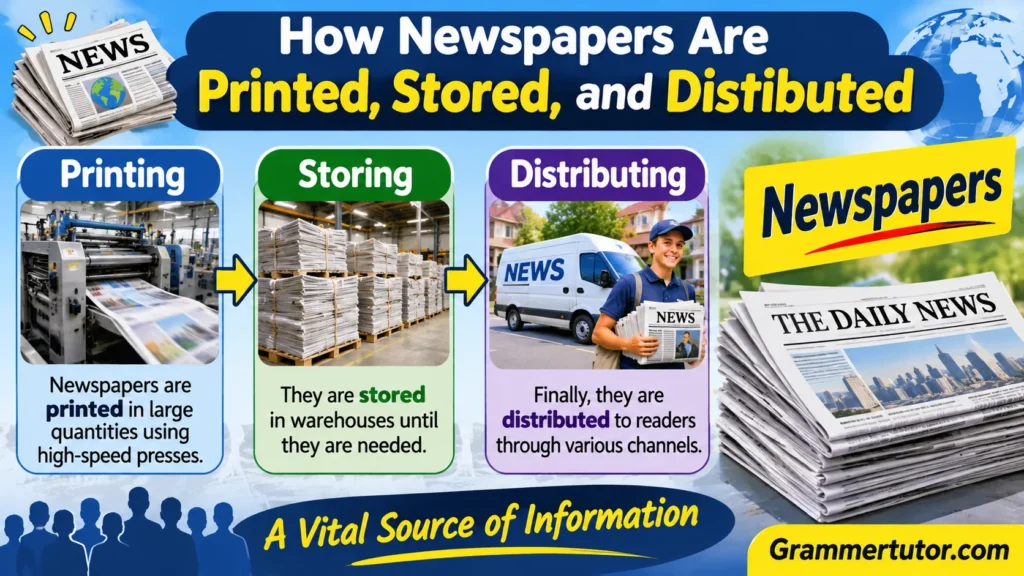
Newspapers pass through several stages before reaching readers. The process begins with journalists, editors, photographers, and designers preparing the content. Once the pages are finalised, printing facilities produce copies using large commercial printing machines. These publications are then organised for transportation and delivery.
During distribution, workers arrange newspapers into bundles or stacks according to their destinations. Newsagents and retail stores place different editions on display so customers can choose the publications they prefer. Unsold copies may be returned, stored, or sent for recycling.
Libraries and historical institutions follow a different approach. They preserve selected editions for research and reference purposes. Older publications may be organised by publication date, newspaper title, or historical subject.
Simple Examples of Newspaper Activities
- Journalists prepare reports for publication.
- Editors review articles before printing.
- Printing machines produce multiple copies.
- Distributors organise publications into bundles.
- Newsagents arrange editions on display shelves.
- Readers purchase newspapers for daily information.
- Libraries preserve older editions for reference.
- Recycling facilities process discarded publications.
- Researchers examine historical newspaper archives.
- Publishers distribute printed editions to different regions.
Interesting Facts About Newspapers
Newspapers have a fascinating history that stretches back several centuries. One of the earliest regularly published newspapers appeared in Germany in 1605, known as Relation. Over time, printed news publications developed into an important part of public communication. They helped people learn about political developments, scientific discoveries, economic changes, wars, and cultural events. Newspapers traditionally used large printing presses and movable type, while modern production relies on advanced digital design systems and high-speed printing technology. Their physical appearance has also changed considerably, with different page sizes, paper qualities, layouts, and printing methods becoming popular in different countries.
An interesting feature of newspapers is their material composition. Most modern newsprint is produced using wood-based fibres, although recycled paper fibres are also commonly included. The lightweight paper makes publications easier to print, transport, and distribute in large quantities. Newspapers are generally designed with multiple sections, including international news, local reporting, business updates, entertainment, sports, and opinion articles. Their headlines, photographs, captions, and columns help readers navigate information quickly. Some historical editions become valuable collectibles because they record major events or preserve information that may no longer appear in modern publications.
Newspapers also have an important relationship with recycling and environmental conservation. Many discarded copies can be processed into recycled paper products, packaging materials, and other useful items. Their paper fibres can be reused, although the number of recycling cycles is limited because fibres gradually become shorter and weaker. Newspaper archives also provide valuable research material for historians, students, and journalists. By examining old editions, researchers can discover how societies responded to major events and how language, public attitudes, and reporting styles changed over time. Even with the growth of online journalism, printed newspapers continue to serve readers who appreciate physical publications and traditional reading experiences.
Conclusion
The collective noun for newspapers can vary depending on how the papers are grouped or stored. Stack, pile, bundle, heap, and collection are useful terms for describing groups of newspapers. Each word has a slightly different meaning, so choosing the right one makes your English clearer and more natural. By understanding these expressions, you can improve your vocabulary and use collective nouns more confidently in everyday writing.
FAQs
Q1. What is the collective noun for newspapers?
There isn’t one universally established traditional collective noun for newspapers. Stack, pile, bundle, and collection are commonly useful expressions for describing multiple newspapers together.
Q2. What do you call a group of newspapers?
A group of newspapers can be described as a stack of newspapers, pile of newspapers, or bundle of newspapers. The appropriate expression depends on how the publications are arranged.
Q3. Is a stack of newspapers a collective noun?
Yes. Stack is a collective group expression that describes several newspapers arranged neatly on top of one another.
Q4. What is the difference between a pile and a stack of newspapers?
A stack usually suggests an organised arrangement, whereas a pile can describe newspapers placed together without a particular order.
Q5. Can we say a bundle of newspapers?
Yes. A bundle of newspapers is a natural expression for several copies tied or grouped together, particularly for transportation and delivery.