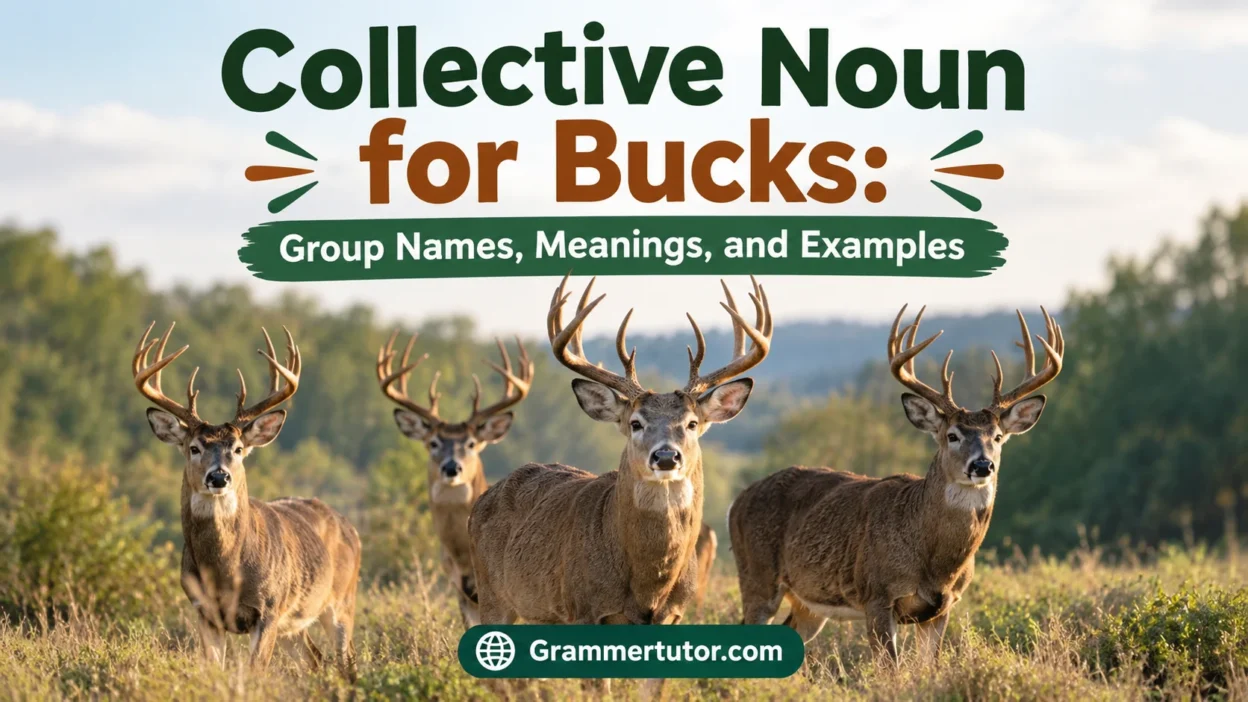
The collective noun for bucks is usually a herd of bucks, describing male deer that gather and move together in their natural surroundings. Bucks may form groups during particular seasons, depending on their age, social behavior, and breeding patterns. Understanding these animal groups helps you improve your English vocabulary and describe wildlife more clearly. For example, you can write, “A herd of bucks grazed peacefully near the forest.”
Another expression is a bachelor group of bucks, which refers to male deer living together without females. These groups can form outside the breeding season, when bucks gather in separate social groups. Their group behavior provides an interesting example of how animals interact in their natural habitat. When writing about deer, using terms such as herd, bachelor group, and male deer helps you describe their behavior accurately and make your wildlife descriptions more informative.
Learning these expressions also strengthens your grammar skills and understanding of animal terminology. A collective noun allows you to describe several animals with a single expression, making sentences simpler and more natural. For instance, “A bachelor group of bucks crossed the meadow” clearly describes several male deer moving together. Whether you are studying English, writing about wildlife, or learning animal names, knowing these group terms helps you communicate confidently and use the correct vocabulary in different contexts.
Why Collective Nouns Are Used for Bucks
Bucks sometimes travel, feed, and rest alongside other males. During certain periods, they establish separate gatherings, which are commonly described as bachelor groups. Such arrangements can provide opportunities for social interaction and may change when mating season approaches.
The expression herd of bucks works when referring to several male deer together. Meanwhile, the bachelor group gives more information about the gender and social composition of the animals.
These expressions help readers understand whether a description refers to deer generally or specifically to gatherings of male animals.
Collective Nouns for Bucks

| Collective Noun | Used For | Simple Example |
| Herd | Several male deer together | A herd of bucks crossed the meadow. |
| Bachelor group | Males living together | A bachelor group of bucks rested nearby. |
| Group | A general gathering | A group of bucks entered the woodland. |
| Gathering | Bucks assembled in one place | A gathering of bucks appeared near the stream. |
| Band | A collection of male deer | A band of bucks moved through the valley. |
Herd of Bucks
A herd of bucks describes multiple male deer occupying the same area or moving alongside one another. These animals may search for vegetation, explore woodland habitats, or gather around natural water sources.
This expression is widely understandable and suitable for ordinary conversations, educational materials, and wildlife descriptions.
Examples of “Herd of Bucks”
- A herd of bucks wandered across the grassy hillside.
- Several bucks gathered beneath the tall oak trees.
- The herd moved toward a nearby freshwater pond.
- We spotted male deer grazing beside the mountain trail.
- A herd of bucks disappeared behind the thick bushes.
- The animals crossed the open countryside together.
- Several bucks rested beneath the afternoon sunshine.
- A herd approached the riverbank during sunrise.
- The male deer searched for fresh vegetation.
- Tourists photographed the bucks from a distant viewpoint.
Bachelor Group of Bucks
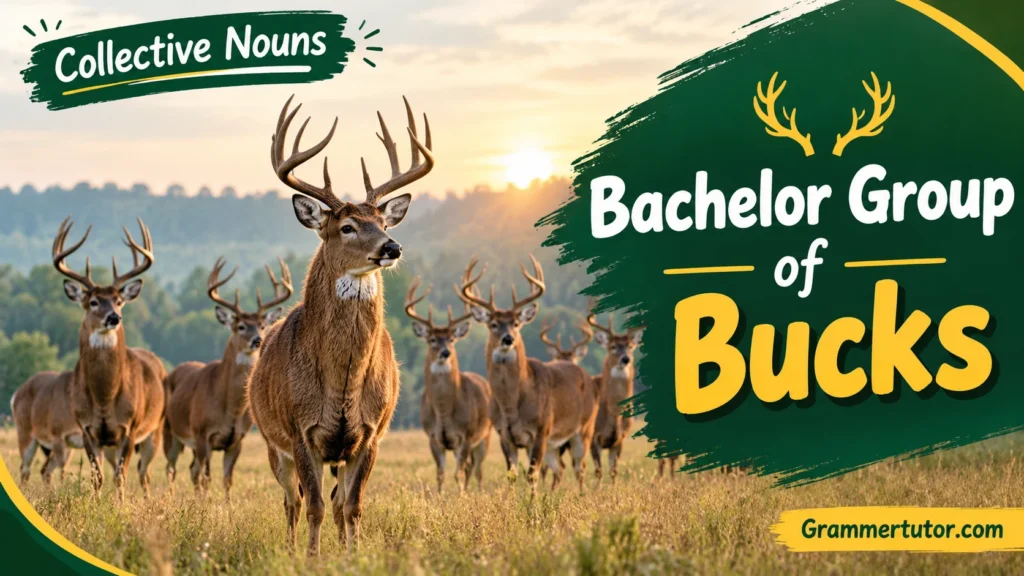
A bachelor group of bucks refers to male deer that associate with one another, particularly outside the breeding season. These gatherings commonly consist of males that spend time feeding, resting, and moving through shared habitats.
The word bachelor distinguishes these male-only social groups from gatherings containing females and young deer.
Examples of “Bachelor Group of Bucks”
- A bachelor group of bucks explored the woodland.
- Several males rested together beneath the branches.
- The bachelor group searched for nutritious plants.
- Young bucks followed their companions across the meadow.
- A bachelor group gathered near the hillside.
- Wildlife researchers observed several males together.
- The bucks traveled through the valley before sunset.
- A bachelor group remained close to the forest.
- Male deer moved together toward a shaded location.
- The animals separated when the breeding season approached.
Group of Bucks
A group of bucks is a straightforward expression describing multiple male deer without specifying their exact social arrangement. It works in almost any situation where several bucks appear together.
Unlike specialized terminology, this phrase does not suggest a particular age, relationship, or behavioral pattern.
Examples of “Group of Bucks”
- A group of bucks appeared near the mountain.
- Several male deer crossed the wooden bridge.
- The group entered a quiet forest clearing.
- A few bucks searched for food near the bushes.
- We noticed several males beside the countryside road.
- The group rested beneath some leafy branches.
- Wildlife photographers followed the animals from afar.
- Several bucks moved across the rocky landscape.
- The group approached a grassy feeding area.
- A family visiting the park watched the male deer.
Gathering of Bucks
A gathering of bucks describes male deer assembled within one particular location. This is a general descriptive expression rather than a recognized specialized animal collective noun.
It can be useful when writing about temporary gatherings around feeding grounds, resting places, or water supplies.
Examples of “Gathering of Bucks”
- A gathering of bucks appeared beside the lake.
- Several males assembled near the forest entrance.
- The gathering attracted attention from nearby visitors.
- A few bucks approached the open pasture.
- Male deer assembled beneath the spreading trees.
- The gathering remained undisturbed throughout the morning.
- Several animals explored the surrounding vegetation.
- A gathering of bucks occupied the grassy clearing.
- The males eventually moved toward higher ground.
- Observers watched the gathering through binoculars.
Band of Bucks
A band of bucks is a descriptive expression for several male deer moving or staying together. The word band can communicate the idea of a collection of animals, although it is not a standard or widely established collective noun specifically for bucks.
It may be used creatively in wildlife writing when describing males traveling through the same habitat.
Examples of “Band of Bucks”
- A band of bucks traveled across the wilderness.
- Several male deer entered the grassy valley.
- The band moved toward a distant woodland.
- A few bucks followed one another along the pathway.
- The animals explored an unfamiliar section of forest.
- A band of bucks appeared beside the mountain stream.
- The male deer searched for shelter beneath the trees.
- Several bucks crossed the meadow during daylight.
- The band continued moving through the countryside.
- Wildlife enthusiasts admired the animals from afar.
Types of Bucks and Their Characteristics
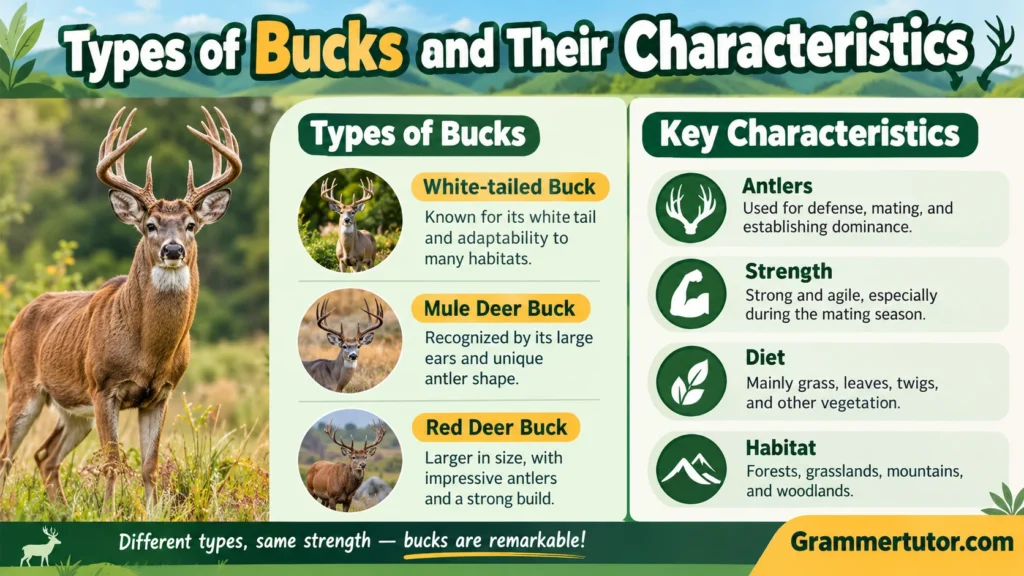
Bucks belong to different deer species, and their physical appearance depends on their particular variety. White-tailed bucks are recognized by their characteristic white underside of the tail, while mule deer have noticeably large ears. Red deer males are commonly called stags, and male elk are also known for their impressive antlers. Moose males are particularly recognizable because of their broad, palm-shaped antlers.
Antler development is one of the most remarkable features of many male deer. These structures grow from specialized tissues and are covered by a soft layer called velvet during development. Once the antlers mature, the velvet dries and is eventually rubbed away. Bucks use their antlers during competition with other males, especially during breeding periods.
Examples of Buck Characteristics
- White-tailed bucks have recognizable tail markings.
- Mule deer possess unusually large ears.
- Red deer males are known as stags.
- Elk males develop impressive antlers.
- Moose possess broad, flattened antlers.
- Growing antlers are initially covered in velvet.
- Bucks have powerful legs for escaping danger.
- Male deer possess sensitive hearing.
- Their coats can change according to seasonal conditions.
- Different species inhabit various geographical regions.
Interesting Facts About Bucks
Bucks have several remarkable biological characteristics that make them interesting wildlife subjects. Their longevity depends on species, environmental conditions, food supplies, and exposure to predators. Many wild deer survive for several years, while some individuals can reach their teenage years. Animals living in protected environments may occasionally enjoy longer lifespans because they face fewer natural threats.
One fascinating physiological feature of bucks is their ability to grow impressive antlers. These bony structures develop rapidly during particular stages of the annual growth cycle. In many species, males shed their antlers after the breeding season and begin producing new ones afterward. Bucks also possess strong hindquarters, flexible bodies, and specialized hooves that help them navigate uneven landscapes. Their excellent senses of smell and hearing provide additional protection against approaching predators.
Their dietary habits are equally interesting because bucks are herbivorous mammals. Depending on their species and surroundings, they consume grasses, leaves, tender shoots, tree buds, fruits, acorns, and other vegetation. During warmer months, fresh greenery may provide much of their nourishment, whereas colder seasons can require them to rely on woody plants, twigs, and available browse. Their digestive systems are specially adapted to process fibrous plant material. Food availability also influences their movements, physical condition, and ability to develop healthy antlers.
Social relationships among bucks provide another interesting subject. Outside the mating period, certain species commonly form bachelor groups in which males feed and rest alongside one another. However, their relationships may become more competitive during the breeding season, when males challenge rivals for access to females.
Conclusion
The most common collective noun for bucks is a herd of bucks, while bachelor group of bucks is another useful expression for male deer living together without females. Both terms help describe deer behavior, social groups, and wildlife interactions. Understanding these expressions also improves your English vocabulary and grammar, making it easier to write clear, accurate, and informative sentences about animals.
FAQs
Q1. What is the collective noun for bucks?
The most common expression is a herd of bucks. It describes several male deer living or moving together.
Q2. What is a bachelor group of bucks?
A bachelor group is an association of male deer that spend time together, particularly outside the breeding season.
Q3. Are bucks and stags the same animals?
Both words describe male deer, but their usage differs. Buck is commonly used for several species, including white-tailed and mule deer, whereas stag generally refers to an adult male red deer.
Q4. Do bucks always live together?
No. Their social arrangements change according to species, age, habitat, and breeding season. Some males spend considerable time alone, while others form temporary groups.
Q5. What do bucks eat in their natural habitats?
Bucks mainly consume vegetation, including grasses, leaves, shoots, fruits, acorns, and woody plants. Their food selection changes according to seasonal availability.