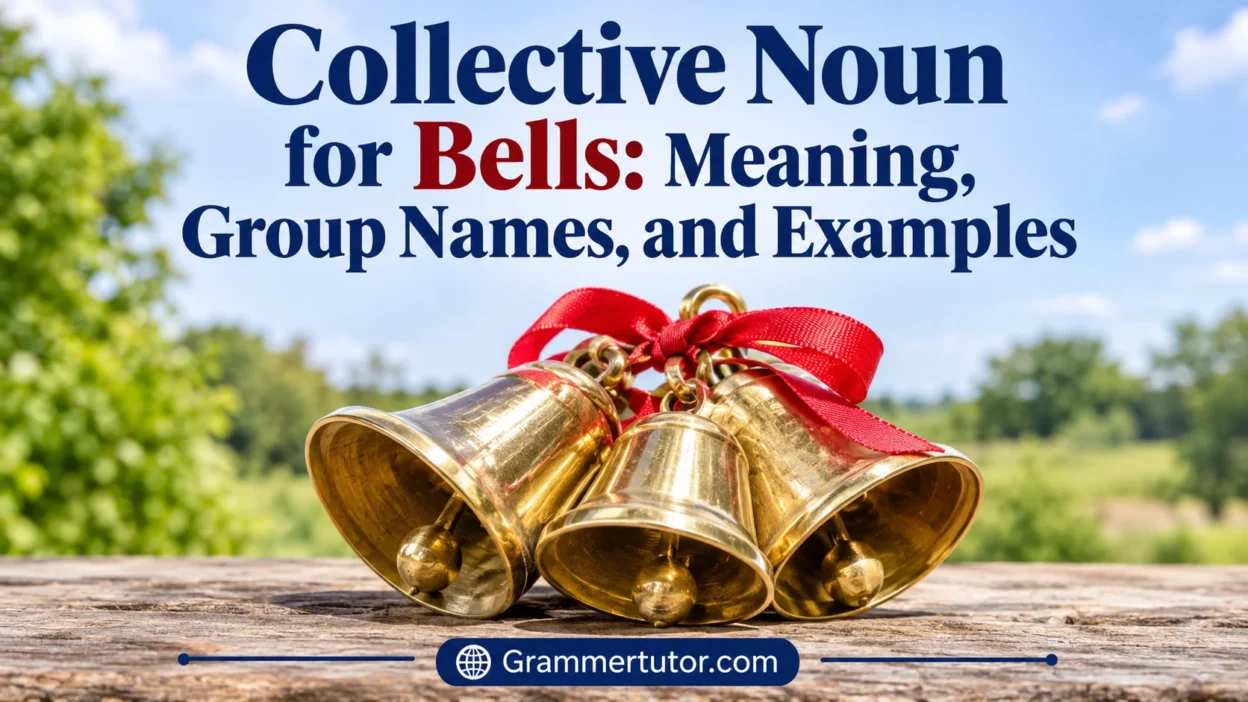
The collective noun for bells describes several bells grouped together, especially when they produce sounds for different purposes in daily life. In everyday English, people use expressions such as a peal of bells, a set of bells, and a chime of bells to describe groups of bells. Each expression has a slightly different meaning depending on how the bells are arranged and used.
Bells are familiar objects found in churches, schools, temples, homes, and public buildings. They can serve as musical instruments or decorative objects, producing different sounds for specific purposes. For example, a peal of bells often describes several bells ringing together, while a collection of bells refers to different bells gathered in one place. These expressions also connect with traditional bell-ringing activities, announcing important events, and marking the passage of time.
Learning these expressions helps you improve your English vocabulary and understand the correct terms for describing bells. Each word or expression has its own use, meaning, and purpose in different writing situations and speaking situations. With practice, you can choose the right phrase to describe bells, their arrangement, and their sounds more naturally.
Why Do Bells Have Different Group Names?
Bells are manufactured in different sizes, shapes, and materials. Some are designed to produce musical notes, while others are used to communicate signals or announce specific occasions. When several bells are placed or operated together, English uses different expressions to describe their arrangement.
For example, a peal of bells describes bells producing a series of ringing sounds. A chime of bells generally refers to bells arranged to produce musical tones. Meanwhile, a set of bells describes several bells belonging to the same arrangement or purpose.
These expressions help readers understand whether bells are ringing, playing music, or simply gathered in one place.
Collective Nouns for Bells
| Collective Noun | Used For | Simple Example |
| Peal | Bells ringing together | A peal of bells echoed across the village. |
| Chime | Bells producing musical sounds | A chime of bells played a gentle tune. |
| Set | Bells belonging to one arrangement | A set of bells stood on the table. |
| Carillon | A musical instrument containing several bells | The carillon played beautiful music. |
| Collection | Bells gathered as collectibles | A collection of bells filled the cabinet. |
| Ring | Bells producing a ringing sound | A ring of bells sounded at noon. |
Peal of Bells
A peal of bells describes a series of loud, clear, and often musical sounds produced by ringing bells. This expression is commonly associated with church towers, celebrations, ceremonies, and special announcements.
The word peal focuses mainly on the sound created when bells ring together or in succession. It is especially suitable when describing a cheerful or powerful ringing experience.
Examples of “Peal of Bells”
- A peal of bells sounded across the quiet town.
- The peal of bells announced the beginning of the celebration.
- We heard a peal of bells from the old church.
- A beautiful peal of bells welcomed the visitors.
- The morning air carried a peal of bells.
- A peal of bells rang throughout the village.
- Everyone enjoyed the cheerful peal of bells.
- The peal of bells marked the special occasion.
- A loud peal of bells interrupted the silence.
- The wedding ceremony began with a joyful peal of bells.
Chime of Bells
A chime of bells refers to several bells that produce pleasant musical tones. These bells may be arranged to create melodies or harmonious sounds. Chimes are often found in musical instruments, decorative wind chimes, clocks, and public buildings.
The expression is particularly useful when discussing bells that create different notes rather than simply making a loud ringing noise.
Examples of “Chime of Bells”
- A chime of bells played a peaceful melody.
- The chime of bells welcomed the new visitors.
- We listened to a chime of bells in the garden.
- A gentle chime of bells filled the room.
- The musician performed using a chime of bells.
- A beautiful chime of bells sounded from the tower.
- The chime of bells created a relaxing atmosphere.
- She purchased a decorative chime of bells.
- A soft chime of bells announced the hour.
- The children enjoyed listening to the chime of bells.
Set of Bells
A set of bells describes several bells that belong together or are designed for a particular purpose. These bells may have different sizes and tones, depending on their intended use.
People commonly use this expression when discussing musical equipment, school instruments, decorative items, or traditional bell arrangements.
Examples of “Set of Bells”
- A set of bells was displayed in the shop.
- The teacher brought a set of bells to school.
- She bought a new set of bells for her garden.
- A set of bells was placed beside the piano.
- The musician practiced with a set of bells.
- We found an old set of bells in the cupboard.
- The children used a set of bells during music class.
- A beautiful set of bells decorated the entrance.
- He polished the set of bells before the performance.
- The museum displayed a historic set of bells.
Carillon of Bells
A carillon is a musical instrument made up of numerous bells arranged to produce melodies. It is commonly installed in church towers, university buildings, and other tall structures.
Unlike ordinary decorative bells, a carillon is designed specifically for musical performances. A trained player can operate its keyboard to produce different notes and compositions.
Examples of “Carillon of Bells”
- The carillon played a beautiful melody.
- Visitors gathered to hear the carillon in the tower.
- The musician performed a traditional song on the carillon.
- A carillon filled the courtyard with music.
- The university installed a new carillon.
- We heard the carillon during the afternoon.
- The historic carillon attracted many tourists.
- A talented musician played the carillon.
- The carillon produced several musical notes.
- The town celebrated the restoration of its carillon.
Collection of Bells
A collection of bells refers to several bells gathered and preserved as valuable, decorative, historical, or interesting objects. Such collections may contain antique bells, miniature ornaments, handmade pieces, and unusual designs.
Collectors often keep bells because of their craftsmanship, cultural importance, distinctive sounds, or historical background.
Examples of “Collection of Bells”
- She displayed her collection of bells in a glass cabinet.
- The museum owns a collection of ancient bells.
- He started a collection of decorative bells.
- A collection of bells was arranged on the shelf.
- My grandfather preserved a collection of old bells.
- The exhibition featured a collection of handmade bells.
- She added another silver bell to her collection.
- The collection of bells included many colorful designs.
- Visitors admired the collection of historical bells.
- His collection of bells became a popular attraction.
Types of Bells and Their Uses
Bells are available in many varieties, and each type performs a different function. Church bells are generally used to announce religious services and special occasions. School bells help organize daily activities by signaling the beginning or ending of lessons. Doorbells notify household members when someone arrives, while alarm bells warn people about possible dangers.
Musical bells are designed to produce specific tones and can be used in performances, orchestras, and educational activities. Handbells are held and played by musicians, whereas tower bells are installed in elevated structures. Wind chimes contain suspended bells or metal tubes that create sounds when moved by the breeze.
Examples of Different Bell Types
- A church bell announces religious services.
- A school bell signals the end of a lesson.
- A doorbell alerts people when visitors arrive.
- An alarm bell warns people about emergencies.
- A handbell produces musical notes when shaken.
- A bicycle bell alerts pedestrians.
- A clock bell announces the passing hour.
- A temple bell is used during religious activities.
- A wind chime creates sounds through moving air.
- A service bell helps customers request assistance.
Interesting Facts About Bells
Bells have been used by human civilizations for thousands of years. Over time, bell-making techniques improved, allowing craftspeople to produce objects with clearer tones, stronger structures, and more attractive designs.
They could announce celebrations, warn communities about danger, mark important hours, and call people together. Today, bells remain part of religious ceremonies, educational institutions, musical performances, and public signaling systems.
Another interesting detail is that some bells have considerable historical and artistic value. Antique bells may feature engraved patterns, inscriptions, traditional symbols, and decorative carvings. Large tower bells can also become recognizable landmarks because of their distinctive sounds and historical importance. These characteristics explain why people preserve individual bells and build collections of them.
Examples of Interesting Bell Facts
- Bells have existed for thousands of years.
- Bronze is commonly used to manufacture large bells.
- Different bell sizes produce different pitches.
- Bells create sound through vibrations.
- Church bells can announce important ceremonies.
- School bells help manage classroom schedules.
- Handbells are used in musical performances.
- Some antique bells contain historical inscriptions.
- Carillons can perform complete musical compositions.
- Wind chimes produce sounds when moved by air.
Conclusion
Knowing the different collective nouns for bells makes your English more accurate and expressive. Whether you use a peal of bells, a chime of bells, or a set of bells, each expression helps describe bells in a clear way. Learning these terms also adds variety to your writing and helps you understand how ordinary objects can have interesting group names.
FAQs
Q1. What is the collective noun for bells?
A peal of bells is a well-known collective expression used when several bells ring together or in succession. Other expressions include a chime of bells and a set of bells.
Q2. Can I use “a peal of bells” in a sentence?
Yes. It is a correct and natural expression. For example, “A peal of bells rang throughout the village during the celebration.”
Q3. What is the difference between a peal and a chime of bells?
A peal of bells emphasizes the ringing sound, often loud or continuous, while a chime of bells generally emphasizes musical tones produced by several bells.
Q4. What is a carillon of bells?
A carillon is a musical instrument containing multiple bells arranged to produce different notes and melodies. It is usually installed in a tower or another tall building.
Q5. Why do people use collective nouns for bells?
Collective expressions make it easier to describe several bells as one arrangement or group. They also help explain whether the bells are ringing, producing music, or being kept together as collectibles.