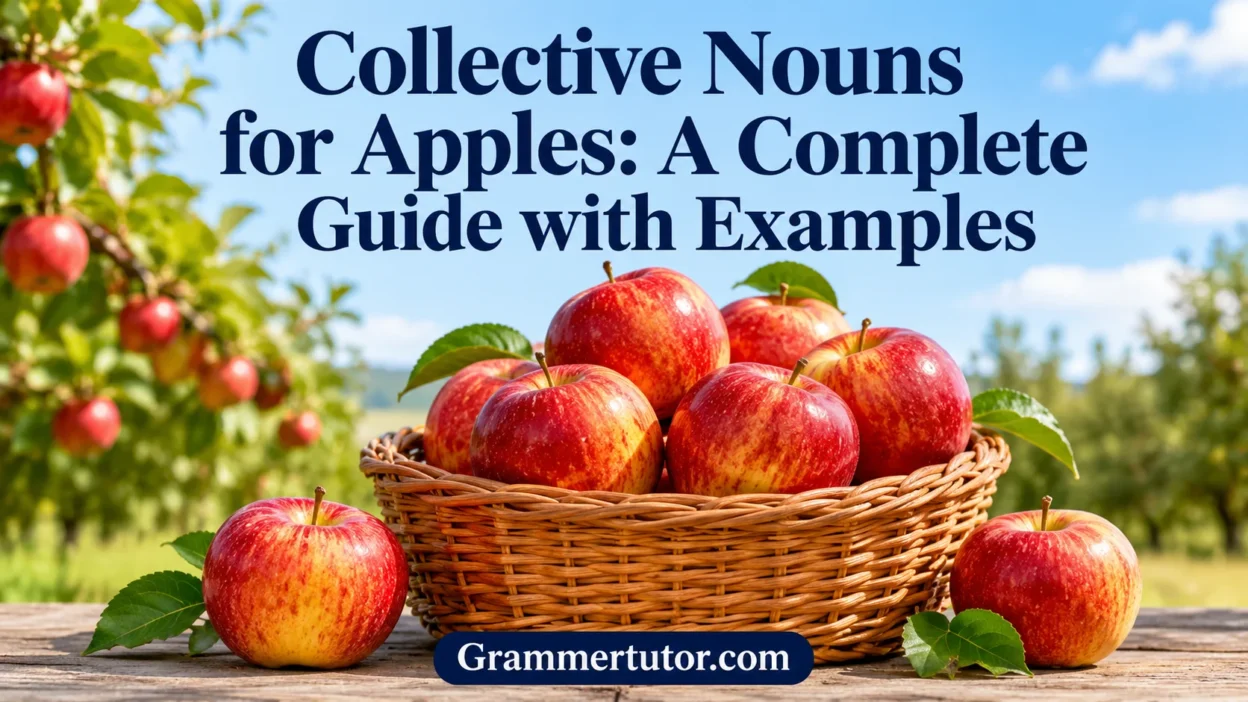
A collective noun for apples helps you describe several apples as one group, depending on how they are gathered or presented. These names make everyday English more natural.
For example, when you collect apples from a garden, you might place them in a basket, arrange them in wooden crates, or gather them into a pile. In a fruit shop, you may also see a bunch of apples or a bushel of apples. Each expression paints a slightly different picture of how the fruit is collected, stored, or displayed.
Learning these expressions adds variety to your English vocabulary and helps you communicate more clearly. Whether you’re describing freshly picked apples, preparing a shopping list, or writing about fruit at a market, choosing the right group name makes your sentences more specific and interesting.
A Bushel of Apples
A bushel of apples is a traditional expression used to describe a large quantity of apples. A bushel is also a standard unit of dry volume used in agricultural measurement, particularly in the United States. It is commonly associated with harvesting, selling, and storing apples.
Farmers often use bushel baskets to collect apples from orchards during harvest season. This expression is especially suitable when discussing agriculture, fruit markets, and large quantities of freshly picked apples.
Examples of “A Bushel of Apples”
- The farmer collected a bushel of apples from his orchard.
- My grandmother bought a bushel of apples at the market.
- A bushel of apples was waiting near the farmhouse.
- We prepared apple pies using a bushel of fresh apples.
- The shopkeeper displayed a bushel of red apples.
- A bushel of apples was delivered to the grocery store.
- The children helped carry a bushel of apples.
- She purchased a bushel of apples for the festival.
- The farmer sold a bushel of apples before noon.
- A bushel of apples was stored in the barn.
A Basket of Apples
A basket of apples describes apples collected and placed inside a basket. It is one of the most familiar expressions used in everyday English. People commonly use baskets to carry, store, display, or present apples.
This expression is often associated with fruit shopping, family gatherings, picnics, and traditional harvest scenes. A basket can contain a few apples or a larger collection, depending on its size.
Examples of “A Basket of Apples”
- She placed a basket of apples on the kitchen table.
- The children carried a basket of apples from the garden.
- My mother bought a basket of fresh apples.
- A basket of apples stood beside the window.
- He gave his teacher a basket of red apples.
- We filled a basket of apples during the harvest.
- The shop displayed a beautiful basket of green apples.
- A basket of apples was delivered to our house.
- She selected the sweetest apples for the basket.
- The farmer brought a basket of apples to the market.
A Crate of Apples
A crate of apples refers to a collection of apples packed inside a strong container, usually made of wood, plastic, or cardboard. Crates are widely used by farmers, wholesalers, and grocery stores to transport and store fruit safely.
This expression is particularly useful when discussing commercial apple production and distribution. Crates help keep apples organized and make it easier to move large quantities from orchards to markets.
Examples of “A Crate of Apples”
- The farmer loaded a crate of apples onto the truck.
- A crate of apples arrived at the grocery store.
- Workers carried a crate of apples into the warehouse.
- She selected fresh apples from the crate.
- The shopkeeper placed a crate of apples near the entrance.
- A crate of apples was waiting outside the orchard.
- We received a crate of apples from the supplier.
- The children helped unload a crate of apples.
- He stored a crate of apples in the cool room.
- The market received several crates of apples today.
A Pile of Apples
A pile of apples describes several apples placed together in an untidy or loosely arranged group. This expression is commonly used when apples are collected after picking, placed on a table, or gathered in one area. Unlike a basket or crate, a pile does not require a particular container.
It is a simple and natural expression that works well in everyday conversations, stories, and descriptions of fruit markets or orchards.
Examples of “A Pile of Apples”
- A pile of apples was lying on the wooden floor.
- The children made a pile of apples after harvesting them.
- She washed a pile of apples in the kitchen.
- A pile of red apples stood near the market entrance.
- The farmer arranged a pile of apples beside the barn.
- We selected the best apples from the pile.
- A small pile of apples was placed on the counter.
- He noticed a pile of apples under the tree.
- The shopkeeper removed the damaged apples from the pile.
- A pile of fresh apples attracted everyone’s attention.
A Heap of Apples
A heap of apples refers to a large collection of apples gathered together, usually without being arranged neatly. It is similar to a pile, but the word heap often suggests a larger or higher collection.
This expression is useful when describing freshly harvested apples, fruit stored temporarily in one place, or a large quantity collected during agricultural work. It also appears naturally in descriptive and creative writing.
Examples of “A Heap of Apples”
- A heap of apples was collected in the orchard.
- The farmer placed a heap of apples near the storage room.
- We found a heap of fresh apples at the market.
- She picked a red apple from the heap.
- A heap of apples covered part of the wooden table.
- The workers sorted the apples from the heap.
- He carried several apples away from the heap.
- A large heap of apples stood beside the farmhouse.
- The children enjoyed looking at the colourful heap of apples.
- The shopkeeper divided the heap of apples into smaller groups.
A Bowl of Apples
A bowl of apples describes apples placed together inside a bowl. It is a familiar expression used in homes, restaurants, offices, and dining areas. People often place fresh apples in bowls as a convenient snack or as a decorative display.
This expression is particularly useful when describing a small collection of apples arranged neatly for serving or presentation. It also creates a simple picture of a healthy and welcoming kitchen or dining table.
Examples of “A Bowl of Apples”
- A bowl of apples was placed on the dining table.
- My mother filled a bowl with fresh apples.
- She offered her guests a bowl of apples.
- A bowl of green apples stood near the window.
- He took an apple from the bowl.
- We prepared a bowl of apples for breakfast.
- The children shared a bowl of sweet apples.
- A colourful bowl of apples decorated the kitchen.
- She washed the apples before placing them in the bowl.
- My grandmother kept a bowl of apples on the counter.
A Barrel of Apples
A barrel of apples describes apples stored together inside a large round container, traditionally made from wood. Barrels have been used for storing and transporting different agricultural products for centuries.
This expression is suitable when discussing traditional fruit storage, food preservation, and historical farming practices. Apples can also be stored in barrels for certain food preparations, including fermentation and cider production.
Examples of “A Barrel of Apples”
- A barrel of apples stood outside the farmhouse.
- The farmer filled a barrel with freshly picked apples.
- We discovered a barrel of apples in the old barn.
- The workers moved a barrel of apples into storage.
- A barrel of apples was displayed at the harvest festival.
- He selected some apples from the barrel.
- The family stored a barrel of apples for the winter.
- A barrel of apples was placed beside the wooden fence.
- The farmer prepared a barrel of apples for transportation.
- The children enjoyed seeing a barrel full of colourful apples.
A Harvest of Apples
A harvest of apples refers to the apples collected from trees during the harvesting season. Unlike expressions that describe apples inside containers, this phrase focuses on the overall crop gathered from an orchard.
It is frequently used in farming, agriculture, seasonal celebrations, and discussions about fruit production. A good apple harvest usually means that farmers have collected a large quantity of healthy and mature fruit.
Examples of “A Harvest of Apples”
- The farmer celebrated a successful harvest of apples.
- This year’s harvest of apples was excellent.
- The workers began the harvest of apples in September.
- A beautiful harvest of apples filled the orchard baskets.
- The family helped collect the harvest of apples.
- Rain affected the harvest of apples this year.
- The farmers prepared for the annual harvest of apples.
- A large harvest of apples was sent to the market.
- The village celebrated its harvest of apples together.
- The children learned about the harvest of apples at school.
Quick Table of Collective Nouns for Apples
The following table provides a quick summary of the nine expressions, their uses, and simple examples.
| Collective Expression | Type or Use | Simple Example |
| Bushel | Measured quantity | A bushel of apples was sold. |
| Basket | Apples inside a basket | A basket of apples was ready. |
| Crate | Apples packed for transport | A crate of apples arrived. |
| Pile | Apples placed together | A pile of apples was on the floor. |
| Heap | A large loose collection | A heap of apples stood nearby. |
| Bowl | Apples placed in a bowl | A bowl of apples was on the table. |
| Sack | Apples packed in a bag | A sack of apples was delivered. |
| Barrel | Apples stored in a barrel | A barrel of apples was full. |
| Harvest | Apples collected from trees | The harvest of apples was plentiful. |
Note: These are useful collective expressions and quantity or container phrases. They are not all formal grammatical collective nouns.
Interesting Facts About Apples
Apples have a fascinating history that stretches back thousands of years. They originally developed in Central Asia, particularly in the region of modern-day Kazakhstan, before spreading to different parts of the world. Today, apples are cultivated in many countries and are available in thousands of varieties. Some popular varieties include Gala, Fuji, Golden Delicious, Red Delicious, and Granny Smith. These varieties differ in colour, sweetness, texture, and acidity, making apples suitable for fresh eating, cooking, baking, and juice production.
One interesting feature of apples is their nutritional value. They contain dietary fibre, vitamin C, potassium, and several beneficial plant compounds. Their skin contains a significant amount of fibre and antioxidants, which contribute to their nutritional benefits. Apples also contain a high proportion of water, making them a refreshing fruit. The familiar saying “An apple a day keeps the doctor away” reflects their reputation as a healthy food, although eating apples alone cannot prevent every illness.
Apple trees are also interesting because they belong to the rose family, known scientifically as Rosaceae. They produce beautiful blossoms during spring, which are usually white or pink. These flowers attract bees and other pollinators that help apple trees produce fruit. Depending on the variety and growing conditions, apples generally take several months to mature after flowering. Interestingly, apples can float in water because approximately one-quarter of their volume consists of air. This natural feature makes them useful in traditional apple-bobbing games.
Conclusion
Learning the collective nouns for apples makes it easier to describe groups of fruit in everyday English. Expressions such as a basket of apples, a bushel of apples, a bunch of apples, and a pile of apples each help explain how apples are gathered or arranged. Although these expressions may describe different situations, they all add variety to your vocabulary. Practising them in simple sentences can help you become more confident in writing and speaking English.
FAQs
Q1. What is the most common collective noun for apples?
A basket of apples is one of the most familiar expressions used in everyday English. Other common expressions include a bunch of apples and a bushel of apples.
Q2. Is “a bunch of apples” correct?
Yes, a bunch of apples is understandable English. It describes several apples gathered together, although basket, pile, or group may be more suitable depending on the arrangement.
Q3. What is a bushel of apples?
A bushel is a traditional unit of dry volume used to measure agricultural products, including apples. In the United States, one bushel of apples is approximately 42 pounds.
Q4. What is the difference between a basket of apples and a crate of apples?
A basket of apples describes apples placed inside a basket, often for carrying or display. A crate of apples refers to apples packed in a container commonly used for storage and transportation.
Q5. Can we say a pile of apples?
Yes, a pile of apples is a correct expression. It describes apples placed together without necessarily being arranged neatly.