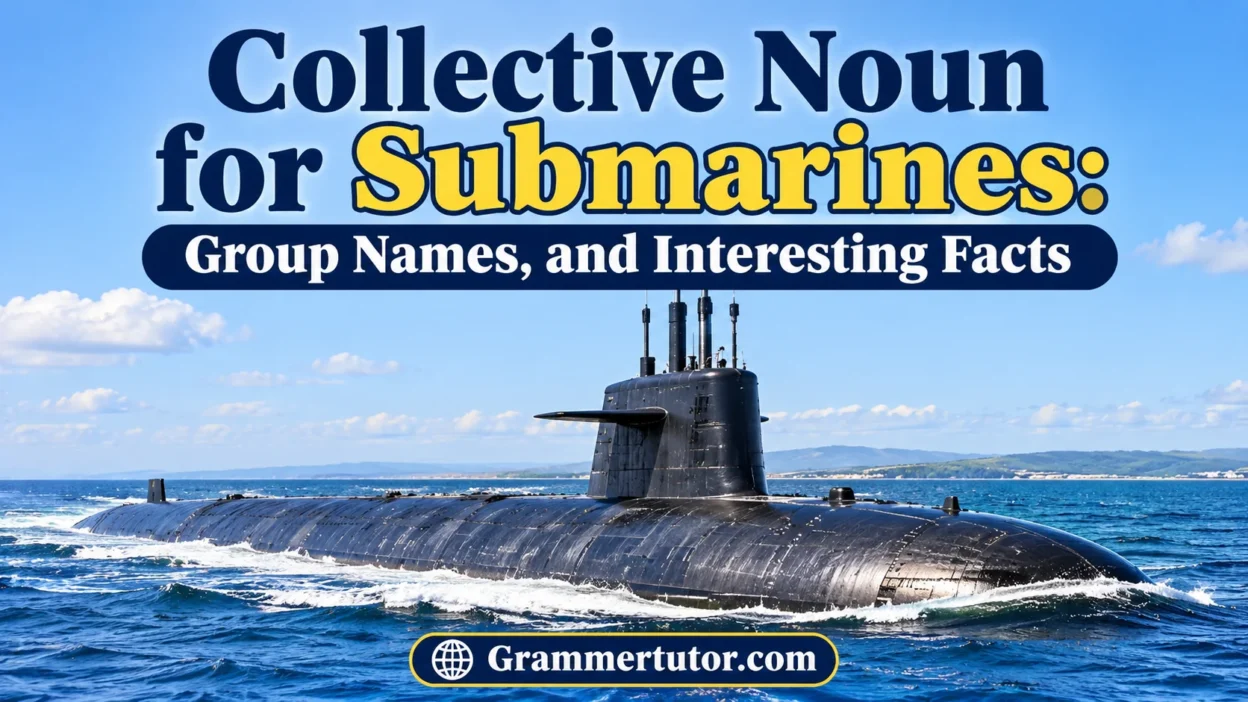
The collective noun for submarines describes several underwater vessels travelling or operating together as one organised group beneath the ocean surface. These specialised vehicles travel through oceans, seas, and other bodies of water. Their work may involve naval defence, scientific exploration, underwater research, and ocean observation.
During naval operations, several submarines may operate together or travel in a coordinated formation. Expressions such as a fleet of submarines, a flotilla of submarines, a squadron of submarines, and a wolf pack of submarines help describe these groups. Each expression has its own meaning and use in different naval situations. Understanding these group names improves your English vocabulary and vocabulary precision.
You can use them in naval writing, military writing, historical accounts, and educational material. They also make everyday communication clearer when discussing submarine organisation, naval history, and ocean exploration. Simple practical examples can help you understand these expressions and use the right collective noun when describing submarine groups.
Why Are Collective Nouns Used for Submarines?
Submarines are complex vessels that often operate as part of organised naval forces. Instead of mentioning individual underwater craft separately, writers can use group expressions to describe several vessels belonging to the same naval organisation or participating in a coordinated mission.
These terms also help readers understand how submarines are organised. For example, fleet generally refers to a larger collection of naval vessels, whereas flotilla can describe a smaller naval formation. The expression wolf pack has a particular historical association with groups of German submarines that coordinated attacks during the Second World War.
Such vocabulary is useful in naval history, military discussions, ocean exploration articles, and general English writing. However, these expressions are not interchangeable in every situation. Some describe formal military organisations, while others refer to particular operational arrangements.
Seven Collective Nouns for Submarines
| Type | Simple Example |
| Fleet | A fleet of submarines entered the naval harbour. |
| Flotilla | A flotilla of submarines travelled underwater. |
| Squadron | A squadron of submarines prepared for deployment. |
| Wolf pack | A wolf pack of submarines approached the convoy. |
| Division | A division of submarines received new orders. |
| Formation | A formation of submarines moved through the water. |
| Group | A group of submarines participated in the exercise. |
Fleet of Submarines
A fleet of submarines is a general expression describing a collection of underwater vessels belonging to a naval force or operating under a shared command structure. The word fleet is widely associated with naval forces and can include different kinds of military vessels.
Submarines within a fleet may perform different responsibilities. Some are designed to monitor underwater activity, while others support national defence, gather intelligence, or carry specialised equipment. Their activities depend on their design, mission, and the instructions received from naval authorities.
This expression is particularly useful when describing a country’s submarine resources or a large collection of vessels maintained by its navy. It provides a clear picture without requiring the names of individual submarines.
Examples of “Fleet of Submarines”
- A fleet of submarines remained stationed at the naval base.
- The admiral inspected a fleet of submarines before deployment.
- A fleet of submarines protected the country’s maritime interests.
- The documentary explored the history of a fleet of submarines.
- A fleet of submarines participated in the naval exercise.
- The harbour welcomed a fleet of submarines after their mission.
- A fleet of submarines operated across the northern waters.
- The navy maintained a fleet of submarines for strategic purposes.
- A fleet of submarines received updated navigation equipment.
- The country announced plans to modernise its fleet of submarines.
Flotilla of Submarines
A flotilla of submarines refers to a relatively small collection of naval vessels organised to operate under a common command. The word flotilla is traditionally used in naval terminology for a group of smaller ships or boats, including submarines.
A flotilla may be responsible for conducting patrols, supporting maritime operations, or participating in scheduled training activities. Its organisation allows naval authorities to coordinate several vessels while assigning specific responsibilities to individual units.
The term is especially useful in discussions about naval structures and underwater operations. It gives a more specialised description than simply calling several submarines a group.
Examples of “Flotilla of Submarines”
- A flotilla of submarines departed from the coastal installation.
- The commander supervised a flotilla of submarines during training.
- A flotilla of submarines operated throughout the maritime region.
- The naval report described a flotilla of submarines on patrol.
- A flotilla of submarines assembled for a scheduled exercise.
- The documentary examined a flotilla of submarines from the past.
- A flotilla of submarines received instructions from headquarters.
- The coastal authorities monitored a flotilla of submarines.
- A flotilla of submarines returned following an extended assignment.
- The naval museum displayed photographs of a historic flotilla of submarines.
Squadron of Submarines
A squadron of submarines describes a group of underwater vessels organised within a naval command structure. The word squadron is frequently associated with military units, especially those involving aircraft and naval vessels.
In submarine operations, squadrons can represent organised collections of vessels assigned to particular responsibilities. Their duties may include surveillance, maritime defence, training, and other specialised naval activities.
The exact meaning of a submarine squadron can differ between countries because naval organisations use their own command structures and classifications. Nevertheless, the expression is useful when discussing submarines as part of an organised military unit.
Examples of “Squadron of Submarines”
- A squadron of submarines received its annual inspection.
- The naval commander addressed a squadron of submarines.
- A squadron of submarines prepared for a training programme.
- The report mentioned a squadron of submarines stationed overseas.
- A squadron of submarines participated in a maritime demonstration.
- The navy reorganised its squadron of submarines.
- A squadron of submarines completed its scheduled exercises.
- The visitors learned about a squadron of submarines at the naval exhibition.
- A squadron of submarines underwent technical maintenance.
- The documentary followed a squadron of submarines through its history.
Wolf Pack of Submarines
A wolf pack of submarines is a distinctive expression associated with coordinated underwater warfare. It became particularly famous during the Second World War, when German U-boats used group tactics to attack Allied shipping convoys in the Atlantic Ocean.
The expression wolf pack compares the coordinated movements of submarines with the hunting behaviour of wolves. Instead of attacking independently, several submarines could cooperate by locating, tracking, and approaching a target convoy.
During the Battle of the Atlantic, these tactics presented serious challenges to Allied merchant shipping and naval protection forces. The development of improved radar, sonar, intelligence, and convoy defence gradually reduced their effectiveness.
Unlike a general term such as fleet, wolf pack has a specific historical and tactical association. It is particularly appropriate when discussing coordinated submarine operations rather than every collection of underwater vessels.
Examples of “Wolf Pack of Submarines”
- A wolf pack of submarines targeted merchant shipping during wartime.
- Historians studied the tactics of a wolf pack of submarines.
- A wolf pack of submarines coordinated its movements across the Atlantic.
- The naval museum presented a model of a wolf pack of submarines.
- A documentary explained how a wolf pack of submarines operated.
- The commander organised a wolf pack of submarines for a coordinated attack.
- A wolf pack of submarines became a major concern for Allied convoys.
- The historical account described a wolf pack of submarines operating at night.
- Researchers examined the communication methods used by a wolf pack of submarines.
- The exhibition highlighted the role of a wolf pack of submarines in naval history.
Division of Submarines
A division of submarines describes an organised section of a naval force containing multiple underwater vessels. The term division is commonly used in military organisations to identify a particular unit or administrative grouping.
Depending on the navy, a submarine division may have responsibilities involving vessel management, training, readiness, or operational coordination. It can also refer to a designated group within a larger naval structure.
The exact organisation varies across different maritime forces. Therefore, division should be understood as an organisational expression rather than a universal name for every collection of submarines.
Examples of “Division of Submarines”
- A division of submarines received new operational guidelines.
- The naval headquarters reviewed a division of submarines.
- A division of submarines completed its technical assessment.
- The officer supervised a division of submarines during the inspection.
- A division of submarines was assigned to a training facility.
- The military archive contained records of a division of submarines.
- A division of submarines prepared for its next assignment.
- The navy strengthened its division of submarines with modern equipment.
- A division of submarines participated in a readiness evaluation.
- The commander visited a division of submarines at the naval station.
Formation of Submarines
A formation of submarines describes several underwater vessels arranged or moving in a coordinated pattern. Unlike formal organisational terms, formation focuses on the physical arrangement and movement of the vessels.
Submarines may maintain planned distances from one another during certain training exercises or coordinated maritime activities. Their positions depend on operational requirements, communication procedures, safety considerations, and the conditions of the surrounding waters.
The expression is useful in military reports, fictional accounts, documentaries, and descriptions of underwater exercises. It helps readers imagine several vessels moving in an organised arrangement rather than operating independently.
Examples of “Formation of Submarines”
- A formation of submarines appeared on the naval monitoring display.
- The formation of submarines maintained its assigned positions.
- Several observers watched a formation of submarines during the exercise.
- A formation of submarines moved through the designated training area.
- The captain reviewed the arrangement of the formation of submarines.
- A formation of submarines participated in a coordinated demonstration.
- The documentary showed a formation of submarines beneath the ocean.
- A formation of submarines completed its scheduled manoeuvres.
- The naval exercise included a formation of submarines.
- The formation of submarines changed its arrangement during training.
Group of Submarines
A group of submarines is the simplest general expression for several underwater vessels considered together. It does not necessarily suggest a formal military unit, a particular command arrangement, or a coordinated combat operation.
This term is suitable for everyday English because almost everyone understands what it means. You can use it when discussing submarine collections in museums, underwater research projects, military exercises, or historical events.
It is also a useful choice when you don’t know the official organisational name of the vessels. Rather than using a specialised term incorrectly, you can simply describe them as a group.
Examples of “Group of Submarines”
- A group of submarines appeared in the research report.
- The exhibition featured a group of submarines from different periods.
- A group of submarines participated in the underwater exercise.
- The documentary introduced a group of submarines used for exploration.
- Researchers examined a group of submarines at the naval facility.
- A group of submarines was included in the historical collection.
- The photographs showed a group of submarines near the harbour.
- A group of submarines supported the scientific expedition.
- The students studied a group of submarines during their marine technology lesson.
- The captain discussed a group of submarines during the briefing.
Interesting Facts About Submarines
Submarines are among the most technologically advanced vessels ever developed. Their ability to travel beneath the ocean surface depends on specialised engineering, pressure-resistant structures, and carefully controlled buoyancy. The main body, known as the pressure hull, protects the crew and essential equipment from the enormous water pressure found at greater depths. Unlike ordinary surface ships, submarines can control their buoyancy through ballast tanks. These tanks take in water to help the vessel descend and use compressed air to expel water when it needs to rise.
Another fascinating feature is their propulsion system. Conventional submarines commonly use diesel engines and electric batteries, while nuclear-powered submarines generate electricity through onboard nuclear reactors. Nuclear propulsion allows certain submarines to remain underwater for extended periods without needing to surface for atmospheric oxygen. However, food supplies, maintenance requirements, and crew wellbeing still influence how long a submarine can remain deployed. Modern submarines also use sonar, which stands for Sound Navigation and Ranging, to detect and identify underwater objects. Because radio signals do not travel effectively through seawater, sound-based technology plays an essential role in underwater navigation and detection.
Submarines have also contributed significantly to scientific research and ocean exploration. Specialised research submersibles can carry scientists to remarkable depths, allowing them to investigate marine ecosystems, underwater geological formations, and deep-sea organisms. Some exploration vehicles are designed to withstand pressures that would destroy ordinary vessels. The development of underwater technology has also improved our understanding of ocean currents, seafloor structures, and marine biodiversity. From military patrols to scientific discoveries, submarines continue to demonstrate how engineering can help humans explore an environment that remains largely mysterious.
Conclusion
Understanding the collective noun for submarines makes it easier to describe several underwater vessels as one group. Although a fleet of submarines is the most common general expression, terms such as a flotilla, a squadron, and a wolf pack also appear in naval contexts. Learning these group names improves your vocabulary and helps you use accurate expressions when writing or talking about submarines.
FAQs
Q1. What is the collective noun for submarines?
The most suitable general collective noun is fleet. The expression a fleet of submarines describes several underwater vessels belonging to or operating within a naval force.
Q2. Can submarines be called a flotilla?
Yes. A flotilla of submarines is an appropriate expression for a relatively small collection of naval vessels organised under common command.
Q3. What does a wolf pack of submarines mean?
A wolf pack of submarines refers to several submarines coordinating their activities during naval operations. The expression is particularly associated with German U-boat tactics during the Second World War.
Q4. Is squadron a suitable word for submarines?
Yes. A squadron can describe an organised naval unit containing submarines. However, the exact meaning depends on the organisational structure of the navy using the term.
Q5. What is the difference between a fleet and a flotilla?
A fleet generally describes a larger collection of naval vessels, whereas a flotilla usually refers to a smaller naval formation. Both expressions can be used when discussing submarines.