A collective noun for eggs describes how eggs are grouped, collected, stored, or counted in everyday English. These expressions make conversations about eggs clearer and help learners understand their correct usage in different situations.
A clutch usually refers to a group of eggs laid by a bird in a nest. A batch describes eggs collected or prepared together, while a dozen means twelve eggs. Similarly, a carton refers to a container used for keeping eggs safe during storage, shopping, and transportation. Eggs collected from a farm may also be arranged in a basket before being packed.
Understanding these expressions improves English vocabulary and makes everyday communication more natural. Whether discussing cooking, farming, food storage, or bird reproduction, each expression has a useful purpose. Learning their meanings through simple example sentences also helps explain egg structure, nutritional value, and importance in nature and everyday life.
Why Are Collective Nouns Used for Eggs?
Collective nouns and group expressions make it easier to describe several eggs without mentioning each one separately. For example, instead of saying several eggs laid together in a nest, you can use the expression a clutch of eggs. Similarly, when eggs are packed for sale, expressions such as a carton of eggs or a dozen eggs are more convenient.
These expressions are useful in different situations. Farmers use them when collecting eggs from poultry, shopkeepers use them when selling eggs, and cooks use them when discussing ingredients for recipes. Birdwatchers and wildlife researchers also use particular expressions to describe eggs laid by birds.
Understanding these terms helps learners recognize the difference between a natural group of eggs, a quantity of eggs, and a container used for storing them.
Collective Nouns for Eggs
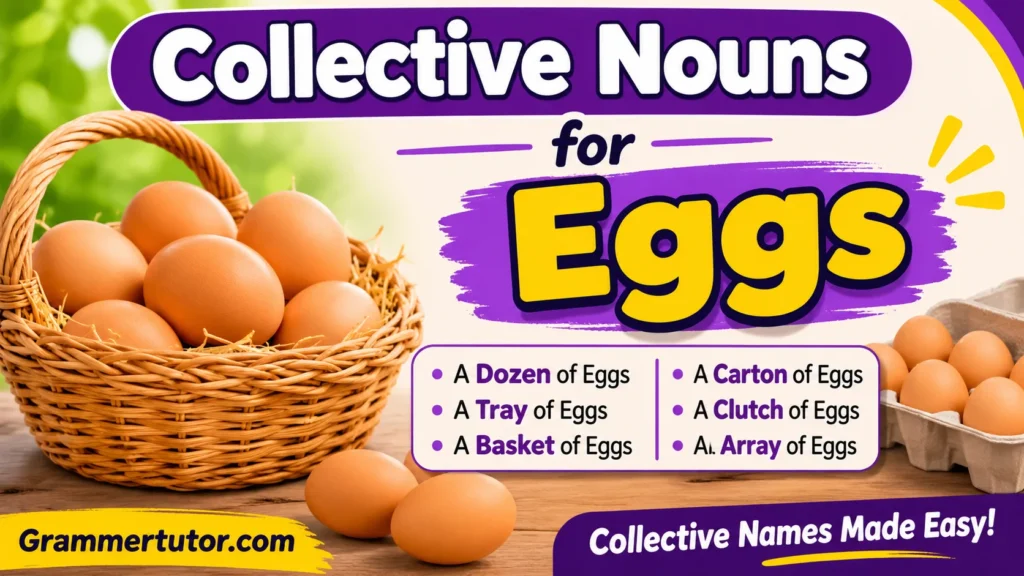
There are several common expressions used to describe groups and quantities of eggs. Each expression has a slightly different meaning depending on the situation.
| Collective Noun | Type or Use | Simple Example |
| Clutch | Eggs laid by a bird during one breeding period | A clutch of eggs was in the nest. |
| Batch | Eggs collected or prepared together | A batch of eggs was delivered. |
| Dozen | A quantity of twelve eggs | A dozen eggs were in the basket. |
| Carton | Eggs packed in a container | A carton of eggs was on the shelf. |
| Tray | Eggs arranged together for storage | A tray of eggs was in the kitchen. |
| Nest | Eggs laid or kept in a bird’s nest | A nest of eggs was found in the garden. |
| Collection | Different eggs gathered together | A collection of eggs was displayed. |
| Set | Eggs considered together as a group | A set of eggs was placed on the table. |
Note: A clutch is a recognized biological term for eggs laid during one breeding attempt. Dozen describes a specific quantity, while carton and tray refer to containers or arrangements rather than strict grammatical collective nouns.
A Clutch of Eggs
A clutch of eggs is a widely recognized expression used in bird biology. It refers to the group of eggs laid by a bird during a single breeding attempt. Different bird species lay different numbers of eggs in each clutch. Some birds lay only one or two eggs, while others may lay several.
This expression is particularly useful when discussing nests, bird reproduction, and wildlife. It helps describe eggs that belong to the same breeding period rather than simply referring to eggs stored together.
Examples of “A Clutch of Eggs”
- A clutch of eggs was discovered inside the nest.
- The mother bird carefully protected her clutch of eggs.
- We noticed a clutch of eggs beneath the tree.
- A clutch of eggs was resting safely in the nest.
- The farmer found a clutch of eggs near the garden.
- The bird returned to protect its clutch of eggs.
- A clutch of eggs was observed by the researchers.
- The children quietly watched the clutch of eggs.
- The mother bird kept her clutch of eggs warm.
- A clutch of eggs was hidden among the leaves.
A Batch of Eggs
A batch of eggs refers to eggs collected, handled, or prepared together. This expression is commonly used in farming, food production, cooking, and commercial businesses. For example, a poultry farm may collect a batch of eggs in the morning before sorting and packaging them.
The word batch focuses on eggs that are treated as one group during a particular activity. It does not necessarily indicate a fixed number of eggs.
Examples of “A Batch of Eggs”
- A batch of eggs arrived at the grocery store.
- The farmer collected a fresh batch of eggs.
- A batch of eggs was prepared for delivery.
- She checked the quality of the batch of eggs.
- The bakery ordered a large batch of eggs.
- A batch of eggs was placed in the refrigerator.
- The workers packed the batch of eggs carefully.
- We bought a fresh batch of eggs from the farm.
- The shop received another batch of eggs today.
- A batch of eggs was used to prepare breakfast.
A Dozen Eggs
A dozen eggs means exactly twelve eggs. It is one of the most familiar expressions used in grocery shopping, cooking, and household conversations. Eggs are commonly sold in dozens because twelve is a convenient quantity for packaging, counting, and purchasing.
This expression is different from most collective nouns because it describes a specific number rather than how eggs are naturally grouped together. You may also hear the expression half a dozen, which means six eggs.
Examples of “A Dozen Eggs”
- My mother bought a dozen eggs from the market.
- A dozen eggs were kept inside the refrigerator.
- The recipe requires a dozen eggs.
- He delivered a dozen eggs to the customer.
- We need a dozen eggs for the celebration.
- She placed a dozen eggs inside the basket.
- The shopkeeper sold me a dozen eggs.
- A dozen eggs were enough for the family.
- They ordered a dozen eggs for breakfast.
- I carried a dozen eggs carefully into the kitchen.
A Carton of Eggs
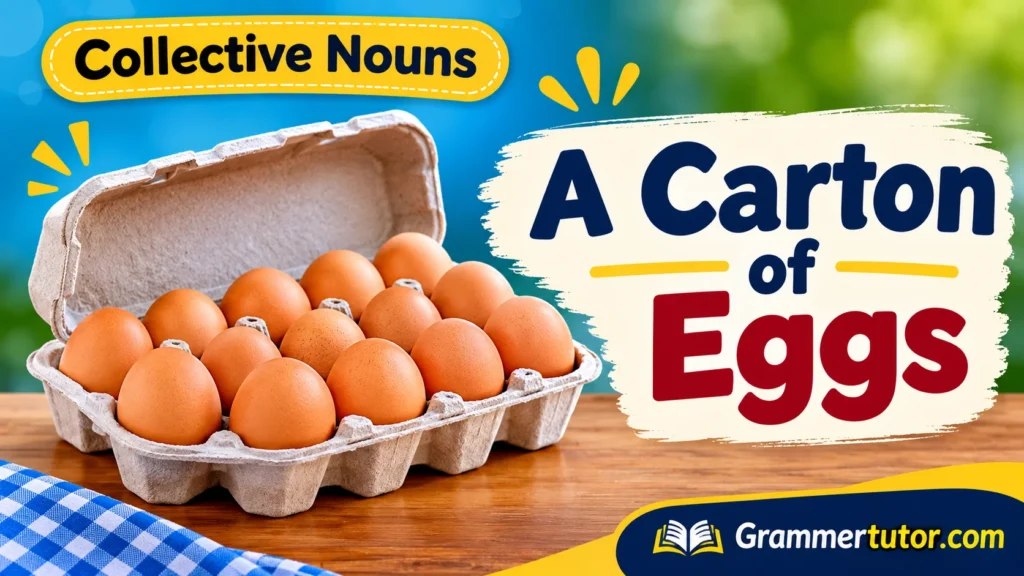
A carton of eggs refers to eggs packed inside a specially designed container. Egg cartons are commonly made from cardboard, molded paper pulp, or plastic. They usually contain individual spaces that protect eggs from hitting one another and breaking during transportation.
This expression is especially common in supermarkets, grocery stores, and households. Cartons are available in different sizes, including packages containing six, twelve, or more eggs.
Examples of “A Carton of Eggs”
- She placed a carton of eggs in the shopping basket.
- A carton of eggs was stored in the refrigerator.
- I bought a fresh carton of eggs this morning.
- He carefully carried a carton of eggs home.
- The supermarket displayed a carton of eggs on the shelf.
- My brother dropped a carton of eggs accidentally.
- A carton of eggs was delivered to our house.
- She checked the carton of eggs before purchasing it.
- We opened a carton of eggs for breakfast.
- The shopkeeper placed a carton of eggs in the bag.
A Tray of Eggs
A tray of eggs describes eggs arranged together in a special tray for storage, handling, or transportation. Egg trays are widely used by poultry farmers, wholesalers, and food suppliers. They often have separate compartments that help prevent eggs from touching and breaking.
Unlike a carton, which is often designed for retail packaging, a tray may hold a larger quantity of eggs. Some commercial trays contain thirty eggs, although sizes can vary.
Examples of “A Tray of Eggs”
- A tray of eggs was placed on the kitchen counter.
- The farmer carried a tray of eggs from the poultry house.
- She bought a tray of eggs from the local market.
- A tray of eggs was ready for transportation.
- The worker carefully arranged eggs in the tray.
- We stored a tray of eggs in the cool room.
- A tray of eggs was delivered to the grocery shop.
- He checked every egg in the tray.
- The children helped their mother carry a tray of eggs.
- The shopkeeper placed a tray of eggs near the counter.
Interesting Facts About Eggs
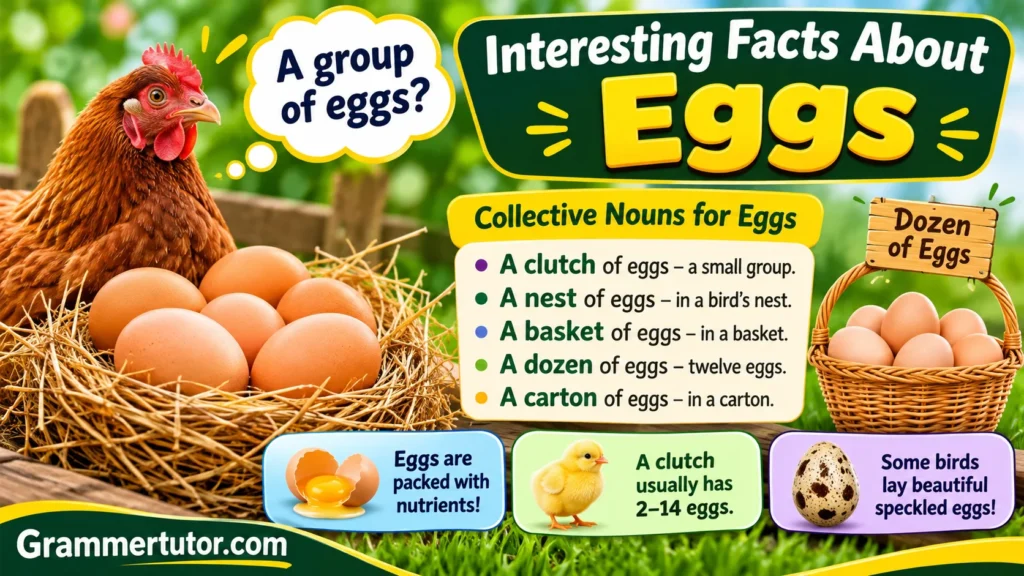
Eggs are among the most widely used natural food products in the world. They are produced by many animals, including birds, reptiles, fish, amphibians, and insects. However, chicken eggs are the most commonly consumed eggs in many countries. Their popularity comes from their availability, versatility, and nutritional value. Depending on the species, eggs can vary considerably in size, shape, colour, and shell texture.
Eggs are also highly nutritious and are commonly included in balanced diets. They provide high-quality protein and important nutrients such as vitamin B12, vitamin D, selenium, and choline. The yolk contains most of the egg’s fat-soluble vitamins, while the white is particularly rich in protein. Eggs can be boiled, fried, scrambled, poached, or used as ingredients in cakes, bread, and many other dishes.
Another fascinating fact is that eggs come in different natural colours. Chicken eggs can have white, brown, blue, greenish, or cream-coloured shells depending on the breed of the hen. Shell colour does not generally determine the nutritional value of an egg. In nature, eggs also have different incubation periods depending on the species. For example, chicken eggs usually take around 21 days to hatch under suitable incubation conditions. This makes eggs important not only as food but also as a fascinating part of animal reproduction and life cycles.
Conclusion
Understanding the different collective nouns for eggs makes English vocabulary more practical and interesting. Expressions such as clutch, batch, dozen, and carton describe eggs in different ways, depending on their quantity, collection, and storage. Learning these terms helps improve everyday communication and makes it easier to use the correct expressions when discussing birds, farming, cooking, and food
FAQs
Q1. What is the most common collective noun for eggs?
A clutch of eggs is a common and recognized collective expression, particularly when referring to eggs laid by birds in a nest. In everyday shopping and conversation, a bunch or a dozen eggs is also commonly used.
Q2. What is a clutch of eggs?
A clutch of eggs refers to the group of eggs laid by a bird during one breeding attempt. The number of eggs depends on the bird species.
Q3. Is a dozen eggs a collective noun?
A dozen eggs is a collective quantity expression that means exactly twelve eggs. It is commonly used in shopping, cooking, and everyday conversations.
Q4. What is the difference between a carton of eggs and a tray of eggs?
A carton of eggs usually refers to eggs packed in a retail container, often holding six or twelve eggs. A tray of eggs generally refers to eggs arranged in a larger storage or transportation container.
Q5. Can we say a batch of eggs?
Yes, a batch of eggs is correct English. It describes eggs collected, processed, or prepared together.