The Collective Noun for Jewels describes how precious ornaments and gemstones are grouped, displayed, or stored together. These expressions help you talk about valuable items clearly and naturally. A group of jewels can have different names depending on its arrangement, appearance, or value.
A collection of jewels refers to different precious items gathered in one place. A trove of jewels usually describes a valuable collection of gemstones, diamonds, or ornaments, often discovered or carefully stored. An assortment of jewels highlights a mixture of different designs, colours, and types. Similarly, a treasure of jewels suggests a group of precious objects that are especially valuable or meaningful.
These expressions are useful in everyday English, jewellery descriptions, and creative writing. For example, you might describe a display of colourful gemstones as an assortment of jewels or a hidden collection of valuable ornaments as a trove of jewels. Learning these terms can enrich your vocabulary and help you describe precious objects with greater accuracy.
Why Are Collective Nouns Used for Jewels?
Jewels often appear together in jewellery boxes, display cabinets, museums, and private collections. Describing every gemstone or ornament separately can make a sentence unnecessarily long. Collective expressions allow you to refer to several precious objects with just a few words.
These expressions also help communicate the character of a group. A trove suggests valuable discoveries, an assortment indicates different varieties, and a collection refers to objects gathered or preserved together.
Unlike collective nouns for animals, there isn’t one universally established traditional collective noun specifically reserved for jewels. Many expressions used for jewellery collections are descriptive phrases rather than fixed grammatical terms. Nevertheless, they are useful in everyday English and creative writing.
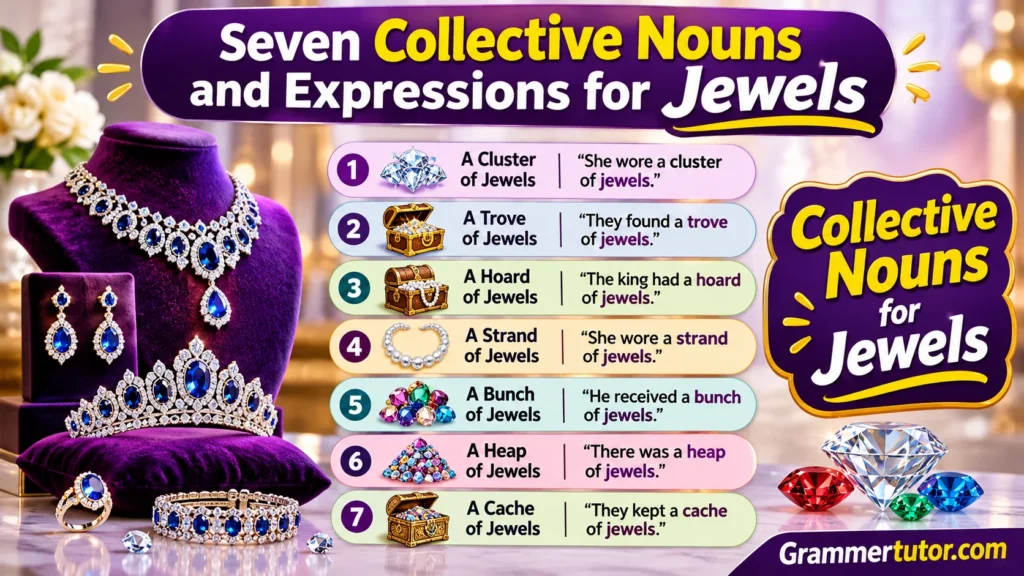
Seven Collective Nouns and Expressions for Jewels
| Type | Simple Example |
| Collection | A collection of jewels filled the display cabinet. |
| Trove | A trove of jewels was discovered underground. |
| Assortment | An assortment of jewels decorated the counter. |
| Treasure | A treasure of jewels remained inside the chest. |
| Hoard | A hoard of jewels was hidden beneath the floor. |
| Array | An array of jewels sparkled under the lights. |
| Set | A set of jewels was presented to the bride. |
Collection of Jewels
A collection of jewels is a straightforward expression for several precious stones or ornaments gathered and kept together. The word collection suggests that the objects have been brought together intentionally, often because of their beauty, rarity, financial worth, or personal importance.
People collect jewels for different reasons. Some enjoy purchasing gemstones as valuable possessions, while others preserve inherited ornaments that have been passed down through generations. Museums and jewellery exhibitions also maintain collections to showcase historical craftsmanship and precious materials.
This expression is particularly suitable for everyday conversations, formal descriptions, and educational writing because its meaning is immediately clear.
Examples of “Collection of Jewels”
- A collection of jewels occupied the glass cabinet.
- The museum displayed a collection of jewels from ancient civilizations.
- Her collection of jewels included diamonds, rubies, and sapphires.
- A collection of jewels was carefully arranged on the velvet cloth.
- The royal family preserved a collection of jewels for generations.
- The exhibition featured a remarkable collection of jewels.
- A collection of jewels attracted visitors from different countries.
- The collector kept a collection of jewels inside a secure vault.
- Every piece in the collection of jewels had a unique design.
- The antique dealer presented a collection of jewels to potential buyers.
Trove of Jewels
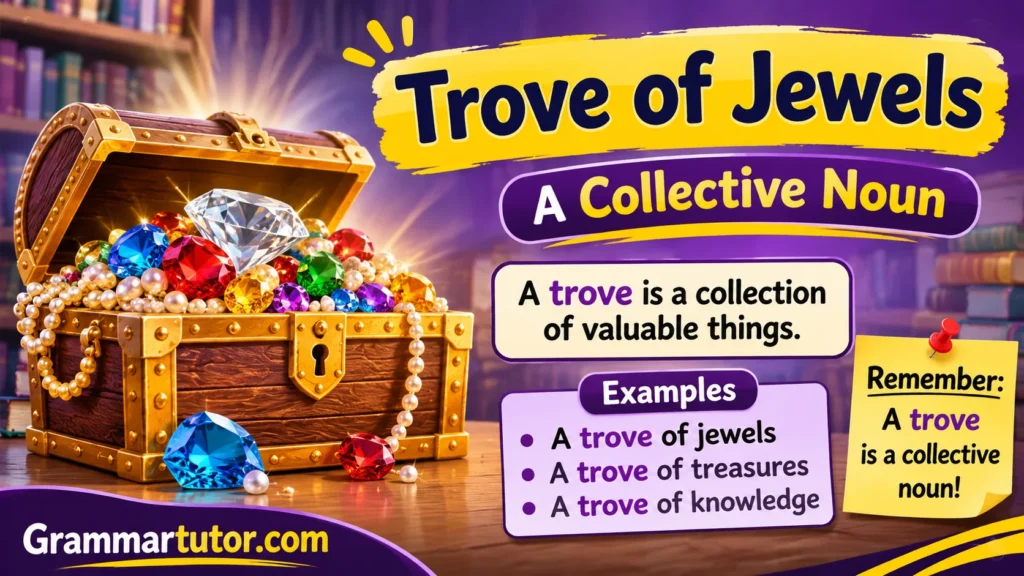
A trove of jewels describes a valuable gathering of precious ornaments or gemstones. The word trove is often associated with hidden wealth, rare discoveries, and objects of considerable importance. It creates an image of precious items found in an unexpected place or preserved for many years.
This expression is especially suitable for stories involving ancient treasures, archaeological discoveries, royal possessions, and forgotten valuables. A trove might contain gold necklaces, sparkling diamonds, engraved rings, colourful sapphires, and other valuable pieces.
Unlike the general word collection, trove places greater emphasis on the richness and importance of the objects being described. It is an excellent choice for descriptive storytelling and historical writing.
Examples of “Trove of Jewels”
- A trove of jewels emerged from the ruins of an ancient palace.
- The explorers uncovered a trove of jewels beneath the stone chamber.
- A trove of jewels remained concealed for several centuries.
- The archaeologists carefully examined a trove of jewels.
- A trove of jewels was discovered inside an abandoned fortress.
- The royal treasury contained a magnificent trove of jewels.
- The expedition uncovered a trove of jewels near the coastline.
- A trove of jewels attracted the attention of historians.
- The ancient chest concealed a trove of jewels.
- The family inherited a trove of jewels from their ancestors.
Assortment of Jewels
An assortment of jewels refers to a selection containing different types, colours, shapes, or sizes of precious ornaments and gemstones. The word assortment highlights variety rather than simply the quantity or monetary value of the objects.
For instance, a jewellery shop might display emerald pendants alongside diamond earrings, ruby bracelets, pearl necklaces, and sapphire rings. Together, these different pieces form an assortment of jewels.
This phrase is useful when describing mixed jewellery displays, retail arrangements, gift selections, and decorative presentations. It allows readers to imagine several contrasting pieces brought together in one place.
Examples of “Assortment of Jewels”
- An assortment of jewels decorated the boutique’s front window.
- The merchant arranged an assortment of jewels on the counter.
- An assortment of jewels included colourful stones and golden ornaments.
- The designer selected an assortment of jewels for the exhibition.
- An assortment of jewels was displayed beneath bright spotlights.
- The jewellery catalogue featured an assortment of jewels.
- She examined an assortment of jewels before choosing a necklace.
- An assortment of jewels arrived in a beautifully decorated package.
- The craftsman used an assortment of jewels in his latest designs.
- Visitors admired an assortment of jewels at the international exhibition.
Treasure of Jewels
A treasure of jewels is an expressive phrase describing precious ornaments regarded as valuable possessions. The word treasure suggests something worth protecting because of its financial value, historical importance, sentimental meaning, or exceptional beauty.
Jewels have often been associated with royal families, wealthy merchants, cultural traditions, and important historical events. Crowns, ceremonial necklaces, gemstone-encrusted accessories, and inherited ornaments can all be considered treasured possessions.
This expression works particularly well in storytelling because it gives the objects a sense of importance and admiration. It can also describe jewellery that has emotional significance rather than merely a high market price.
Examples of “Treasure of Jewels”
- The queen guarded a treasure of jewels inside her private chamber.
- A treasure of jewels was preserved in the royal palace.
- The old manuscript mentioned a treasure of jewels beneath the castle.
- Her grandmother left behind a treasure of jewels.
- The palace exhibition revealed a treasure of jewels from the past.
- A treasure of jewels became the centrepiece of the celebration.
- The historian documented a treasure of jewels belonging to an ancient ruler.
- The family protected its treasure of jewels for generations.
- A treasure of jewels was presented during the royal ceremony.
- The visitors admired a treasure of jewels behind the glass enclosure.
Hoard of Jewels

A hoard of jewels describes a large quantity of precious objects accumulated and stored in one place. The word hoard often suggests that someone has gathered valuable possessions and kept them hidden or protected.
This expression frequently appears in historical accounts, archaeological reports, adventure stories, and descriptions of buried wealth. A hoard might contain ancient coins, gold ornaments, gemstone rings, precious necklaces, and decorative objects.
One interesting feature of this phrase is that it can suggest secrecy. Unlike an assortment displayed openly in a shop, a hoard may remain concealed in a chest, underground chamber, or private storage area.
Examples of “Hoard of Jewels”
- A hoard of jewels was uncovered beneath an ancient building.
- The investigators discovered a hoard of jewels inside a wooden box.
- An enormous hoard of jewels belonged to a wealthy merchant.
- The villagers heard stories about a hidden hoard of jewels.
- The excavation revealed a hoard of jewels from an earlier civilization.
- A hoard of jewels remained buried beneath the old mansion.
- The thieves attempted to steal a hoard of jewels from the vault.
- The museum acquired a hoard of jewels for its historical exhibition.
- A forgotten hoard of jewels was found during construction work.
- The ancient ruler reportedly possessed a hoard of jewels.
Array of Jewels
An array of jewels describes an impressive selection of precious ornaments arranged together for viewing. The word array highlights the attractive presentation of objects, particularly when they are organised in an appealing or eye-catching manner.
Imagine walking into a luxury jewellery showroom where diamond bracelets, emerald pendants, ruby earrings, and golden necklaces are arranged under carefully positioned lights. Such a display can be described as an array of jewels.
This expression is especially appropriate for fashion articles, product descriptions, exhibition reviews, and elegant writing. It creates a visual impression of beauty, variety, and careful arrangement.
Examples of “Array of Jewels”
- An array of jewels glittered beneath the showroom lights.
- The designer presented an array of jewels at the fashion event.
- An array of jewels covered the exhibition table.
- The royal collection featured an impressive array of jewels.
- An array of jewels enhanced the beauty of the ceremonial costume.
- The boutique displayed an array of jewels near its entrance.
- An array of jewels attracted attention during the auction.
- The bride admired an array of jewels before selecting her accessories.
- The exhibition showcased an array of jewels from different periods.
- An array of jewels added elegance to the decorated hall.
Set of Jewels
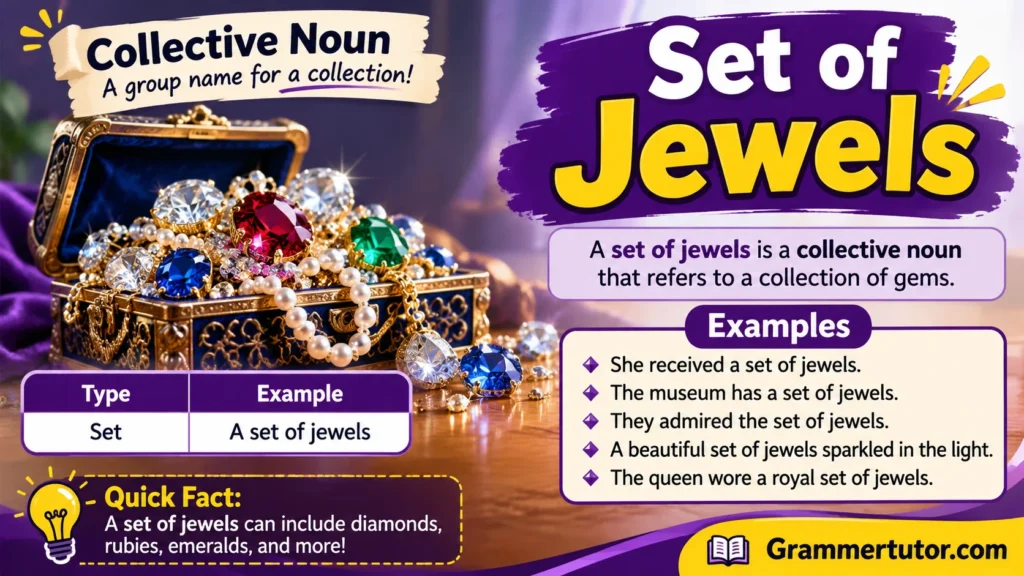
A set of jewels refers to several jewellery pieces designed, selected, or presented to be used together. These pieces often share similar materials, gemstone patterns, colours, or decorative styles.
For example, a matching necklace, pair of earrings, bracelet, and ring may form a coordinated jewellery set. Such combinations are popular for weddings, formal celebrations, cultural ceremonies, and special occasions.
The word set is particularly useful when the individual pieces have been brought together because they complement one another. Unlike a random mixture of ornaments, a jewellery set usually has a common design or purpose.
Examples of “Set of Jewels”
- A set of jewels completed the bride’s wedding outfit.
- The jeweller designed a set of jewels featuring emerald stones.
- A beautiful set of jewels was gifted on her birthday.
- The necklace and earrings belonged to the same set of jewels.
- The royal family displayed a ceremonial set of jewels.
- A set of jewels arrived in an elegant velvet case.
- The designer created a matching set of jewels for the occasion.
- She selected a set of jewels for the evening celebration.
- A handcrafted set of jewels attracted several customers.
- The antique shop displayed a traditional set of jewels.
How to Choose the Right Expression for a Jewellery Collection
Different expressions communicate different ideas, so selecting the appropriate wording can make your sentences more accurate. Consider whether you are describing mixed gemstones, hidden valuables, coordinated ornaments, or an attractive display.
| Expression | Best Context | Meaning |
| Collection | Personal or museum holdings | Objects gathered together |
| Trove | Valuable discoveries | A supply of precious items |
| Assortment | Mixed jewellery pieces | Different varieties together |
| Treasure | Important possessions | Highly valued objects |
| Hoard | Accumulated wealth | Stored valuables |
| Array | Decorative presentation | An impressive display |
| Set | Matching ornaments | Coordinated jewellery pieces |
Remember that these are descriptive expressions rather than seven officially established collective nouns. In ordinary English, collection of jewels is the safest general choice. The remaining expressions are useful when their particular meanings suit the situation.
Fascinating Facts About Jewels
Jewels have fascinated human societies for thousands of years because of their rarity, appearance, durability, and cultural importance. Many gemstones form naturally deep within the Earth under specific geological conditions involving heat, pressure, and mineral-rich fluids. Diamonds, for example, develop under extremely high pressure deep beneath the Earth’s surface, while emeralds form through geological processes that bring together particular minerals. Some gemstones take millions or even billions of years to develop. Unlike living organisms, jewels do not have a biological lifespan. However, many natural gemstones can remain intact for extraordinarily long periods when protected from damage and unsuitable environmental conditions.
The origins and availability of precious stones also make them fascinating. Some gemstones are extracted from underground mines, while others are recovered from river deposits and weathered rock formations. Their geographical origins can influence their appearance, rarity, and market value. For example, certain regions are particularly famous for producing high-quality sapphires, rubies, and emeralds. Jewels are also valued for their craftsmanship, as skilled artisans transform rough stones into polished gemstones and decorative ornaments. Their beauty, combined with careful cutting and setting, makes them important materials in fashion, heritage, and fine jewellery.
Jewels do not consume food or possess dietary habits because they are non-living natural materials. However, their preservation requires appropriate care. Some gemstones can tolerate everyday handling, while others are more vulnerable to scratches, heat, chemicals, or sudden temperature changes. Pearls, for instance, are softer than diamonds and can be damaged by harsh cleaning products. Emeralds may contain natural internal fractures, making them more delicate than some other gemstones. Proper storage, gentle cleaning, and protection from physical impacts help maintain the appearance of valuable jewellery for generations.
Conclusion
Learning the different collective nouns for jewels helps you describe precious objects more clearly and naturally. Expressions such as a collection of jewels, a trove of jewels, an assortment of jewels, and a treasure of jewels each describe a group of valuable items in a slightly different way. Understanding these expressions improves your English vocabulary and makes your jewellery descriptions and everyday writing more interesting.
FAQs
Q1. What is the collective noun for jewels?
There is no single universally accepted traditional collective noun specifically for jewels. A collection of jewels is the most straightforward and widely suitable expression for describing several precious ornaments or gemstones.
Q2. Can I say a trove of jewels?
Yes. A trove of jewels is a correct descriptive expression, particularly when referring to a valuable discovery or a collection of precious objects.
Q3. What does an assortment of jewels mean?
An assortment of jewels means a selection of different gemstones or ornaments gathered together. It usually includes pieces with different colours, shapes, designs, or materials.
Q4. Is treasure of jewels grammatically correct?
Yes. A treasure of jewels is a grammatically understandable descriptive phrase. It highlights the importance, beauty, or financial value of the precious objects.
Q5. What is the difference between a hoard and a collection of jewels?
A collection generally refers to objects gathered intentionally, often for enjoyment, display, or preservation. A hoard suggests a quantity of valuables accumulated and stored, sometimes secretly.