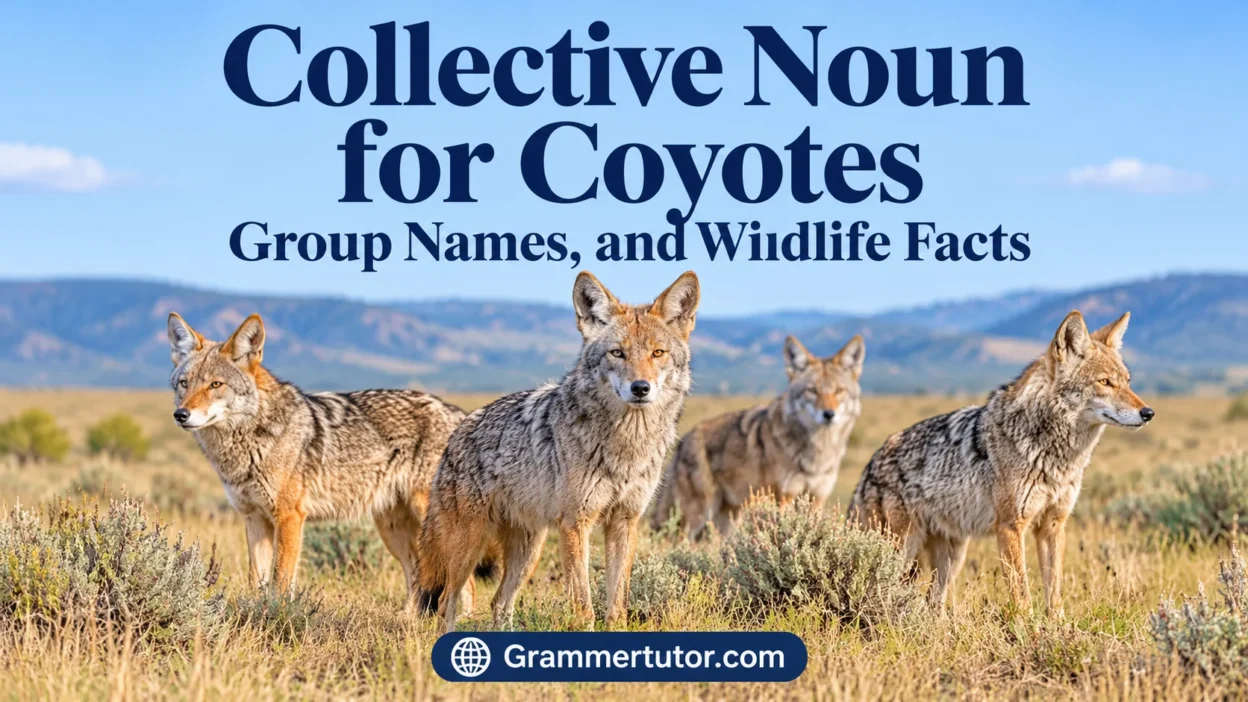
The collective noun for coyotes is commonly a pack, describing several coyotes that live, travel, or hunt together. Coyotes are clever, adaptable wild canines with sharp senses and impressive survival skills. Their distinctive howling calls help them communicate across desert landscapes, grasslands, forests, and suburban neighbourhoods.
Although their social habits can change depending on their surroundings, these animals often form family groups. Other expressions, such as a band of coyotes, a family of coyotes, or simply a group of coyotes, can also describe their gathering. Similar animal-group expressions include a pack of wolves, a herd of deer, and a colony of ants. These examples show how English uses different collective nouns to represent several individuals as one group. Coyotes have a flexible social organisation that allows them to live independently or with other family members.
A typical family may include breeding adults and their offspring, who share responsibilities within their territories. Their social arrangements depend on different activities, including travel, hunting, protecting their young, and learning how to raise their young. They also interact through scent marking, movement, and howling. Understanding these group names, expressions, and animal behaviour connects English vocabulary with the natural behaviour of these fascinating wild animals.
Why Do Coyotes Have Different Group Names?
The way coyotes live influences the expressions used to describe them. Unlike animals that remain in large herds throughout the year, coyotes often adjust their social arrangements according to food supplies, breeding seasons, and territorial conditions.
A breeding pair may occupy an area with their offspring, forming a family unit. In places where food is plentiful, several related coyotes may remain close together. At other times, individual animals travel alone while searching for suitable territory or potential mates.
This flexibility explains why the word pack is particularly useful. It describes coyotes living or travelling together, especially when they cooperate in hunting or protecting their territory. Other expressions, such as family and group, provide additional ways to describe their relationships.
Collective nouns also make wildlife writing easier to understand. Instead of repeatedly mentioning individual animals, you can use one suitable expression to describe their shared presence.
Seven Collective Nouns for Coyotes

| Type | Simple Example |
| Pack | A pack of coyotes crossed the valley. |
| Band | A band of coyotes moved through the grassland. |
| Family | A family of coyotes rested near their den. |
| Group | A group of coyotes searched for food. |
| Pair | A pair of coyotes travelled across the desert. |
| Troop | A troop of coyotes gathered near the woodland. |
| Coalition | A coalition of coyotes defended their territory. |
Pack of Coyotes
A pack of coyotes is the most widely recognised expression for several coyotes living or moving together. The word pack is commonly associated with social carnivores, including wolves and coyotes. It describes animals that maintain relationships and sometimes cooperate during hunting and territorial activities.
Coyote packs often consist of a breeding pair and their offspring. Their organisation can change as young animals mature and eventually leave to establish territories of their own. Unlike some wolf packs, coyote groups are not always large or permanently structured.
Living together can provide advantages, particularly when raising pups, defending a home range, or obtaining food. However, coyotes also demonstrate considerable independence, and many individuals spend time travelling alone.
Examples of “Pack of Coyotes”
- A pack of coyotes crossed the snowy hillside.
- The wildlife photographer spotted a pack of coyotes near the woodland.
- A pack of coyotes gathered around their familiar territory.
- The campers heard a pack of coyotes howling after sunset.
- A pack of coyotes moved quietly through the dry grass.
- The researchers followed a pack of coyotes from a distance.
- A pack of coyotes searched the open landscape for food.
- Several pups remained close to their pack of coyotes.
- A pack of coyotes disappeared behind the rocky ridge.
- The camera captured a pack of coyotes travelling together.
Band of Coyotes
A band of coyotes is a descriptive phrase for several members of this wild canine species travelling or staying in the same area. The word band can refer to a collection of animals that move together, making it suitable for general wildlife descriptions.
Coyotes are highly adaptable creatures, and their social arrangements depend on their surroundings. In areas with sufficient food and suitable shelter, related individuals may remain within the same territory. They communicate through scent markings, body movements, and vocal sounds to maintain awareness of nearby animals.
The expression band offers an alternative to the familiar word pack. However, it is a general descriptive term rather than a universally established scientific name for coyote groups.
Examples of “Band of Coyotes”
- A band of coyotes wandered across the sandy plain.
- The naturalist observed a band of coyotes near the canyon.
- A band of coyotes moved between patches of desert vegetation.
- The distant band of coyotes disappeared into the brush.
- A band of coyotes explored the edge of the forest.
- The villagers noticed a band of coyotes beyond the farmland.
- A band of coyotes travelled along the mountain trail.
- The documentary featured a band of coyotes in their natural habitat.
- A band of coyotes gathered near a water source.
- The researchers monitored a band of coyotes throughout the winter.
Family of Coyotes
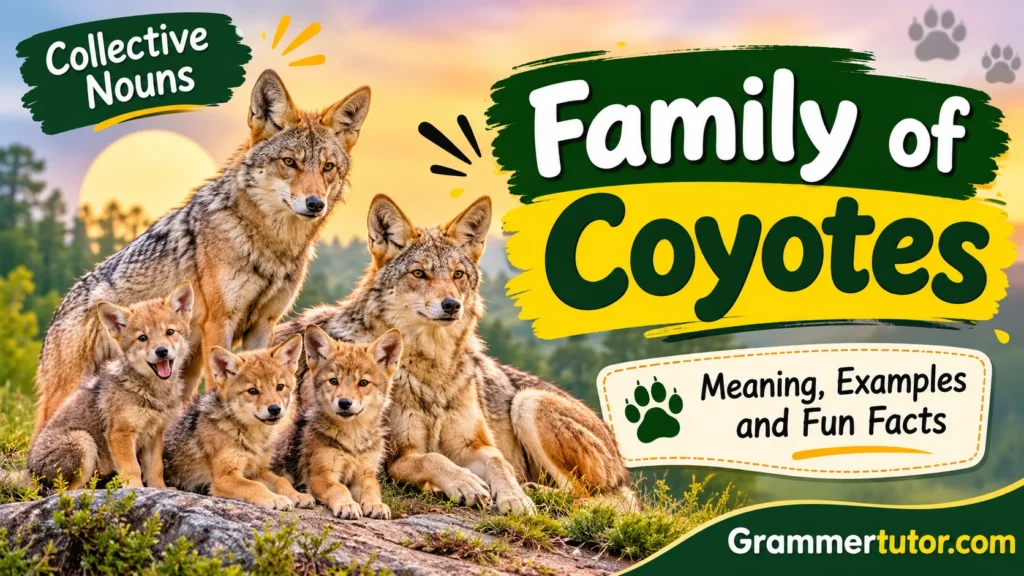
A family of coyotes describes related animals living together, usually consisting of adult parents and their young. This expression is particularly appropriate because coyotes often maintain strong family connections during the breeding and pup-rearing seasons.
A typical coyote family includes a breeding male and female alongside their offspring. Both parents participate in caring for the pups, providing food, protection, and guidance as the young animals develop. Older offspring may sometimes remain in their parents’ territory and help with raising younger pups.
Family relationships play an important role in coyote survival. Young animals gradually learn how to recognise danger, locate food, communicate, and navigate their surroundings by observing adult members.
This expression is more specific than simply saying a group of coyotes because it identifies the relationship between the animals.
Examples of “Family of Coyotes”
- A family of coyotes sheltered inside their underground den.
- The mother watched over her family of coyotes near the hillside.
- A family of coyotes emerged from the bushes at dusk.
- The young pups followed their parents across the meadow.
- A family of coyotes explored the surroundings together.
- The photographer captured a family of coyotes in the wilderness.
- A family of coyotes rested beneath the shaded trees.
- The adult male protected his family of coyotes.
- A family of coyotes searched for food near the grassland.
- The mother guided her family of coyotes towards their shelter.
Group of Coyotes
A group of coyotes is a straightforward expression used whenever several members of the species appear together. Unlike specialised traditional collective nouns, group is a general term that works in almost any situation.
Coyotes may gather around feeding locations, breeding territories, or sheltered areas. Their numbers and relationships can vary according to local conditions. Some groups consist of closely related animals, while others may include individuals temporarily occupying the same area.
This expression is particularly helpful for students and wildlife enthusiasts because it does not require you to know whether the animals belong to the same family or established pack.
It also works naturally in scientific explanations, educational material, and everyday conversations.
Examples of “Group of Coyotes”
- A group of coyotes appeared along the riverbank.
- The conservation team observed a group of coyotes near the reserve.
- A group of coyotes crossed the open prairie.
- Several animals formed a group of coyotes beside the rocky slope.
- A group of coyotes investigated an unfamiliar smell.
- The hikers noticed a group of coyotes in the distance.
- A group of coyotes moved towards the woodland.
- The camera recorded a group of coyotes during the night.
- A group of coyotes gathered around the feeding area.
- The ranger watched a group of coyotes from a safe location.
Pair of Coyotes
A pair of coyotes refers to two animals staying or travelling together. This expression is particularly relevant to coyotes because they often form long-term breeding relationships.
A male and female coyote may establish a shared territory and remain together while raising their offspring. They cooperate in defending their home range, locating food, and caring for young pups.
Coyotes communicate with their partners through scent marking, vocalisations, and body language. Their partnership can remain important throughout the breeding cycle and sometimes for several years.
Although pair describes only two animals rather than a larger gathering, it is a useful group expression when discussing coyote social behaviour.
Examples of “Pair of Coyotes”
- A pair of coyotes travelled across the frozen landscape.
- We spotted a pair of coyotes near the desert shrubs.
- A pair of coyotes rested beside the dry riverbed.
- The male followed his partner across the open field.
- A pair of coyotes investigated the surrounding vegetation.
- The wildlife camera recorded a pair of coyotes after midnight.
- A pair of coyotes approached the edge of the woodland.
- The ranger noticed a pair of coyotes near the den.
- A pair of coyotes moved silently through the snow.
- The photographer watched a pair of coyotes from afar.
Troop of Coyotes
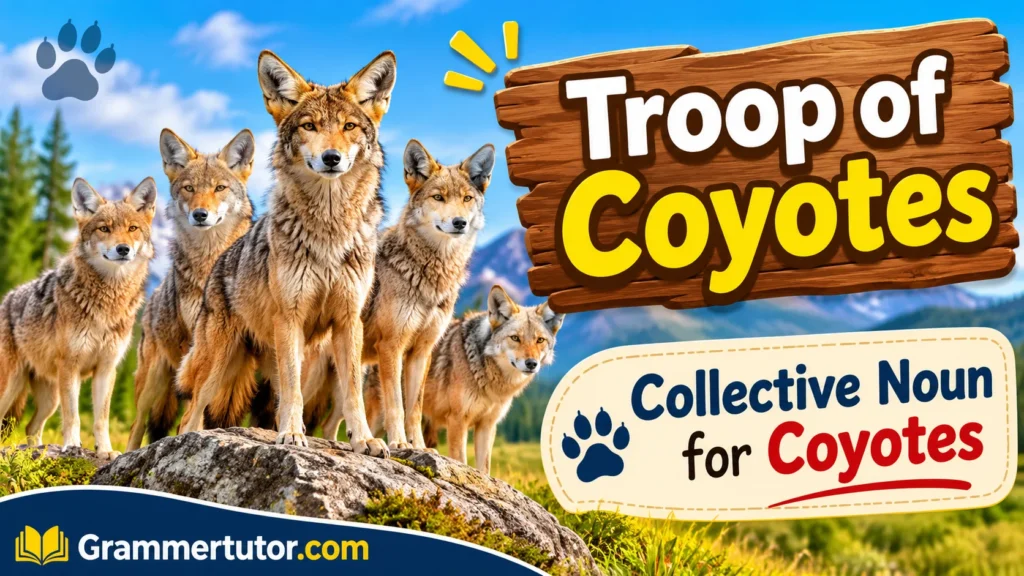
A troop of coyotes is a general descriptive expression that can be used for a gathering of these animals. The word troop is more commonly associated with monkeys and certain other social animals, so it should not be presented as a standard or established coyote collective noun.
Nevertheless, it can appear in creative writing when an author wants to describe several coyotes moving together. For accurate wildlife reporting, pack or group is preferable.
Coyotes are resourceful hunters that can adapt their hunting strategies to different environments. Depending on the availability of prey, they may hunt independently or cooperate with other members of their family group.
Examples of “Troop of Coyotes”
- A troop of coyotes moved across the rugged terrain.
- The storyteller described a troop of coyotes near the canyon.
- A troop of coyotes appeared beyond the distant ridge.
- The animals travelled together across the dry landscape.
- A troop of coyotes explored the edge of the prairie.
- The observer watched a troop of coyotes from a hillside.
- A troop of coyotes crossed the woodland trail.
- The documentary showed a troop of coyotes in the desert.
- A troop of coyotes gathered near the open grassland.
- The troop of coyotes disappeared into the thick vegetation.
Coalition of Coyotes
A coalition of coyotes is a descriptive expression for several animals cooperating or maintaining an association. The word coalition generally refers to individuals working together towards a shared purpose.
In wildlife writing, it can describe coyotes cooperating in a particular situation, but it is not a widely established species-specific collective noun. The ordinary word pack remains more suitable for describing a social coyote family or established group.
Coyotes can display cooperative behaviour when defending their territories, raising young, and obtaining food. Their interactions demonstrate that these animals are capable of adjusting their behaviour according to their surroundings.
This expression is most appropriate in a figurative or descriptive context rather than as a standard biological term.
Examples of “Coalition of Coyotes”
- A coalition of coyotes appeared along the wooded ridge.
- The writer described a coalition of coyotes defending their territory.
- A coalition of coyotes moved across the open landscape.
- The wildlife observer recorded a coalition of coyotes near the valley.
- A coalition of coyotes gathered beyond the rocky hillside.
- The documentary explored the cooperation of a coalition of coyotes.
- A coalition of coyotes travelled through the dry grassland.
- The animals displayed coordinated behaviour in the wilderness.
- A coalition of coyotes explored the surrounding territory.
- The photographer captured a coalition of coyotes in the distance.
Quick Comparison of Coyote Group Names
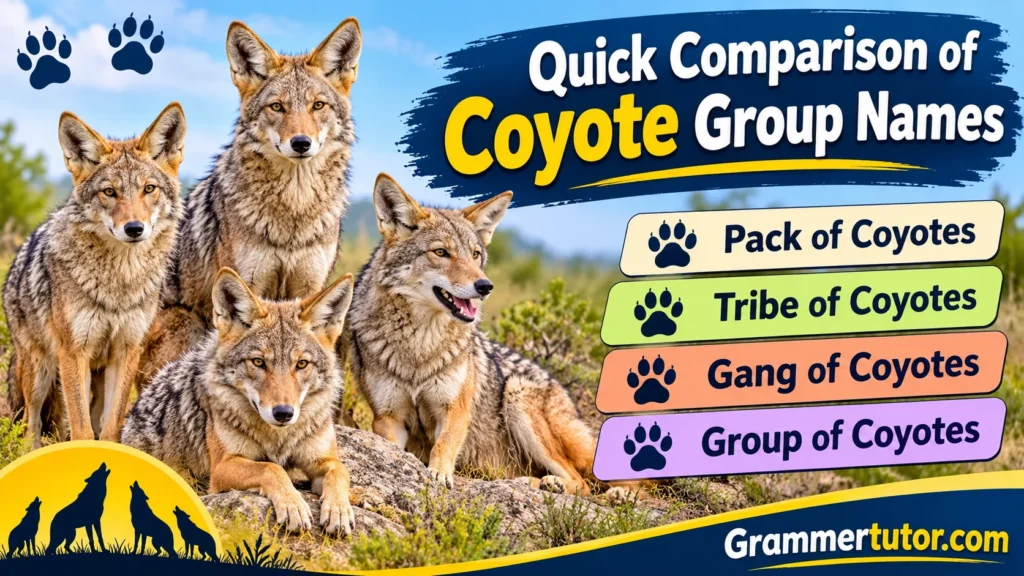
| Collective expression | Best context |
| Pack | Socially connected coyotes |
| Band | Descriptive gathering |
| Family | Parents and offspring |
| Group | Any gathering of several coyotes |
| Pair | Two coyotes together |
| Troop | Creative description |
| Coalition | Cooperative association |
Important language note: Pack is the strongest conventional choice for a coyote group. Family, pair, and group are accurate ordinary descriptions. Band, troop, and coalition are more general or creative expressions, not established species-specific collective nouns.
Coyote Behaviour and Their Everyday Activities
Coyotes have developed a flexible lifestyle that allows them to survive in a wide variety of environments. Their behaviour changes according to their age, surroundings, and access to resources. Some individuals establish territories with a mate, while others travel independently in search of suitable habitats. These differences make coyote social organisation particularly interesting.
Communication is an important part of their daily routine. Coyotes use howling, yipping, barking, and whining to exchange information with nearby animals. Their calls can help family members maintain contact, signal territorial boundaries, or respond to other coyotes. Scent marking also plays a major role in identifying territories and communicating reproductive information.
Food gathering involves several different techniques. Coyotes may quietly approach small mammals, chase insects, search through vegetation, or investigate available food sources. When hunting larger prey, related individuals may cooperate. Their ability to change hunting methods makes them successful in forests, deserts, agricultural regions, and even urban environments.
Raising young is another important activity. During the breeding season, adult coyotes prepare dens and protect their pups from potential threats. The young gradually develop their hunting abilities and learn essential survival behaviours by interacting with their parents. As they mature, some remain temporarily within the family territory, while others disperse to find independent living spaces.
Common Activities Observed in Coyotes
- Adult coyotes establish and defend territories.
- Breeding partners cooperate in raising offspring.
- Young pups learn essential survival skills.
- Family members communicate through distinctive vocalisations.
- Individual animals investigate unfamiliar surroundings.
- Coyotes search for small mammals and insects.
- Some groups cooperate when pursuing larger prey.
- Scent marking helps identify occupied territories.
- Nocturnal activity is common in areas with human disturbance.
- Dispersing juveniles search for suitable habitats.
Interesting Facts About Coyotes
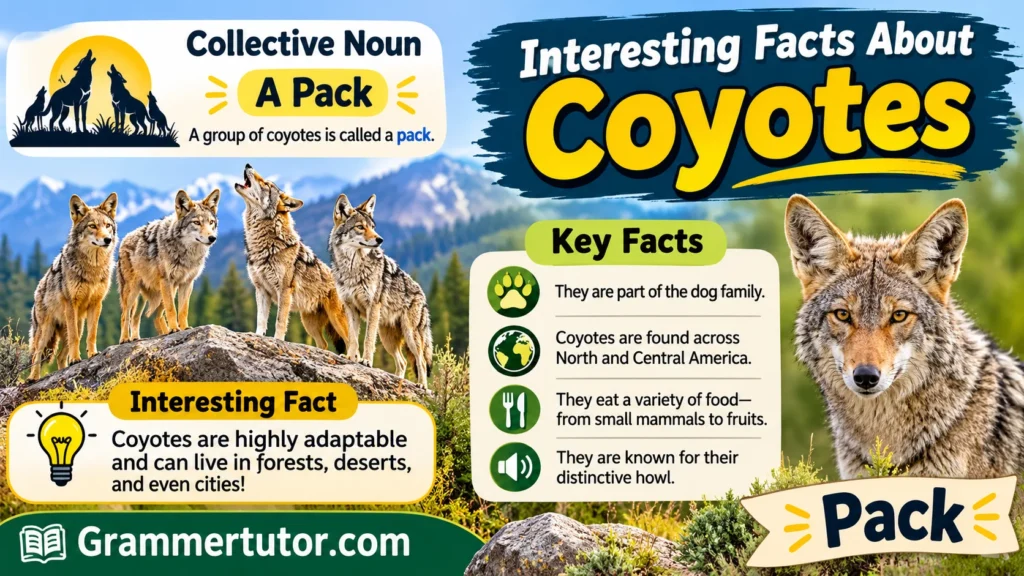
Coyotes, scientifically known as Canis latrans, are members of the Canidae family, which also includes wolves, foxes, and domestic dogs. They are remarkably adaptable animals and can survive in deserts, mountains, grasslands, forests, and suburban environments. Their average lifespan in the wild is often around three to six years, although some individuals live considerably longer. Coyotes have lean bodies, pointed ears, narrow muzzles, and bushy tails that usually hang downward when they move. Their fur can vary from grey and brown to reddish or yellowish shades, depending on their geographical location. These physical characteristics help them blend into different landscapes and move efficiently while searching for food.
One particularly interesting feature is their excellent sensory ability. Coyotes have sharp hearing, a strong sense of smell, and good eyesight, all of which help them locate prey and detect potential dangers. Their long legs allow them to travel considerable distances, while their powerful jaws and sharp teeth help capture and consume food. Coyotes are omnivores, which means their diet includes both animal and plant material. They commonly eat rabbits, mice, voles, squirrels, insects, birds, reptiles, fruits, and berries. They may also consume carrion when other food sources are limited. Their flexible dietary habits allow them to adjust to seasonal changes and survive in locations where food availability varies.
Coyotes are also famous for their vocal communication. Their howls, yelps, barks, and high-pitched calls can create the impression that a much larger group is present. These sounds help family members communicate across distances and announce their presence to neighbouring animals. Another fascinating ability is their adaptability around people. Coyotes can learn to use green spaces, parks, agricultural land, and other developed environments when suitable food and shelter are available. Their reproductive and family behaviour is equally interesting because adult pairs often cooperate in caring for pups. These characteristics make coyotes important members of their ecosystems and fascinating subjects for wildlife research.
Conclusion
The most common collective noun for coyotes is a pack, although band, family, and group are also useful expressions. These terms describe how coyotes live, travel, hunt, and interact with one another. Understanding their group names helps you improve your English vocabulary while learning more about the social habits and natural behaviour of these adaptable wild animals.
FAQs
Q1. What is the collective noun for coyotes?
The most commonly used collective noun for coyotes is pack. The expression a pack of coyotes describes several animals living or travelling together.
Q2. What do you call a group of wild coyotes?
A group of wild coyotes is generally called a pack. You can also use the ordinary expression a group of coyotes when their social relationships are unknown.
Q3. Is a family of coyotes a correct expression?
Yes. A family of coyotes is a correct descriptive expression for related animals, usually including adult parents and their offspring.
Q4. Do coyotes always travel in packs?
No. Coyotes have flexible social arrangements. Some travel in family groups, while others live independently or move around their territories alone.
Q5. What is a pair of coyotes called?
Two coyotes together can simply be described as a pair of coyotes. This expression is especially useful when referring to a breeding male and female.