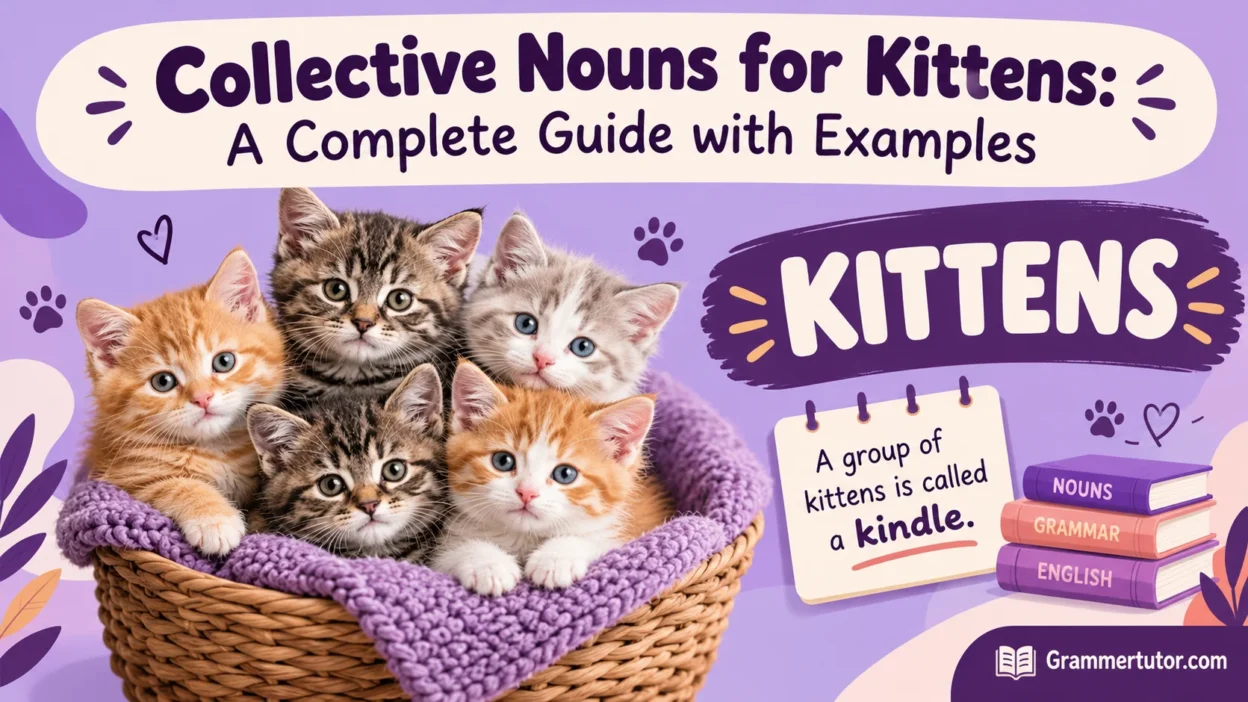
When learning Collective Nouns for Kittens, it helps to know the most familiar terms used for a group of young cats. A litter usually describes several kittens that are siblings and were born to the same mother. This term is common because it clearly connects the kittens with their shared family and early life. In everyday English, saying “a litter of kittens” sounds natural and precise.
Kittens are naturally playful, curious, and highly social, especially when they grow together. Their habit of sleeping, playing, exploring, and staying close to their mother or littermates makes group-related vocabulary useful. When describing these behaviors, specific expressions can make your sentences more lively, natural, and enjoyable. Rather than repeatedly saying “a group of kittens,” you can use a suitable collective term.
Other terms, such as clowder and kindle, can also appear in discussions about groups of cats or kittens. Their meanings and frequency can vary depending on the situation and context. Learning these descriptive terms can make your English more expressive while introducing you to interesting facts about young cats. From an English vocabulary perspective, understanding these differences helps you choose words that fit the context naturally.
Why Collective Nouns Are Used for Kittens
Kittens often spend their early lives in close groups. They sleep together, play with one another, nurse from their mother, and learn important behaviors through interaction. Because several kittens are commonly born in the same birth group, English has a particularly useful term for them: litter.
Different collective expressions can emphasize different aspects of a group. Litter is closely connected with kittens born together, while clowder is a general term for a group of cats. Kindle is another traditional term associated with young cats or kittens.
These words can make descriptions more precise and help readers picture the kittens and their behavior more clearly.
Collective Nouns for Kittens
| Collective Noun | Used For | Simple Example |
| Litter | Kittens born to the same mother | A litter of kittens slept together. |
| Kindle | A group of young kittens | A kindle of kittens played in the room. |
| Clowder | A group of cats or kittens | A clowder of kittens gathered nearby. |
| Group | A general collection of kittens | A group of kittens played outside. |
| Littermates | Kittens from the same litter | The littermates slept beside each other. |
Litter of Kittens
A litter is the most useful and familiar expression when talking about kittens born to the same mother during the same birth. If several newborn kittens belong to the same family group, you can naturally call them a litter of kittens.
This term is especially common when discussing kittens in homes, shelters, veterinary settings, or breeding environments.
Examples of “Litter of Kittens”
- A litter of kittens slept beside their mother.
- We found a litter of kittens in the barn.
- The litter of kittens played together.
- A small litter of kittens was resting in a basket.
- The mother cat cared for her litter of kittens.
- A litter of kittens followed their mother.
- The shelter received a litter of kittens.
- The litter of kittens began exploring the room.
- A healthy litter of kittens was born last week.
- The children watched the litter of kittens playing.
Kindle of Kittens
A kindle is a traditional collective term associated with kittens. It can be used to describe a group of young cats and gives your writing a more distinctive vocabulary choice.
Although litter is generally more familiar in everyday conversation, kindle can be useful when discussing groups of kittens in a descriptive or literary context.
Examples of “Kindle of Kittens”
- A kindle of kittens played beside the basket.
- We watched a kindle of kittens explore the room.
- The kindle of kittens slept near their mother.
- A playful kindle of kittens chased one another.
- The children admired the kindle of kittens.
- A kindle of kittens gathered around the food bowl.
- The kindle of kittens became active in the afternoon.
- A kindle of kittens rested in a warm corner.
- The mother cat watched over her kindle of kittens.
- The kindle of kittens wandered around the garden.
Clowder of Kittens
A clowder is a collective term commonly associated with a group of cats. It can also be used when describing several kittens together, although litter is usually more natural when the kittens are siblings from the same mother.
The word can be useful when you are describing kittens as a general group rather than focusing on their family relationship.
Examples of “Clowder of Kittens”
- A clowder of kittens gathered near the doorway.
- We saw a clowder of kittens in the shelter.
- The clowder of kittens played with a toy.
- A clowder of kittens explored the garden.
- The clowder of kittens rested in the shade.
- A clowder of kittens gathered around the basket.
- The children watched the clowder of kittens.
- The clowder of kittens moved toward the food.
- A playful clowder of kittens filled the room.
- The clowder of kittens stayed close together.
Group of Kittens
A group of kittens is a straightforward expression that can be used in almost any situation. It doesn’t have the specialized character of terms such as litter or kindle, but its meaning is immediately clear.
This expression is useful when the kittens aren’t necessarily related or when you simply want to describe several kittens together.
Examples of “Group of Kittens”
- A group of kittens played in the garden.
- We found a group of kittens near the house.
- The group of kittens followed the mother cat.
- A group of kittens gathered around the bowl.
- The children watched a group of kittens.
- The group of kittens slept in a warm corner.
- A group of kittens explored the room.
- The group of kittens chased a ball.
- A group of kittens rested on the blanket.
- The group of kittens became active after breakfast.
Littermates and Young Cats
Littermates is another useful word when talking about kittens that were born in the same litter. Unlike a collective noun, littermates identify the relationship between the individual kittens.
Kittens that grow up together often interact frequently. They play, wrestle, chase one another, and learn important social behaviors from their mother and siblings.
Using littermates is especially helpful when you want to emphasize that the kittens share the same mother and birth group.
Examples of “Littermates”
- The littermates slept beside each other.
- The kittens played with their littermates.
- The littermates chased one another around the room.
- Two littermates shared the same bed.
- The littermates stayed close to their mother.
- The littermates learned to play together.
- The shelter kept the littermates together.
- The littermates explored their new home.
- The young littermates wrestled playfully.
- The littermates rested after playing.
How Kittens Behave in Groups
Kittens are naturally curious and spend much of their early development learning through interaction with their mother and siblings. They often play, chase, wrestle, climb, and explore together. These activities aren’t simply forms of entertainment; play can help kittens develop coordination and practice behaviors they may use later in life.
Young kittens also spend a considerable amount of time sleeping. A group of kittens may pile together for warmth and comfort, particularly when they are very young. Staying close to their mother provides food, warmth, protection, and an important source of early social learning.
Communication begins early as well. Kittens use meows, purrs, chirps, body movements, and other sounds to interact with their mother and siblings. As they grow, they gradually become more independent and learn how to respond to their surroundings.
Examples of Kitten Behavior
- Kittens often sleep close together.
- Kittens play with their littermates.
- Young kittens explore their surroundings.
- Kittens learn through play.
- A mother cat protects her kittens.
- Kittens communicate with different sounds.
- Kittens often chase one another.
- Young kittens develop coordination through play.
- Kittens may groom one another.
- Littermates can form strong social bonds.
Interesting Facts About Kittens
Kittens are young domestic cats and go through an impressive period of physical and behavioral development during their early months. Their growth is rapid, and they gradually become more coordinated and independent. Cats can live for many years when they receive appropriate nutrition, veterinary care, safe housing, and protection from serious disease. A cat’s lifespan varies according to genetics, health, diet, environment, and quality of care.
One of the most interesting physiological features of kittens is how quickly their senses and motor skills develop. Newborn kittens are highly dependent on their mother, but their abilities develop rapidly as they grow. Their eyes and ears become increasingly functional, and they gradually learn to walk, climb, jump, and coordinate their movements. Their whiskers also provide important sensory information about their surroundings.
Kittens are carnivores, meaning their bodies are adapted to obtain nutrients from animal-based foods. As they grow, they require a nutritionally appropriate diet that supports muscle development, bone growth, and overall health. Young kittens have high nutritional needs because their bodies are developing quickly, so kitten-specific food is commonly used to provide the nutrients they need.
Kittens also have a strong instinct to play. Chasing toys, pouncing, batting objects, and wrestling with littermates can help them practice coordination and hunting-related behaviors. These playful activities can also teach kittens how to control their movements and interact with other cats.
Another fascinating part of kitten development is their relationship with their mother and littermates. Young kittens learn important behaviors through observation and interaction. Their early experiences can influence how confidently they explore their environment and respond to other animals and people.
Examples of Kitten Facts
- Kittens are young domestic cats.
- Kittens develop rapidly during their early months.
- Kittens are carnivores.
- Young kittens require nutrient-rich food.
- Kittens learn through play.
- Littermates often play and sleep together.
- Kittens use whiskers as sensory tools.
- Young kittens gradually develop coordination.
- Mother cats provide food, warmth, and protection.
- Kittens communicate using sounds and body language.
Conclusion
The collective noun for kittens is most commonly litter, especially when several kittens are born to the same mother. Other terms, such as kindle and clowder, may also appear when discussing groups of cats. Understanding these terms can make your English more natural, expressive, and enjoyable when describing young cats.
FAQs
Q1. What is the most common collective noun for kittens?
The most common term is litter, especially for kittens born to the same mother.
Q2. What do you call a group of kittens?
A group of kittens can be called a litter. Other terms, such as kindle, may also be used.
Q3. Is “litter of kittens” correct?
Yes. A litter of kittens is a standard and natural expression.
Q4. What is a kindle of kittens?
Kindle is a collective term that can be used for a group of kittens or young cats.
Q5. Can “clowder” be used for kittens?
Yes. Clowder is a collective term for cats and can sometimes be used when referring to kittens.
Q6. What is the difference between a litter and a clowder?
A litter usually refers to kittens born to the same mother, while clowder generally refers to a group of cats.
Q7. Can kittens from different mothers be called a litter?
Usually, litter refers to kittens from the same mother. For kittens from different mothers, another group term may be more appropriate.
Q8. Why are collective nouns useful for kittens?
They make descriptions shorter, clearer, and more expressive than repeatedly saying “a group of kittens.”
Q9. Are “kindle” and “clowder” commonly used in everyday English?
They are recognized terms, but litter is generally more familiar when specifically talking about young kittens.
Q10. What should I use in formal writing?
Use litter of kittens when you mean kittens born to the same mother. It is clear, natural, and widely understood.