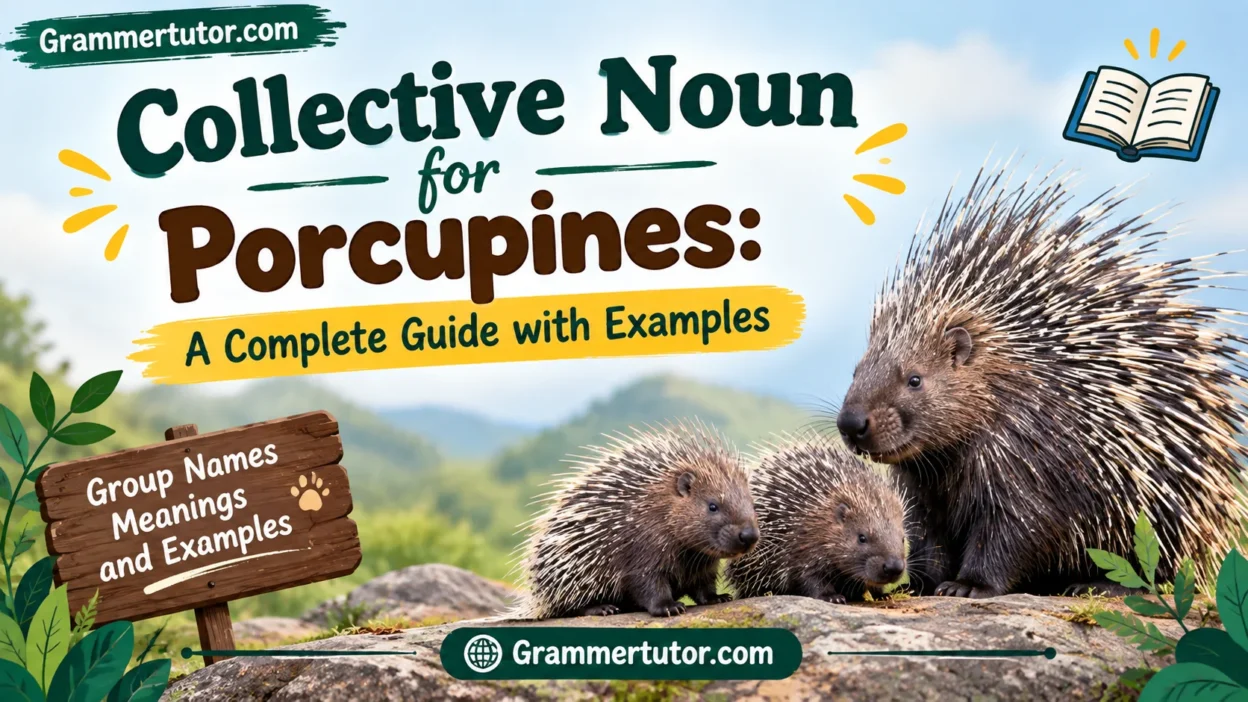
The collective noun for porcupines is prickle of porcupines, a memorable term linked to their sharp quills and spiky appearance. When several porcupines gather in one place, their bodies may seem like a collection of tiny, moving spikes. This unusual collective noun describes an animal group by connecting its group name with its most noticeable feature. The porcupine is an animal that is easy to recognize because of these strong physical features.
Learning this term can improve English vocabulary while introducing readers to these fascinating animals and their interesting habits. Porcupines are known for their defensive quills, slow movements, and strong teeth, which help explain their unique appearance and behavior. The word prickle works as a descriptive term because the animal’s defensive feature is closely connected with quills and spikes. Understanding this connection makes the vocabulary easier to remember and use naturally.
In this guide, the meaning of prickle of porcupines can be understood through example sentences and interesting facts about these animals. Their gathering, movement, and habits provide useful context for understanding how the term is used. When discussing animal groups, knowing the correct collective noun adds useful vocabulary and makes descriptions clearer, especially when explaining where a group is found or how it behaves in a particular place.
Why Collective Nouns Are Used for Porcupines
A collective noun is a special word used to describe a group of people, animals, or things. For example, we say a herd of horses, a flock of birds, and a pride of lions.
Porcupines also have a collective noun that reflects their physical appearance. The term prickle refers to the sharp, pointed quills covering their bodies. Since these quills make porcupines look prickly, the phrase a prickle of porcupines is a natural and memorable expression.
Porcupines usually live alone or in small family groups, depending on the species. They don’t always travel together in large numbers like fish or birds. However, when several porcupines are seen together, you can describe them as a prickle.
This term is especially useful in wildlife writing, nature stories, educational articles, and creative descriptions.
Collective Nouns for Porcupines
The following table explains the most useful group terms connected with porcupines.
|
Collective Noun
|
Used For
|
Simple Example
|
| — | — | — |
|
Prickle
|
A group of porcupines
|
A prickle of porcupines moved through the forest.
|
|
Family
|
Porcupines living together as parents and young
|
A family of porcupines rested near a tree.
|
|
Group
|
A general term for several porcupines
|
A group of porcupines searched for food.
|
|
Colony
|
A larger gathering in a shared area, used descriptively
|
A colony of porcupines lived near the rocky hillside.
|
|
Pair
|
Two porcupines together
|
A pair of porcupines crossed the trail.
|
Among these terms, prickle of porcupines is the most distinctive collective noun. The other words are general or descriptive terms and may be used according to the situation.
Prickle of Porcupines
The phrase prickle of porcupines is the best-known collective noun for a group of porcupines. The word prickle describes something covered with small sharp points or something that causes a prickling feeling.
Porcupines have thousands of modified hairs called quills. These quills help protect them from predators. When porcupines feel threatened, they may raise their quills, making their bodies appear even more prickly.
The term prickle creates a clear picture of several quill-covered animals moving together. It also makes the collective noun easy to remember.
Although porcupines are often solitary, a prickle may include several animals gathered around food, shelter, or a suitable resting place.
Examples of “Prickle of Porcupines”
- A prickle of porcupines wandered through the woodland.
- We saw a prickle of porcupines near the edge of the road.
- A prickle of porcupines searched for fallen fruit.
- The ranger photographed a prickle of porcupines at night.
- A prickle of porcupines rested beneath the trees.
- The children learned about a prickle of porcupines in class.
- A prickle of porcupines moved slowly across the clearing.
- The forest camera recorded a prickle of porcupines.
- A prickle of porcupines gathered near a rocky shelter.
- The guide explained why a group of porcupines is called a prickle.
Family of Porcupines
A family of porcupines refers to parents and their young living or traveling together. This term is not as specialized as prickle, but it is useful when the group includes baby porcupines.
Young porcupines are called porcupine pups. Depending on the species, a mother may raise one or more young. The babies are born with soft or flexible quills that harden soon after birth.
A family group may stay near a den, tree hollow, rocky shelter, or another safe location. The parents help protect the young while they learn how to find food and avoid danger.
Examples of “Family of Porcupines”
- A family of porcupines lived inside a hollow tree.
- We watched a family of porcupines feeding at dusk.
- A family of porcupines stayed close to the rocky den.
- The mother led her family through the grass.
- A family of porcupines searched for roots and bark.
- The wildlife team observed a family of porcupines.
- A family of porcupines rested under a fallen log.
- The young pup followed its family across the forest floor.
- A family of porcupines moved away when people approached.
- The documentary showed a family of porcupines in the wild.
Group of Porcupines
The word group is a simple and correct general term for several porcupines. It does not have the colorful meaning of prickle, but it works in everyday speech and formal writing.
You can use a group of porcupines when you are unsure whether the animals are related, living together, or gathered temporarily. It is also useful when describing scientific observations without using a special collective noun.
For example, a wildlife researcher may write, “A group of porcupines was observed near the river.” This sentence is clear and natural.
Examples of “Group of Porcupines”
- A group of porcupines appeared near the campsite.
- The group of porcupines moved into the bushes.
- We noticed a group of porcupines beside the forest path.
- A group of porcupines looked for food after sunset.
- The scientist studied a group of porcupines.
- A group of porcupines gathered near a water source.
- The group of porcupines disappeared into the dark forest.
- A group of porcupines climbed over the rocks.
- The photographer waited quietly for a group of porcupines.
- A group of porcupines lived in the protected area.
Colony of Porcupines
The term colony of porcupines can be used descriptively for porcupines that occupy the same general area or share nearby shelters. However, it is not as specific or widely recognized as prickle.
Some porcupine species may use the same feeding grounds, dens, or shelter areas. In such cases, a writer may describe the animals as a colony, especially when discussing a population living in one location.
Still, you should use this word carefully. Porcupines are not always highly social animals, and many species spend much of their time alone. Colony is therefore better understood as a contextual term rather than the main collective noun.
Examples of “Colony of Porcupines”
- A colony of porcupines lived near the mountain slope.
- Researchers studied a colony of porcupines in the reserve.
- A colony of porcupines used the same rocky region.
- The colony of porcupines searched for food at night.
- A colony of porcupines was found near the woodland.
- The forest supported a small colony of porcupines.
- A colony of porcupines occupied several nearby shelters.
- The wildlife officer recorded a colony of porcupines.
- A colony of porcupines lived close to a water source.
- The colony of porcupines remained hidden during the day.
Pair of Porcupines
A pair of porcupines means two porcupines together. This term is useful when describing a mother and young porcupine, two adults, or two animals seen traveling near each other.
Porcupines may meet during breeding periods or gather briefly around food and shelter. A pair may also be observed by researchers or wildlife photographers.
The word pair is not unique to porcupines, but it provides a clear description when exactly two animals are present.
Examples of “Pair of Porcupines”
- A pair of porcupines crossed the narrow trail.
- We saw a pair of porcupines beneath a tree.
- A pair of porcupines searched for tender plants.
- The ranger spotted a pair of porcupines at dusk.
- A pair of porcupines moved slowly through the grass.
- The camera captured a pair of porcupines near the den.
- A pair of porcupines rested beside a fallen branch.
- The pair of porcupines disappeared into the undergrowth.
- A pair of porcupines climbed over a small rock.
- The children watched a pair of porcupines from a safe distance.
How Porcupines Behave in Groups
Porcupines do not always live in large, organized groups. Their social behavior depends on the species, season, food supply, and environment.
Many porcupines are mainly solitary. They may spend the day resting in a den, hollow tree, rocky opening, or sheltered place. They often become active during the evening or at night.
However, porcupines may still meet for several reasons:
- Food: Several animals may visit an area with plentiful plants, roots, fruit, or bark.
- Shelter: Porcupines may use the same safe region or nearby dens.
- Breeding: Adults may come together during the mating season.
- Family life: Mothers may stay with their young until the babies become more independent.
- Seasonal movement: Animals may gather in places where food and water are easier to find.
When porcupines feel threatened, they usually rely on their quills rather than running quickly. They may turn their backs toward danger, raise their quills, stamp their feet, or make warning sounds.
A group of porcupines can therefore look peaceful while feeding but may become defensive if a predator or person gets too close.
Interesting Facts About Porcupines
Porcupines are among the most recognizable rodents in the world. Their sharp quills, strong teeth, and unusual habits make them different from many other mammals.
One interesting fact is that porcupines are rodents. They belong to the same broad animal group as mice, rats, squirrels, and beavers. Their front teeth continue growing throughout their lives, so they must chew regularly to keep them from becoming too long.
Porcupines eat a variety of plant materials. Their diet may include bark, leaves, roots, stems, fruits, seeds, grasses, and other vegetation. Some porcupines also chew on branches because their teeth are well suited for gnawing.
Porcupines are generally slow-moving animals, but they have an effective defense system. Their quills are modified hairs made from keratin, the same material found in human fingernails and hair. A porcupine cannot shoot its quills, but the quills can detach easily when a predator makes contact.
Different porcupine species live in different environments. Some live in forests, while others inhabit grasslands, deserts, mountains, or rocky areas. North American porcupines are strong climbers and may spend time in trees searching for food or resting.
Porcupine babies are called pups. They are born with quills that are softer at first and become harder soon after birth. The young remain dependent on their mothers for a period of time while they grow and learn how to survive.
Porcupines also communicate through sounds and body movements. They may grunt, whine, growl, chatter their teeth, or make other noises when they feel uncomfortable or threatened.
READ MORE: Collective Noun for Gorillas: A Complete Guide with Examples
Conclusion
The collective noun for porcupines is a prickle of porcupines. The term connects naturally with their sharp quills and spikes, making it easy to remember. Learning this group name is a simple way to improve English vocabulary while discovering interesting details about this fascinating animal.
FAQs
Q1. What is the collective noun for porcupines?
The collective noun for porcupines is commonly a prickle of porcupines.
Q2. Why are porcupines called a prickle?
The word prickle relates to the porcupine’s sharp quills, which are its most noticeable physical feature.
Q3. What is a group of porcupines called?
A group of porcupines is called a prickle of porcupines.
Q4. What does “prickle of porcupines” mean?
Prickle of porcupines is a collective term used to describe a group of these animals.
Q5. Are porcupines dangerous animals?
Porcupines are generally not aggressive, but their quills provide an effective defensive feature when they feel threatened.
Q6. What are porcupines known for?
Porcupines are especially known for their sharp quills, strong teeth, slow movements, and interesting habits.
Q7. Do porcupines live alone or in groups?
Porcupines are often solitary animals, although several may sometimes be found in the same place when conditions bring them together.
Q8. How can I use “prickle of porcupines” in a sentence?
You can write: “We saw a prickle of porcupines moving through the woodland.”
Q9. What makes the word “prickle” easy to remember?
The term is easy to remember because prickle suggests something sharp or spiky, which matches the porcupine’s quills.
Q10. Is “prickle of porcupines” a common English expression?
It is a recognized collective term for porcupines, although it is not a phrase people commonly use in everyday conversation.