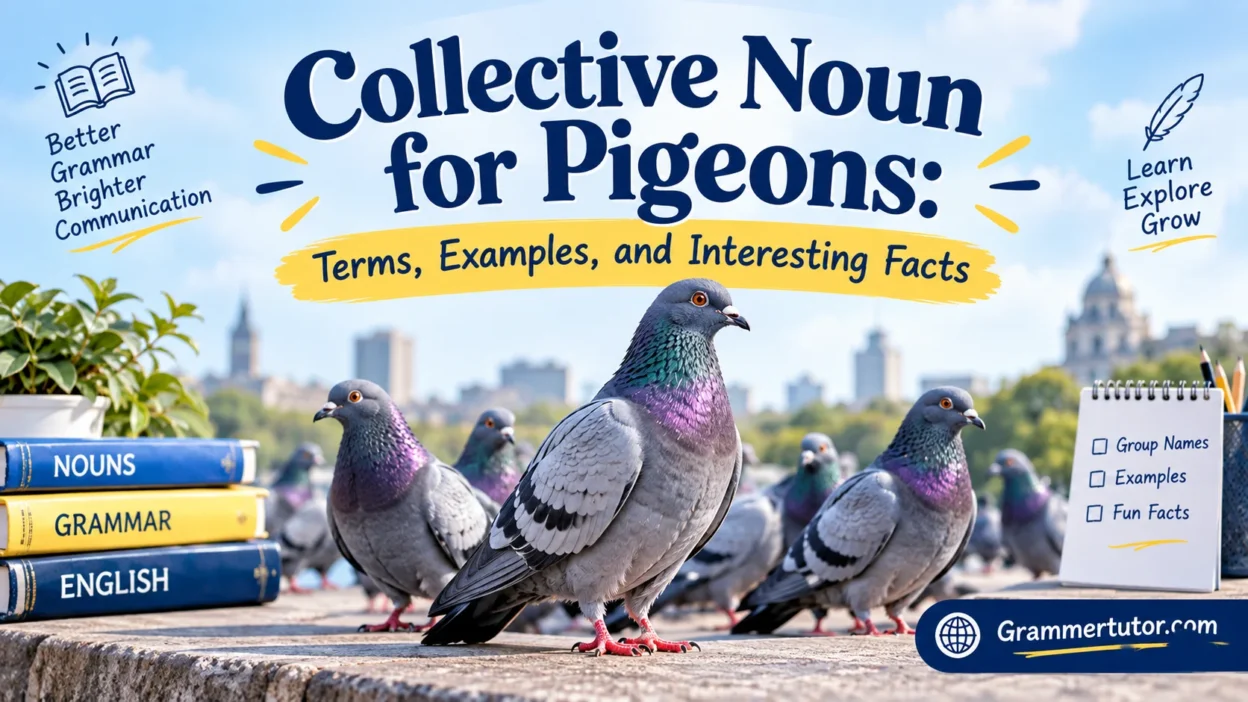
The collective noun for pigeons is usually flock, a familiar and commonly used term in English vocabulary for a group of birds.When pigeons are gathering in parks, city streets, rooftops, or other places, you can use flock to describe several animals as one group.
A collective noun helps you describe people, animals, or objects together. For example, “A flock of pigeons gathered on the rooftop” is a clear and natural sentence. I find that learning these group names makes English sentences more descriptive and easier to understand.The words flight and kit can also appear in traditional or specialized descriptions, depending on the situation and circumstances.
Flight can describe pigeons flying together, while kit may refer to pigeons that are kept and trained. These expressions are useful when you want to give a more specific description. Whether you are writing about birds, studying vocabulary, or describing pigeons in your surroundings, understanding these terms can be helpful.
Why Do We Use Collective Nouns for Pigeons?
Pigeons are commonly observed in groups rather than completely alone. They may gather around food, rest together on buildings, or fly across an open area. A collective noun allows us to describe several pigeons with one simple expression.
The word flock is the easiest and most natural choice when referring to pigeons as a group. For example, a flock of pigeons immediately tells the reader that several pigeons are together.
The word flight can also be found in traditional descriptions of pigeons, particularly when they are moving through the air. Kit is a more specialized term associated with pigeons, especially in contexts involving trained or homing birds.
Using these expressions adds variety to English and helps describe the behavior or situation of pigeons more clearly.
Collective Nouns for Pigeons
| Collective Noun | Used For | Simple Example |
| Flock | A general group of pigeons | A flock of pigeons gathered in the park. |
| Flight | Pigeons flying together | A flight of pigeons crossed the sky. |
| Kit | A group of trained or homing pigeons | A kit of pigeons returned home. |
| Group | A general gathering of pigeons | A group of pigeons sat on the roof. |
Flock of Pigeons
A flock of pigeons is the most common expression for several pigeons gathered together. It can be used whether the birds are feeding, resting, walking, or flying.
This term is suitable for everyday conversations, school writing, wildlife descriptions, and general English. If you are unsure which collective noun to choose, flock is usually the simplest option.
Examples of “Flock of Pigeons”
- A flock of pigeons gathered in the park.
- We watched a flock of pigeons near the fountain.
- A flock of pigeons flew over the buildings.
- The flock of pigeons searched for food.
- A large flock of pigeons rested on the roof.
- The children saw a flock of pigeons in the square.
- A flock of pigeons moved across the pavement.
- The flock of pigeons suddenly flew into the air.
- We noticed a flock of pigeons beside the road.
- A flock of pigeons returned to the building.
Flight of Pigeons
A flight of pigeons is a traditional expression that can describe pigeons moving or flying together. The word flight emphasizes their movement through the air.
Although flock is much more common in everyday English, flight can make a description more vivid when the birds are airborne.
Examples of “Flight of Pigeons”
- A flight of pigeons crossed the morning sky.
- We saw a flight of pigeons above the trees.
- A flight of pigeons rose from the rooftop.
- The flight of pigeons moved toward the city.
- A flight of pigeons passed over the park.
- The photographer captured a flight of pigeons.
- A flight of pigeons disappeared behind the buildings.
- We watched a flight of pigeons flying together.
- A flight of pigeons circled above the square.
- The flight of pigeons landed near the fountain.
Kit of Pigeons
A kit of pigeons is a more specialized collective expression. It is particularly associated with groups of trained, homing, or performing pigeons in pigeon-keeping contexts.
This term is not as familiar as flock, so it is better suited to specific discussions about pigeon keeping and training rather than ordinary conversation.
Examples of “Kit of Pigeons”
- A kit of pigeons returned to the loft.
- The trainer released a kit of pigeons.
- A kit of pigeons flew above the village.
- The keeper watched his kit of pigeons carefully.
- A kit of pigeons circled over the loft.
- The kit of pigeons returned before sunset.
- A skilled trainer prepared a kit of pigeons.
- The kit of pigeons flew together across the field.
- The owner called his kit of pigeons back home.
- A kit of pigeons landed near the pigeon loft.
Group of Pigeons
A group of pigeons is a straightforward expression that can be used whenever several pigeons are together. It is not as distinctive as flock, but it is perfectly clear and easy to understand.
This expression works well when the exact type of gathering is not important.
Examples of “Group of Pigeons”
- A group of pigeons sat on the wall.
- We saw a group of pigeons near the market.
- A group of pigeons gathered around the food.
- The group of pigeons flew away suddenly.
- A group of pigeons rested on the roof.
- She photographed a group of pigeons in the park.
- A group of pigeons walked across the square.
- The group of pigeons gathered near the fountain.
- We watched a group of pigeons from a bench.
- A group of pigeons flew toward the trees.
Pigeon Types and Their Common Characteristics
Pigeons belong to the bird family Columbidae, which also includes doves. There are many different species and varieties, and they can differ in size, color, habitat, and behavior. The familiar city pigeon is often seen around buildings, roads, parks, bridges, and public spaces.
Pigeons have strong wings that allow them to fly efficiently through urban and natural environments. Their bodies are compact, and their short necks and small heads give them a distinctive appearance. Many pigeons have excellent directional abilities and can travel considerable distances.
Different pigeon varieties are also kept by people for various purposes. Some are bred for appearance, while others are associated with homing, racing, or particular flying abilities.
Examples of Pigeon Characteristics
- Pigeons are birds.
- Pigeons belong to the family Columbidae.
- Many pigeons live successfully in cities.
- Pigeons have strong wings.
- Pigeons can fly considerable distances.
- Some pigeons have excellent homing abilities.
- Pigeons can have many different feather colors.
- Some pigeon varieties are kept by people.
- Pigeons often gather where food is available.
- Pigeons can adapt to a variety of environments.
Interesting Facts About Pigeons
Pigeons are surprisingly adaptable birds and have lived alongside humans for a very long time. Their lifespan can vary according to species, living conditions, predators, food availability, and other environmental factors. Domestic and well-cared-for pigeons can sometimes live for many years, while pigeons living in difficult urban conditions may face greater challenges.
One interesting physiological feature of pigeons is their strong and efficient flight system. Their wings are specially shaped for powered flight, allowing them to take off quickly and maneuver through crowded environments. Their lightweight skeleton and powerful flight muscles help them remain airborne and travel between different locations.
Pigeons also have impressive sensory and navigational abilities. Homing pigeons are especially famous for their ability to return to a familiar loft from unfamiliar locations. Scientists have studied several possible mechanisms involved in pigeon navigation, including their sensitivity to environmental cues.
Their dietary habits are quite varied. Pigeons commonly eat seeds, grains, fruits, and other plant material. In urban environments, they may also consume food provided or discarded by people. Their ability to find food in different surroundings contributes to their success in cities.
Pigeons are also highly social birds. They often gather in groups around reliable food sources and suitable resting places. This social behavior is one reason why flock of pigeons is such a useful expression in everyday English.
READ MORE: Collective Noun for Toads: Group Names, Examples, and Facts
Conclusion
The most common collective noun for pigeons is flock. It is simple, familiar, and natural in everyday English. Other terms, such as flight and kit, can be used in particular situations and descriptions. Understanding these terms can help you write clearer and more descriptive sentences when talking about groups of pigeons.
FAQs
Q1. What is the collective noun for pigeons?
The most common collective noun for pigeons is flock. You can say, “A flock of pigeons gathered in the park.”
Q2. What do you call a group of pigeons?
A group of pigeons is commonly called a flock of pigeons. This is the most familiar expression in everyday English.
Q3. Is “flock of pigeons” grammatically correct?
Yes. Flock of pigeons is grammatically correct and widely understood. Flock works as the collective noun, while pigeons identify the birds in the group.
Q4. Can “flight” be used for a group of pigeons?
Yes, flight can be used in descriptions involving pigeons flying together. However, flock is the more familiar general term.
Q5. What does “kit” mean for pigeons?
Kit is a specialized term that can be used for a group of pigeons, particularly in contexts involving pigeons that are kept and trained.
Q6. Which collective noun should I use in everyday English?
For everyday English, flock is the straightforward choice. It is familiar and works naturally when describing pigeons gathered together.
Q7. Can I say “a flock of pigeons flew over the city”?
Yes. “A flock of pigeons flew over the city” is a natural sentence because flock identifies the group and the sentence describes the birds in flight.
Q8. Why are collective nouns useful?
Collective nouns allow you to refer to several similar animals, people, or objects as one group. They make sentences shorter, clearer, and more descriptive.
Q9. Is “flock” only used for pigeons?
No. Flock is also commonly used for groups of other birds and can be used in other contexts. Its exact meaning depends on the noun and context.
Q10. How can I remember the collective noun for pigeons?
A simple way to remember it is to picture many pigeons gathering together in a park or rooftop. Think of the phrase “a flock of pigeons.”