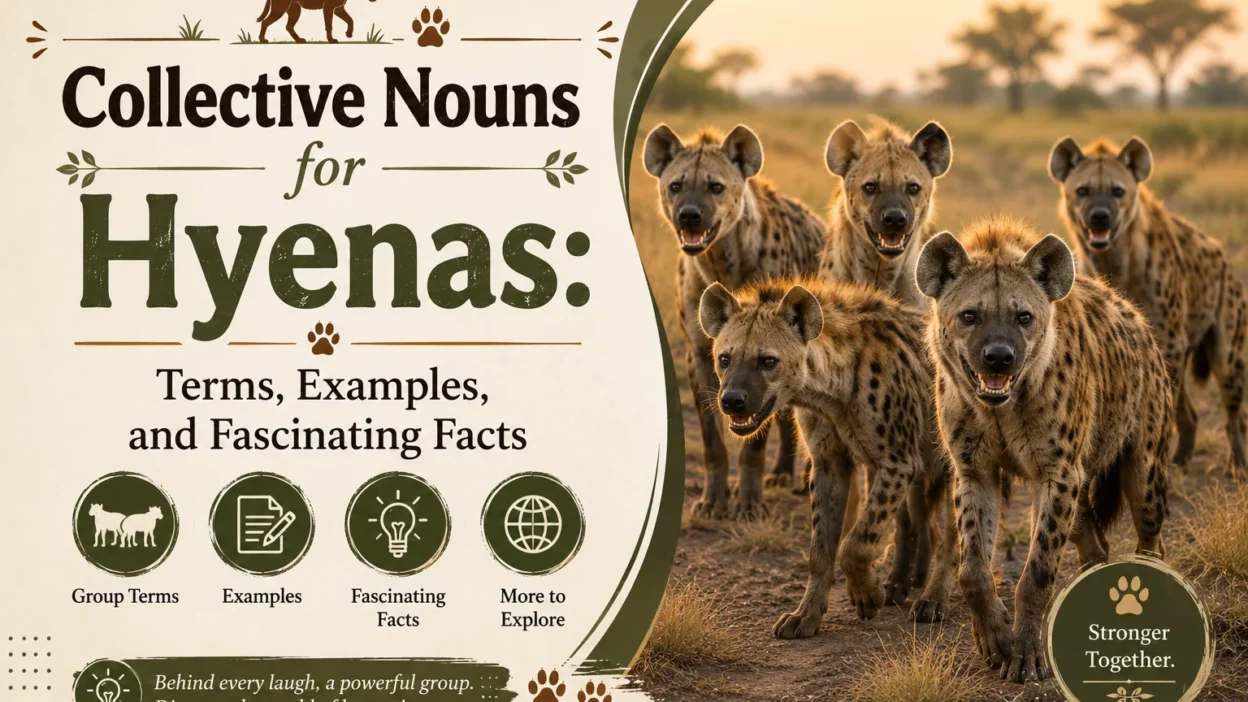
The collective noun for hyenas is a cackle of hyenas, a traditional expression used for a group of these fascinating carnivores. The word cackle connects with their distinctive vocal sounds, making the term easy to remember. When learning English, this expression can help you make your writing more descriptive instead of simply saying “a group of hyenas.” It also gives you a clear expression for talking about several hyenas together.
Hyenas are social predators with complex social systems, and their behavior makes them especially interesting when studying wildlife. Spotted hyenas, in particular, live in large groups known as clans. Within these groups, individuals interact through vocalizations, body language, and established social relationships. Understanding these behaviors can make animal group names more meaningful because the words connect with how the animals actually live and communicate.
If you’re curious about hyenas, learning these terms can make your vocabulary richer while giving you a better understanding of these species. The word clans describes their social groups, while a cackle of hyenas is the colorful collective expression used in English. This distinction is useful when learning English, studying wildlife, or talking about animal behavior, because it combines language knowledge with facts about hyenas and their social lives.
Why Collective Nouns Are Used for Hyenas
Hyenas are social predators, especially spotted hyenas, which live in large and organized clans. They cooperate around food, communicate with one another, care for the young, and maintain complex social relationships.
The most famous collective noun for hyenas is cackle. The word reflects their distinctive vocalizations, including sounds commonly described as cackling or laughing. This makes the term especially memorable.
In wildlife writing, however, clan is also extremely useful when specifically discussing a social group of spotted hyenas. Unlike cackle, which is a colorful collective expression, clan describes the actual social organization of spotted hyenas.
Collective Nouns for Hyenas
| Collective Noun | Used For | Simple Example |
| Cackle | A group of hyenas | A cackle of hyenas gathered near the carcass. |
| Clan | A social group of spotted hyenas | A clan of hyenas moved across the grassland. |
| Pack | A general group of hyenas | A pack of hyenas searched for food. |
| Group | A general group of hyenas | A group of hyenas rested near the den. |
Cackle of Hyenas
A cackle of hyenas is the best-known traditional collective noun for hyenas. The word cackle refers to the distinctive vocal sounds associated with these animals and gives the expression a vivid and memorable quality.
Hyenas produce a variety of vocalizations, including calls that can sound like laughter or cackling to human ears. These sounds play important roles in communication.
Examples of “Cackle of Hyenas”
- A cackle of hyenas gathered near the carcass.
- We heard a cackle of hyenas after sunset.
- A cackle of hyenas moved across the grassland.
- The cackle of hyenas echoed through the valley.
- A cackle of hyenas approached the watering hole.
- Rangers observed a cackle of hyenas from a distance.
- A cackle of hyenas searched for food.
- The cackle of hyenas became louder at night.
- A cackle of hyenas disappeared into the darkness.
- We watched a cackle of hyenas near the den.
Clan of Hyenas
A clan of hyenas is particularly appropriate when referring to spotted hyenas, which live in complex social groups called clans. These groups can contain many individuals and have established social relationships and hierarchies.
The word clan is therefore more than a colorful collective noun. It describes an important part of the social organization of spotted hyenas.
Examples of “Clan of Hyenas”
- A clan of hyenas moved across the savanna.
- The clan of hyenas gathered near the den.
- A large clan of hyenas searched for food.
- Rangers studied the clan of hyenas.
- The clan of hyenas returned to the den.
- A clan of hyenas surrounded the carcass.
- The clan of hyenas communicated with one another.
- Scientists observed the clan from a distance.
- A clan of hyenas rested beneath the trees.
- The clan of hyenas moved through the grassland.
Pack of Hyenas
A pack of hyenas can be used as a general description for a group, but it isn’t the most precise term for spotted hyenas. Clan is more accurate when describing the organized social group of spotted hyenas.
Still, packs can appear in general or informal descriptions of hyenas moving or hunting together.
Examples of “Pack of Hyenas”
- A pack of hyenas moved across the plain.
- We saw a pack of hyenas near the river.
- The pack of hyenas searched for food.
- A pack of hyenas gathered near the carcass.
- The pack of hyenas moved through the grass.
- Rangers watched the pack from a safe distance.
- A pack of hyenas approached the watering hole.
- The pack of hyenas disappeared into the bushes.
- A pack of hyenas rested near the den.
- The pack of hyenas became active after sunset.
Group of Hyenas
A group of hyenas is a simple and general expression. It doesn’t have the distinctive character of cackle or the specific social meaning of clan, but it can be used whenever you want to describe several hyenas together.
This expression is particularly useful when you’re unsure about the social structure or species involved.
Examples of “Group of Hyenas”
- A group of hyenas gathered near the water.
- We spotted a group of hyenas in the grassland.
- The group of hyenas moved toward the den.
- A group of hyenas searched for food.
- The group of hyenas rested beneath the trees.
- Rangers observed a group of hyenas.
- A group of hyenas crossed the open plain.
- The group of hyenas disappeared into the darkness.
- A group of hyenas approached the carcass.
- The group of hyenas moved through the savanna.
Hyena Behavior and Social Life
Hyenas are among Africa’s most interesting carnivores, and their social behavior is particularly remarkable. Spotted hyenas live in clans that can contain many individuals and have complex social hierarchies. Members communicate through vocalizations, scent marking, body posture, and facial expressions.
Spotted hyenas cooperate in several aspects of life. They may gather around food, defend their territory, care for young, and interact with other members of their clan. Their social relationships can be highly complex, and individuals can recognize members of their own group.
Hyenas are also skilled hunters and scavengers. Although they are often described simply as scavengers, spotted hyenas are highly capable predators that can hunt and kill prey themselves. Their powerful jaws and strong teeth allow them to process parts of carcasses that many other predators cannot easily consume.
Examples of Hyena Behavior
- Hyenas can live in complex social groups.
- Spotted hyenas live in clans.
- Hyenas communicate through many vocalizations.
- Hyenas use scent marking.
- Clan members can cooperate around food.
- Hyenas can hunt their own prey.
- Hyenas have powerful jaws.
- Hyenas can consume parts of carcasses left by other predators.
- Young hyenas remain dependent on their mothers.
- Spotted hyenas have complex social hierarchies.
Interesting Facts About Hyenas
Hyenas are mammals belonging to the family Hyaenidae. Despite their dog-like appearance, they are more closely related to cats and other feliform carnivores. There are four living hyena species: the spotted hyena, brown hyena, striped hyena, and aardwolf. Their lifestyles differ considerably, with spotted hyenas being particularly social and living in large clans.
Hyenas have remarkable physiological adaptations. Spotted hyenas have exceptionally powerful jaws and teeth capable of crushing and processing bones. Their digestive systems are also well adapted to consuming parts of carcasses that many other predators leave behind. Their strong forequarters and muscular bodies help them travel long distances and handle difficult prey.
Hyenas are carnivores, although their exact feeding strategies differ between species. Spotted hyenas are skilled hunters as well as scavengers and can consume a wide variety of animal material. Brown and striped hyenas rely more heavily on scavenging, while the aardwolf has a highly specialized diet consisting mainly of termites.
Hyenas are also known for their distinctive vocalizations. The famous “laugh” associated with spotted hyenas isn’t necessarily an expression of happiness. Their vocal sounds can communicate information about excitement, social interactions, submission, or other situations. This distinctive communication helps explain why cackle of hyenas is such a memorable collective expression.
Examples of Hyena Facts
- Hyenas are mammals.
- Hyenas belong to the family Hyaenidae.
- There are four living hyena species.
- Spotted hyenas live in complex clans.
- Hyenas have extremely powerful jaws.
- Hyenas can crush and digest bones.
- Spotted hyenas are skilled hunters.
- Hyenas are carnivores.
- The aardwolf mainly eats termites.
- Hyenas communicate through distinctive vocalizations.
Conclusion
The collective noun for hyenas is a cackle of hyenas, a memorable expression linked to their distinctive sounds and social behavior. Spotted hyenas also live in organized clans, where individuals communicate through vocalizations, body language, and social relationships. Learning these terms can make your English vocabulary richer while helping you understand these fascinating animals.
FAQs
Q1. What is the collective noun for hyenas?
The most commonly known collective noun for hyenas is a cackle of hyenas.
Q2. Why are hyenas called a cackle?
The word cackle refers to the distinctive vocal sounds that hyenas can make, creating a memorable connection between the animal and its group name.
Q3. What is a group of hyenas called?
A group of hyenas can be called a cackle of hyenas. Spotted hyenas also live in social groups known as clans.
Q4. What is a clan of hyenas?
A clan is a large social group of Spotted hyenas that live and interact together.
Q5. Are hyenas social animals?
Yes. Hyenas are highly social predators, particularly Spotted hyenas, which live in complex and organized social groups.
Q6. How do hyenas communicate?
Hyenas communicate through vocalizations, body language, scent signals, and other social behaviors.
Q7. What is the most famous collective noun for hyenas?
A cackle of hyenas is the best-known traditional collective expression for these animals.
Q8. Are all hyenas called a cackle?
A cackle of hyenas is a general English collective expression. However, the clan is especially associated with the social groups of Spotted hyenas.
Q9. Why are collective nouns for animals useful?
Collective nouns make language more descriptive and provide specific ways to talk about groups of animals.
Q10. How can I remember the collective noun for hyenas?
A simple way is to connect cackles with the distinctive sounds associated with hyenas. This makes a cackle of hyenas easier to remember.