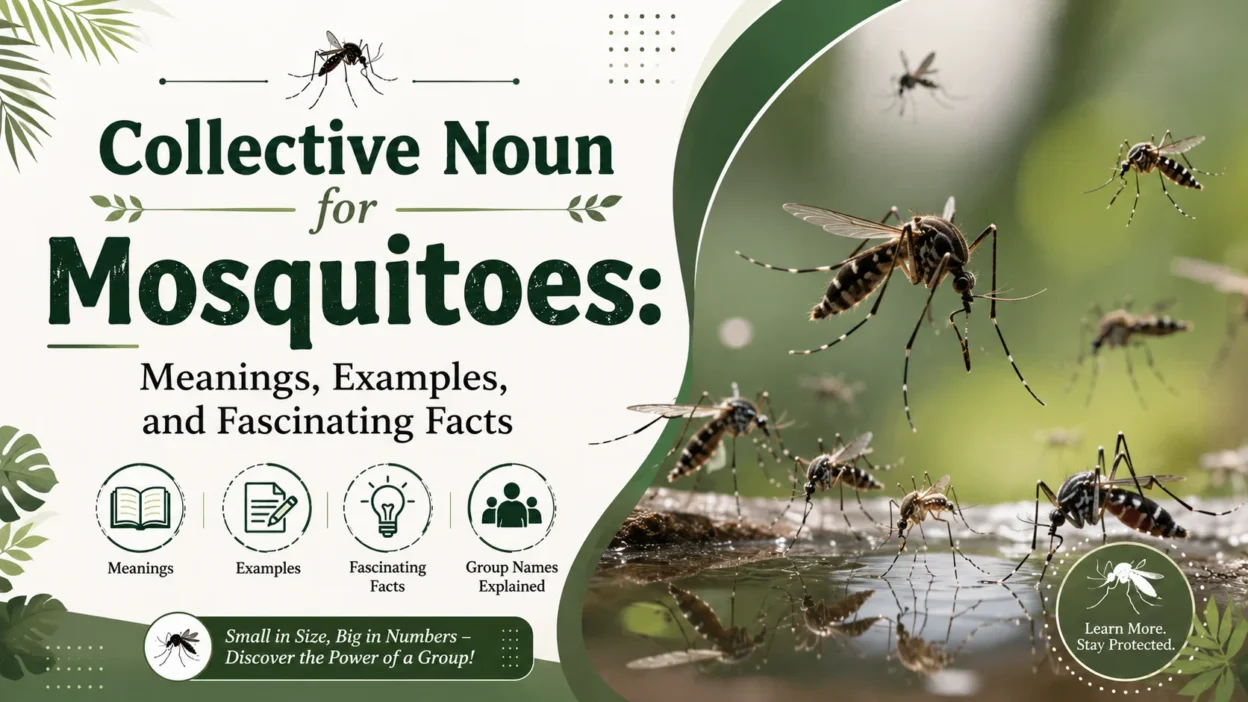
The collective noun for mosquitoes is usually swarm, especially when many mosquitoes are flying and moving together in one group.In everyday English, a swarm of mosquitoes creates a clear picture of tiny insects gathering in one place.
This expression is a useful descriptive term because it helps you understand how these flying insects behave and move. You can also use cloud or group as general terms in particular situations, depending on the description you want to create.
When learning English or studying insects, these animal group names and insect group names can enrich your vocabulary. Mosquito behavior, movement, and feeding habits can guide your choice of the right expression when talking about many mosquitoes. Using descriptive terms makes your writing more engaging and helps you connect language with real-world insects.
Why Collective Nouns Are Used for Mosquitoes
Mosquitoes are small flying insects that can gather in noticeable numbers, particularly around suitable breeding areas, vegetation, water, or food sources. When many mosquitoes fly together, they can appear as a moving cloud or swarm.
Because of this behavior, swarm of mosquitoes is the most useful and familiar expression for a large group. Descriptive terms such as cloud can also create a vivid image of numerous mosquitoes flying together.
These expressions help make language more precise and allow you to describe not only the number of mosquitoes but also how they appear or behave.
Collective Nouns for Mosquitoes
| Collective Noun | Used For | Simple Example |
| Swarm | A large group of mosquitoes flying together | A swarm of mosquitoes surrounded us. |
| Cloud | A large number of mosquitoes appearing together | A cloud of mosquitoes rose from the grass. |
| Group | A general group of mosquitoes | A group of mosquitoes gathered near the water. |
| Swarms | Multiple large groups of mosquitoes | Swarms of mosquitoes appeared near the marsh. |
Swarm of Mosquitoes
A swarm is the most common and natural collective expression for a large number of mosquitoes flying together. Mosquitoes may gather in areas where environmental conditions are suitable, and males may form mating swarms.
The expression a swarm of mosquitoes is especially useful when the insects are present in large numbers and moving through the air.
Examples of “Swarm of Mosquitoes”
- A swarm of mosquitoes surrounded us.
- We noticed a swarm of mosquitoes near the pond.
- The swarm of mosquitoes appeared at dusk.
- A large swarm of mosquitoes flew over the marsh.
- The swarm of mosquitoes moved through the garden.
- A swarm of mosquitoes gathered near the water.
- The campers tried to avoid the swarm of mosquitoes.
- The swarm of mosquitoes disappeared after the wind increased.
- A swarm of mosquitoes hovered above the grass.
- The swarm of mosquitoes became noticeable after sunset.
Cloud of Mosquitoes
A cloud of mosquitoes is a descriptive expression for a large number of mosquitoes appearing together, particularly when they form a visible mass in the air.
The word cloud emphasizes the appearance of the insects rather than their social organization. It can be especially effective in descriptive or natural writing.
Examples of “Cloud of Mosquitoes”
- A cloud of mosquitoes rose from the grass.
- We walked into a cloud of mosquitoes.
- The cloud of mosquitoes hovered above the marsh.
- A cloud of mosquitoes gathered near the pond.
- The cloud of mosquitoes moved with the wind.
- A cloud of mosquitoes surrounded the travelers.
- The cloud of mosquitoes appeared at dusk.
- A cloud of mosquitoes covered the area near the water.
- The hikers noticed a cloud of mosquitoes.
- The cloud of mosquitoes quickly dispersed.
Group of Mosquitoes
A group of mosquitoes is a simple general expression that can be used whenever several mosquitoes are together. It isn’t as vivid as swarm, but it’s easy to understand and works in almost any context.
Examples of “Group of Mosquitoes”
- A group of mosquitoes gathered near the pond.
- We saw a group of mosquitoes around the plants.
- The group of mosquitoes moved through the air.
- A group of mosquitoes appeared after sunset.
- The group of mosquitoes hovered over the water.
- A group of mosquitoes gathered near the garden.
- The group of mosquitoes disappeared into the vegetation.
- A group of mosquitoes flew around the light.
- The group of mosquitoes became active at dusk.
- We tried to avoid the group of mosquitoes.
Swarms of Mosquitoes
Swarms of mosquitoes refers to multiple large groups of mosquitoes. This expression is useful when several separate concentrations of mosquitoes are present in an area.
It can also describe repeated or widespread mosquito activity across wetlands, forests, gardens, or other suitable environments.
Examples of “Swarms of Mosquitoes”
- Swarms of mosquitoes appeared near the marsh.
- We encountered swarms of mosquitoes along the trail.
- Swarms of mosquitoes gathered around the water.
- The researchers observed swarms of mosquitoes.
- Swarms of mosquitoes became active at dusk.
- The workers protected themselves from swarms of mosquitoes.
- Swarms of mosquitoes filled the wetland.
- The wind scattered the swarms of mosquitoes.
- Several swarms of mosquitoes appeared after the rain.
- The swarms of mosquitoes moved toward the vegetation.
Mosquito Behavior and Life Cycle
Mosquitoes are small insects belonging to the order Diptera, which means they are true flies with one functional pair of wings. Their life cycle includes four major stages: egg, larva, pupa, and adult. Mosquito larvae and pupae develop in water, making standing water an important part of their reproductive cycle.
Mosquito behavior varies considerably among species. Male mosquitoes generally feed on plant nectar and other sugary substances, while female mosquitoes of many species require a blood meal to produce eggs. Not every mosquito species feeds on humans, and mosquito feeding preferences vary according to species and host availability.
Mosquitoes can also form mating swarms. In some species, males gather in the air and use visual and acoustic cues to locate females. These gatherings can make a swarm of mosquitoes a particularly appropriate expression when describing their behavior.
Examples of Mosquito Behavior
- Mosquitoes have four major life stages.
- Mosquito eggs are often laid in or near water.
- Mosquito larvae develop in water.
- Male mosquitoes generally feed on plant-based sugars.
- Female mosquitoes of many species take blood meals.
- Some mosquitoes form mating swarms.
- Mosquito activity varies among species.
- Mosquitoes can become active around dusk or dawn.
- Standing water can provide breeding habitat.
- Different mosquito species prefer different environments.
Interesting Facts About Mosquitoes
Mosquitoes are among the most widespread insects on Earth, and thousands of species have been scientifically described. They occupy diverse environments and can be found on every continent except Antarctica. Their small size doesn’t reflect their ecological importance. Mosquitoes form part of food webs and provide food for numerous predators, including fish, birds, bats, amphibians, and other insects.
One of their most interesting physiological features is their specialized mouthparts. Female mosquitoes of blood-feeding species use a slender feeding structure called a proboscis to pierce skin and obtain blood. Their sensory systems are also highly developed. Mosquitoes can detect cues such as carbon dioxide, body heat, odors, and other signals that help them locate potential hosts.
Mosquitoes have a varied diet depending on sex and species. Adult mosquitoes commonly consume nectar and other plant sugars for energy. In many species, females also require blood meals to obtain nutrients needed for egg production. This is why people often associate mosquitoes with biting, although only females of species that require blood meals engage in this behavior.
Their life cycle is closely connected with water. Females lay eggs in suitable aquatic environments, and the larval and pupal stages develop in water before the adult mosquito emerges. Even small amounts of standing water can provide suitable breeding conditions for some species.
Mosquitoes can also be surprisingly specialized. Different species prefer different habitats, hosts, temperatures, and breeding sites. This diversity helps explain why mosquito behavior can vary significantly from one species to another.
Examples of Mosquito Facts
- Mosquitoes are insects.
- Mosquitoes belong to the order Diptera.
- Mosquitoes have four major life stages.
- Eggs, larvae, and pupae are associated with water.
- Male mosquitoes generally feed on plant nectar.
- Females of many species take blood meals.
- Mosquitoes use specialized mouthparts for feeding.
- Mosquitoes can detect carbon dioxide and other host cues.
- Some mosquitoes form mating swarms.
- Mosquitoes are found on every continent except Antarctica.
Conclusion
Knowing the collective noun for mosquitoes makes your English more accurate and descriptive. Swarm is the most common term for many mosquitoes moving or gathering together, while cloud and group can also work in suitable contexts. Learning these expressions can improve your vocabulary, make your writing clearer, and help you describe mosquito behavior and movement naturally.
FAQs
Q1. What is the collective noun for mosquitoes?
The most common collective noun for mosquitoes is swarm. You can say a swarm of mosquitoes when referring to many mosquitoes together.
Q2. What do you call a group of mosquitoes?
A group of mosquitoes is commonly called a swarm of mosquitoes. This expression is widely understood in everyday English.
Q3. Is “swarm of mosquitoes” correct?
Yes, swarm of mosquitoes is a natural and commonly used expression for many mosquitoes flying or gathering together.
Q4. Can “cloud” be used for mosquitoes?
Yes. Cloud can describe a large number of mosquitoes gathered closely together, especially when they appear as a visible mass.
Q5. Can I simply say “group of mosquitoes”?
Yes. Group is a general term and is grammatically correct, although swarm gives a more specific and descriptive image.
Q6. Why is “swarm” used for mosquitoes?
Swarm is used because mosquitoes often move or fly together in large numbers. The word creates a clear picture of their collective movement.
Q7. Is “swarm” a collective noun?
Yes. Swarm is a collective noun because it refers to a collection or group of living creatures considered together.
Q8. What is the difference between “swarm” and “cloud” of mosquitoes?
Swarm emphasizes the group of mosquitoes, particularly their movement, while cloud emphasizes how numerous and closely gathered they appear.
Q9. Are there other collective nouns for mosquitoes?
Yes. Besides swarm, terms such as cloud and group can describe mosquitoes depending on the situation and the type of description you want.
Q10. How can learning mosquito group names improve English?
Learning terms such as swarm of mosquitoes can expand your vocabulary and help you use more descriptive and natural language when writing or speaking.