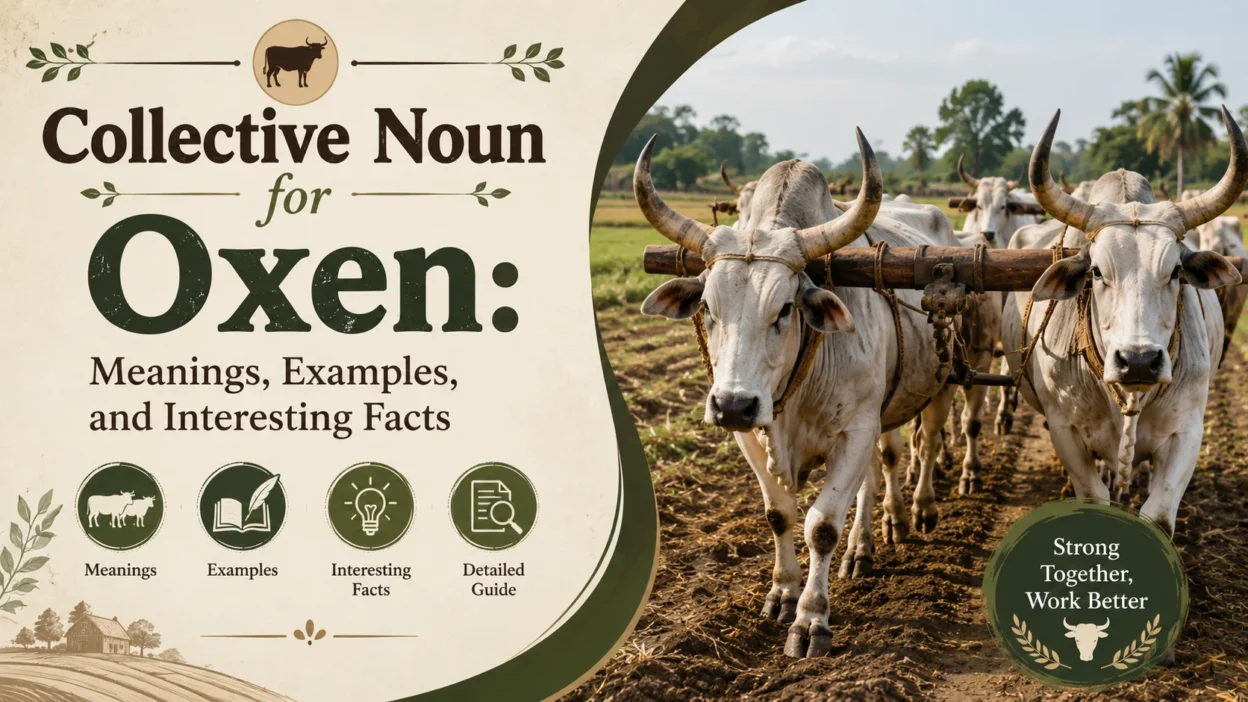
The collective noun for oxen gives you a clear way to describe a group of oxen while learning useful animal group names in English. A team of oxen is the most common expression when several powerful working animals work together. They may pull a plow, cart, or heavy equipment, making the term closely connected with practical work. In everyday English, this expression helps make writing and conversation more descriptive and natural.
Another familiar expression is a yoke of oxen, which usually refers to two oxen that are harnessed together. These traditional expressions show how language can describe animals according to how they work or gather. A yoke of oxen is especially useful when the context involves a pair working side by side, while a team of oxen can describe a larger working group.
These collective nouns also reflect the important role oxen have played in farming and transportation. If you’re learning English or studying agriculture, understanding these expressions can enrich your vocabulary and help you choose the right expression when discussing several oxen. In my experience, connecting each term with a real farming situation makes these animal group names easier to remember and use correctly.
Why Collective Nouns Are Used for Oxen
Oxen are domesticated cattle that have traditionally been trained to perform draft work. They can pull heavy loads, plows, carts, and other agricultural equipment. Because they often work together, English has developed specific expressions for describing them.
The term team emphasizes a group of oxen working together, while yoke traditionally refers to two oxen harnessed together with a wooden device called a yoke. These expressions therefore describe not only the animals but also the way they are organized and used.
Collective Nouns for Oxen
| Collective Noun | Used For | Simple Example |
| Team | Oxen working together | A team of oxen pulled the plow. |
| Yoke | Two oxen harnessed together | A yoke of oxen pulled the cart. |
| Herd | A general group of cattle or oxen | A herd of oxen grazed in the field. |
| Pair | Two oxen together | A pair of oxen worked in the field. |
| Group | A general group of oxen | A group of oxen rested near the barn. |
Team of Oxen
A team of oxen is one of the most useful collective expressions for oxen. It describes oxen that work together, particularly when pulling a plow, cart, wagon, or other heavy equipment.
Oxen are often trained to respond to commands and work cooperatively, making team an especially appropriate word when discussing their role in agriculture.
Examples of “Team of Oxen”
- A team of oxen pulled the heavy plow.
- The farmer guided a team of oxen across the field.
- A team of oxen worked together all morning.
- The team of oxen pulled the wooden cart.
- A strong team of oxen prepared the field.
- The farmer trained a team of oxen.
- A team of oxen moved slowly along the road.
- The team of oxen stopped near the barn.
- A team of oxen pulled the wagon uphill.
- The workers used a team of oxen to transport supplies.
Yoke of Oxen
A yoke of oxen traditionally refers to two oxen harnessed together with a yoke. A yoke is a wooden or other sturdy device designed to connect working animals so they can pull a load together.
This is one of the most recognizable expressions associated with oxen and their traditional use in farming.
Examples of “Yoke of Oxen”
- A yoke of oxen pulled the plow.
- The farmer guided a yoke of oxen through the field.
- A yoke of oxen pulled the wooden cart.
- The yoke of oxen worked steadily.
- A farmer trained a yoke of oxen for farm work.
- The yoke of oxen moved toward the barn.
- A yoke of oxen helped prepare the farmland.
- The farmer rested the yoke of oxen after a long day.
- A yoke of oxen pulled the heavy load.
- The yoke of oxen worked together in the field.
Herd of Oxen
A herd of oxen is a general expression for a group of oxen. Since oxen are cattle, a herd can describe them when they are gathered or living together rather than specifically working as a team.
However, when you’re focusing on oxen performing draft work, team of oxen or yoke of oxen is usually more specific.
Examples of “Herd of Oxen”
- A herd of oxen grazed in the field.
- We saw a herd of oxen near the farm.
- The herd of oxen moved toward the water.
- A large herd of oxen rested near the trees.
- The farmer watched the herd of oxen.
- The herd of oxen crossed the pasture.
- A herd of oxen gathered near the barn.
- The herd of oxen walked across the field.
- The farmer cared for the herd of oxen.
- A herd of oxen moved slowly through the grassland.
Pair of Oxen
A pair of oxen is a simple and accurate expression for two oxen working or staying together. It is particularly useful when you want to emphasize the number rather than use a traditional collective noun.
A pair of oxen is often associated with a yoke, because traditional farming commonly used two oxen harnessed together.
Examples of “Pair of Oxen”
- A pair of oxen pulled the cart.
- The farmer used a pair of oxen to plow the field.
- A pair of oxen stood near the barn.
- The pair of oxen worked together.
- A pair of oxen pulled the heavy wagon.
- The farmer trained a pair of oxen.
- A pair of oxen walked across the field.
- The pair of oxen rested after working.
- A pair of oxen moved toward the farm.
- The farmer guided a pair of oxen along the road.
Group of Oxen
A group of oxen is a general expression that can be used whenever several oxen are together. It doesn’t specify whether the animals are working, grazing, or simply gathered in one place.
Although team and yoke are more specific in working contexts, group is simple and easy to understand.
Examples of “Group of Oxen”
- A group of oxen rested near the barn.
- We saw a group of oxen in the field.
- The group of oxen moved toward the river.
- A group of oxen grazed peacefully.
- The farmer watched the group of oxen.
- A group of oxen crossed the pasture.
- The group of oxen gathered near the trees.
- A group of oxen stood beside the farm.
- The farmer fed a group of oxen.
- The group of oxen returned to the shelter.
Oxen Behavior and Working Life
Oxen are domesticated cattle trained for work, particularly pulling heavy loads. Historically, farmers relied on oxen for plowing fields, transporting crops, moving timber, and performing other tasks that required strength and endurance.
Oxen are known for their steady strength and patience. They generally don’t move as quickly as horses, but they can pull heavy loads efficiently and work for long periods when properly trained and cared for.
Working oxen must learn to respond to commands from their handlers. When two oxen work together, coordination is important. This is why expressions such as team of oxen and yoke of oxen are closely connected with their traditional agricultural role.
Examples of Oxen Behavior
- Oxen can pull heavy loads.
- Oxen have traditionally been used for plowing.
- A team of oxen can work together.
- Oxen can be trained to respond to commands.
- Oxen are known for their strength.
- Oxen can work for extended periods with proper care.
- A yoke connects two working oxen.
- Oxen have played an important role in agriculture.
- Oxen can transport heavy equipment.
- Farmers traditionally used oxen for draft work.
Interesting Facts About Oxen
Oxen are cattle trained for draft work, rather than a separate species of animal. Almost any cattle breed can potentially be trained as an ox, although some breeds are better suited to heavy work because of their size, strength, temperament, and physical build. Traditionally, oxen have been important agricultural animals in many parts of the world.
One of their most important physiological features is their powerful muscular body. Oxen have strong shoulders, sturdy legs, and cloven hooves that support their considerable body weight. Their physical strength allows them to pull heavy loads and agricultural equipment. Their digestive system is also adapted to their herbivorous diet.
Oxen are ruminants, meaning they have a specialized digestive system that allows them to process fibrous plant material. They have a four-compartment stomach consisting of the rumen, reticulum, omasum, and abomasum. This system helps them digest grasses and other vegetation that many animals cannot efficiently process.
Their diet mainly consists of grass, hay, forage, and other plant materials. When working animals have higher energy requirements, farmers may provide additional feed to support their health and workload.
Oxen have also played a major role in human history. Before modern machinery became widespread, farmers depended on working cattle for plowing, transportation, and heavy agricultural tasks. Their strength and endurance made them valuable partners in farming communities.
Examples of Ox Facts
- Oxen are trained cattle.
- Oxen are commonly used for draft work.
- Oxen have powerful muscles and sturdy bodies.
- Oxen are herbivores.
- Oxen are ruminants.
- Their stomach has four compartments.
- Oxen eat grass, hay, and other forage.
- Oxen can pull heavy loads.
- Two working oxen can be called a yoke of oxen.
- A group working together can be called a team of oxen.
Conclusion
Understanding the collective noun for oxen makes it easier to describe groups of these powerful working animals clearly and naturally. Expressions such as team of oxen and yoke of oxen connect English vocabulary with the traditional roles oxen have played in farming, transportation, and other forms of work. Learning these terms can also make your writing and conversation more descriptive while helping you choose the right expression for different situations.
FAQs
Q1. What is the collective noun for oxen?
The most common collective noun for oxen is team of oxen, especially when the animals work together.
Q2. What is a group of oxen called?
A group of oxen can be called a team of oxen. The term is particularly suitable when the oxen work together.
Q3. What is a yoke of oxen?
A yoke of oxen usually refers to two oxen harnessed together to perform work such as pulling a plow or cart.
Q4. Is “team of oxen” correct?
Yes. Team of oxen is a traditional and widely understood expression for oxen working together.
Q5. Is “yoke of oxen” the same as “team of oxen”?
Not exactly. A yoke of oxen generally refers to a pair of oxen harnessed together, while a team of oxen focuses more broadly on oxen working together.
Q6. Why are oxen called working animals?
Oxen have traditionally been trained to perform tasks such as pulling plows, carts, and other heavy loads.
Q7. Can “team” refer to several oxen?
Yes. The team can describe several oxen working together, particularly in agricultural or transportation contexts.
Q8. Why are collective nouns useful for oxen?
Collective nouns make descriptions shorter, clearer, and more specific when talking about animals as a group.
Q9. Where are oxen commonly associated with traditional work?
Oxen have historically been associated with farming and transportation, where their strength made them useful for pulling heavy equipment.
Q10. How can I remember the collective nouns for oxen?
A simple way is to connect a team of oxen with animals working together and a yoke of oxen with two oxen harnessed together.