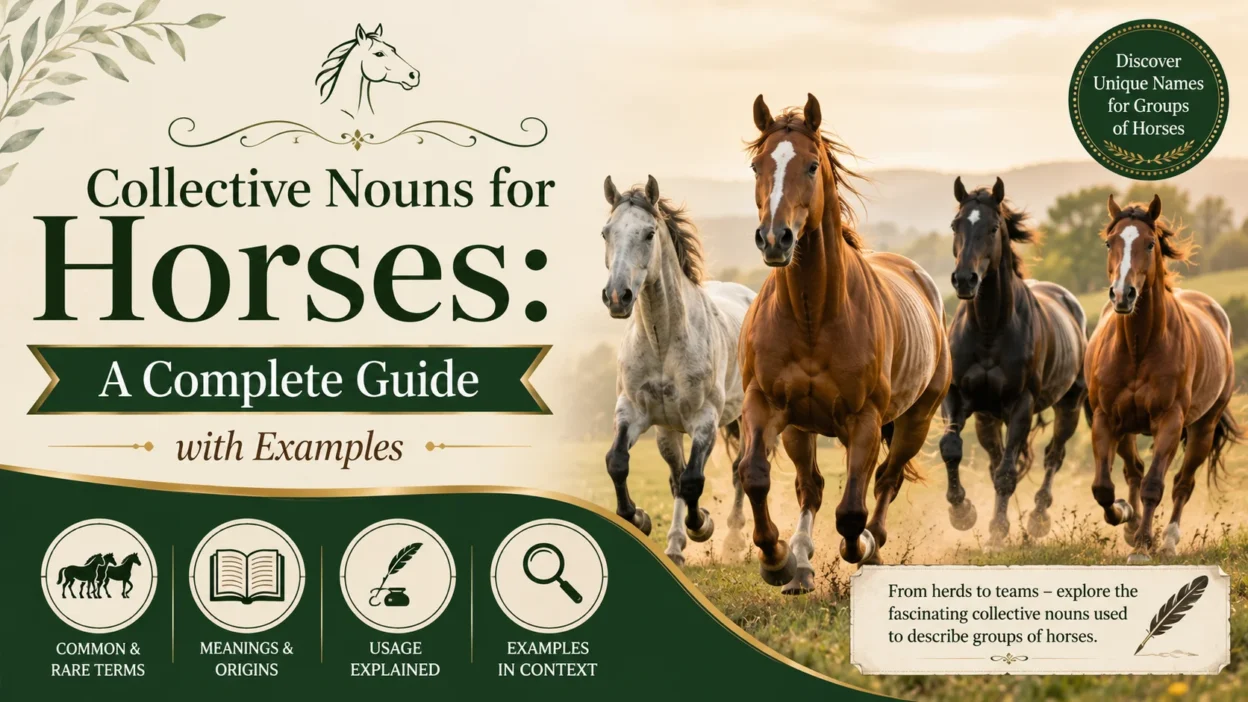
The collective noun for horses helps you describe a group of these large, social mammals in clear, everyday English. The most common expression is herd, which refers to horses that live, move, or gather together. Learning this term can make your writing and conversation more descriptive and engaging, especially when you’re learning English or studying animals.
English has several special terms for describing horses in different contexts. A team can describe horses that work together, while a band may refer to horses living together in a social group. The word stud has a more specific meaning and can relate to a group of male horses kept for breeding. These collective nouns connect language with horse behavior and social life, making animal writing richer.
Whether you’re curious about unique collective nouns or want to improve your vocabulary, knowing the right expression can help you describe horses naturally. Instead of simply saying “a group of horses,” choosing the appropriate term lets you explain how horses live, move, work, or gather. This makes descriptions clearer while showing how language reflects the behavior of these animals.
Why Collective Nouns Are Used for Horses
Horses are highly social animals. They often live in groups, graze together, move together, and communicate through sounds and body language. Because of these social behaviors, English commonly uses herd to describe a group of horses.
Different terms can also describe horses in particular situations. Team is commonly associated with horses working together, while band can describe horses living or moving together. Stud has a more specific connection with horse breeding.
These expressions give readers a clearer picture of what the horses are doing rather than simply saying a group of horses.
Collective Nouns for Horses
| Collective Noun | Used For | Simple Example |
| Herd | A group of horses living or moving together | A herd of horses grazed in the field. |
| Team | Horses working together | A team of horses pulled the wagon. |
| Band | Horses living or moving together | A band of horses crossed the plain. |
| Stud | Horses associated with breeding | A stud of horses was kept for breeding. |
| Group | A general group of horses | A group of horses stood near the fence. |
Herd of Horses
A herd is the most common and widely understood collective noun for horses. Horses naturally form social groups where they can graze, rest, move, and interact with one another.
A herd may contain horses of different ages and sexes, depending on the environment and social structure. The word herd is the best general choice when you simply want to describe several horses together.
Examples of “Herd of Horses”
- A herd of horses rested in the meadow.
- We saw a herd of horses near the river.
- The herd of horses grazed in the pasture.
- A large herd of horses crossed the field.
- The herd of horses moved toward the water.
- A herd of horses gathered near the fence.
- The farmer watched a herd of horses.
- The herd of horses returned to the stable.
- A herd of horses ran across the grassland.
- The children admired the herd of horses.
Team of Horses
A team of horses refers to horses that work together, especially when pulling a wagon, carriage, plow, or other equipment. The word team emphasizes cooperation and shared work.
This expression is different from herd because it focuses on what the horses are doing rather than simply describing a social group.
Examples of “Team of Horses”
- A team of horses pulled the wagon.
- The farmer used a team of horses to plow the field.
- A team of horses pulled the carriage.
- The driver guided a team of horses.
- The team of horses worked together.
- A team of horses pulled the farm equipment.
- The workers prepared a team of horses.
- A team of horses transported the heavy load.
- The team of horses moved slowly uphill.
- A team of horses stopped near the barn.
Band of Horses
A band of horses can describe a group of horses living or moving together, particularly when referring to free-ranging or wild horses. The expression emphasizes horses traveling or remaining together as a social group.
Although a herd is more common for general use, the band can create a more descriptive image in wildlife or nature writing.
Examples of “Band of Horses”
- A band of horses crossed the open plain.
- We saw a band of horses near the mountains.
- The band of horses moved across the grassland.
- A band of horses gathered near the water.
- The band of horses ran toward the valley.
- A band of horses traveled across the open land.
- The band of horses rested beneath the trees.
- A band of horses moved along the hillside.
- We watched a band of horses from a distance.
- The band of horses disappeared into the grassland.
Stud of Horses
A stud of horses is associated with horse breeding. The word stud can refer to a breeding stallion and can also be used in connection with a horse-breeding establishment or collection.
It isn’t the best general expression for any group of horses. When horses are simply grazing or moving together, herd is more appropriate.
Examples of “Stud of Horses”
- The farm maintained a stud of horses.
- The breeder managed a successful stud.
- The stud included several valuable horses.
- The farm was known for its horse stud.
- The breeder selected horses for the stud.
- The stud was used for breeding purposes.
- Several horses were kept at the stud.
- The owner carefully managed the stud.
- The breeder monitored the horses regularly.
- The stud produced several healthy foals.
Group of Horses
A group of horses is a simple general expression rather than a specialized collective noun. It can be used whenever you want to describe several horses together without focusing on their particular behavior.
Although the herd is more specific, the group is always easy to understand and can work in almost any context.
Examples of “Group of Horses”
- A group of horses stood near the fence.
- We saw a group of horses in the field.
- The group of horses moved toward the barn.
- A group of horses gathered near the water.
- The group of horses rested under the trees.
- A group of horses crossed the meadow.
- The farmer watched a group of horses.
- A group of horses walked along the road.
- The group of horses returned to the stable.
- A group of horses grazed peacefully.
Interesting Facts About Horses
Horses are fascinating hoofed mammals belonging to the family Equidae. They have been closely associated with humans for thousands of years and have played important roles in transportation, agriculture, sport, and companionship. Many domestic horses can live into their 20s, while some individuals reach their 30s. Their longevity depends on factors such as genetics, breed, nutrition, veterinary care, exercise, and living conditions.
One of the most distinctive physiological features of horses is their specialized hoof. A horse has a single functional toe enclosed within its hoof, which helps support its body and allows efficient movement. Horses also have long, powerful legs and strong muscles that allow them to run quickly. Their eyes are positioned toward the sides of their heads, giving them a broad field of vision, while their mobile ears help them detect sounds from different directions.
Horses are herbivores and are adapted to consume plant-based foods. Grass is an important natural food source, while domestic horses commonly receive grass, hay, and other feeds according to their nutritional needs. Unlike cattle and other ruminants, horses don’t have multiple stomach compartments. Instead, they rely heavily on hindgut fermentation, particularly in the cecum and colon, to digest fibrous plant material.
Horses also have interesting social habits. They communicate using vocalizations, facial expressions, ear movements, body posture, and physical contact. Mutual grooming can strengthen social bonds between horses, while group living can provide safety and companionship. Horses can also develop social hierarchies and form strong relationships with particular members of their group.
Examples of Horse Facts
- Horses are social mammals.
- Horses often live in groups.
- Horses communicate through sounds and body language.
- Horses can form strong social bonds.
- Horses practice mutual grooming.
- Horses are herbivores.
- Grass and hay are important sources of forage.
- Horses rely on hindgut fermentation to digest fiber.
- Horses have specialized single-toed hooves.
- Horses have a broad field of vision.
Conclusion
Understanding the collective noun for horses makes your English more precise and interesting. Herd is the most common term, while words such as team, band, and stud can be used in more specific situations. Learning these terms helps you describe horses clearly and connect language with their natural behavior, movement, and social life.
FAQs
Q1. What is the most common collective noun for horses?
The most common collective noun for horses is herd. You can say, “A herd of horses was grazing in the field.”
Q2. What do you call a group of horses?
A group of horses is generally called a herd of horses. This is the most familiar and widely understood expression.
Q3. Can “team” be used as a collective noun for horses?
Yes. Team can describe horses that work together, especially horses used for pulling, transportation, farming, or other tasks.
Q4. Is “band” a collective noun for horses?
Yes, band can be used for a group of horses, particularly when referring to horses living together as a social group.
Q5. What does “stud” mean when referring to horses?
Stud can refer to a group of horses kept for breeding, although its meaning depends on the context. It can also refer to a male horse used for breeding.
Q6. Which collective noun should I use in everyday English?
Use a herd in most everyday situations. It’s the clearest and most natural choice when you’re simply describing several horses together.
Q7. Is “herd of horses” grammatically correct?
Yes. “A herd of horses” is grammatically correct because herd is a singular collective noun referring to a group of horses.
Q8. Can I use different collective nouns depending on the situation?
Yes. The best term can depend on what the horses are doing or how they are grouped. Herd, team, band, and stud can have different contextual uses.
Q9. Why are collective nouns for horses useful?
Collective nouns make descriptions more specific, natural, and engaging. They also help you describe animal groups without repeatedly saying “a group of horses.”
Q10. What is an example of a collective noun for horses?
A simple example is: “A herd of horses was running across the meadow.” Here, the herd identifies the group of horses.