The collective noun for keys helps you describe several keys kept together as one group in everyday English conversations and writing. When you keep several keys together, you can use expressions such as a bunch of keys, a ring of keys, or a set of keys.
For example, a bunch of keys may hang near a door, while a bundle of keys might be stored in a drawer. You may also describe several keys as a collection of keys, especially when they are displayed on a shop counter or kept as household objects. These expressions make it easier to explain how keys are arranged, connected, or presented together.
In practical writing, these terms help improve your English vocabulary and make communication clearer. Keys are essential items that help you unlock doors, secure cabinets, start vehicles, and protect valuable belongings. Just as English uses a flock of birds, a bunch of flowers, and a pack of cards, it also uses different group terms for everyday objects. Understanding these familiar expressions makes describing groups easier when completing a school assignment or talking about valuable items.
Why Do Keys Have Different Group Expressions?
Keys are commonly used in homes, offices, vehicles, shops, and many other places. People often carry several keys together because each one serves a different purpose. One may open the front entrance, another may unlock a cupboard, and a third may operate a vehicle.
English uses different group expressions to explain how these objects are arranged. For instance, ring refers to keys attached to a circular holder, whereas set generally describes keys belonging together for a particular purpose.
These expressions also make descriptions more precise. Instead of repeatedly saying several keys, you can use a suitable phrase that communicates their arrangement, ownership, or purpose.
Seven Collective Nouns for Keys
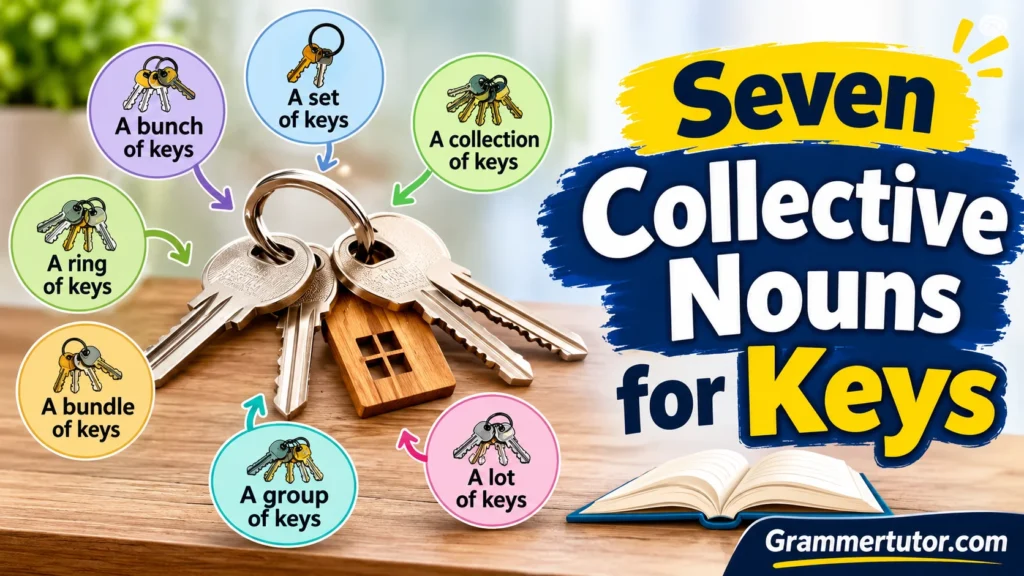
| Type | Simple Example |
| Bunch | A bunch of keys hung beside the door. |
| Ring | A ring of keys rested on the table. |
| Set | A set of keys opened the office doors. |
| Bundle | A bundle of keys was kept inside the drawer. |
| Collection | A collection of keys decorated the cabinet. |
| Cluster | A cluster of keys dangled from the hook. |
| Group | A group of keys was arranged neatly. |
Note: These are everyday collective expressions rather than seven formally established special collective nouns. Their suitability depends on the way the keys are gathered or used.
Bunch of Keys
A bunch of keys is the most familiar expression used when several keys are gathered together. It usually describes keys attached to one another with a keyring or kept together for convenience.
People commonly carry a bunch of keys in their pockets, handbags, backpacks, or key holders. Such an arrangement prevents individual keys from becoming separated or misplaced. A household bunch might contain entrance keys, bedroom keys, storage keys, and other useful items.
This expression is suitable for everyday conversations, descriptive writing, and informal situations. It is also easy for English learners to understand because bunch is commonly used for several objects gathered together.
Examples of “Bunch of Keys”
- A bunch of keys hung from the wooden cupboard.
- She discovered a bunch of keys beneath the office desk.
- My father placed a bunch of keys beside the entrance.
- A bunch of keys slipped out of his jacket pocket.
- The caretaker carried a bunch of keys around the building.
- We found a bunch of keys inside the old suitcase.
- He attached a bunch of keys to his leather belt.
- A bunch of keys remained on the kitchen counter.
- The receptionist handed me a bunch of keys.
- She searched her handbag for a bunch of keys.
Ring of Keys
A ring of keys describes multiple keys fastened to a circular metal holder. This arrangement is especially common among homeowners, office workers, security staff, and vehicle owners who need to carry several keys conveniently.
The circular holder keeps individual keys connected while allowing them to rotate freely. You can move one key away from the others whenever you need to unlock a particular door or container. Many people also attach decorative tags, small tools, or identification labels to their keyrings.
This expression is particularly useful when describing keys that are physically connected by a metal loop. It provides a clear picture of how the objects are organised.
Examples of “Ring of Keys”
- A ring of keys rested beside the television.
- The security guard carried a ring of keys around the premises.
- She found a ring of keys inside the wooden box.
- A ring of keys was hanging near the entrance.
- He removed one key from the ring of keys.
- The caretaker placed a ring of keys inside his pocket.
- A ring of keys fell onto the tiled floor.
- The manager examined the ring of keys carefully.
- My brother attached a small tag to his ring of keys.
- The ring of keys belonged to the building supervisor.
Set of Keys

A set of keys refers to several keys that belong together because they serve a particular purpose or operate related locks. Unlike a bunch, which mainly describes a physical gathering, the set often highlights the relationship between the individual keys.
For example, a new house may come with a set of keys for its entrance, garage, storage room, and other secured areas. Similarly, an office building may have separate sets for employees, maintenance workers, and administrators.
This expression is especially useful in formal communication, property descriptions, instructions, and business settings. It can also refer to replacement keys supplied with a lock or vehicle.
Examples of “Set of Keys”
- The landlord provided a set of keys for the apartment.
- She received a set of keys after purchasing the house.
- A set of keys was placed inside the reception drawer.
- The technician prepared a set of keys for the new locks.
- We collected a set of keys from the property manager.
- He misplaced the set of keys belonging to his office.
- The hotel receptionist issued a set of keys to the guests.
- A spare set of keys remained with our neighbour.
- The mechanic returned the set of keys after servicing the vehicle.
- Every department received its own set of keys.
Bundle of Keys
A bundle of keys describes several keys gathered or tied together into one arrangement. The word bundle generally refers to multiple objects collected into a single group, making it suitable for describing keys kept together for storage or transportation.
Unlike a typical keyring, a bundle does not necessarily require a circular holder. The keys might be connected using a strap, cord, clip, or another fastening arrangement. They may also simply be gathered together for temporary handling.
This phrase works well when describing a relatively large number of keys. Property managers, maintenance personnel, and building supervisors may handle bundles containing keys for different rooms and facilities.
Examples of “Bundle of Keys”
- A bundle of keys was stored in the wooden cabinet.
- The caretaker placed a bundle of keys on the reception counter.
- He discovered a bundle of keys inside the storage room.
- A bundle of keys remained beside the security register.
- She carried a bundle of keys while inspecting the property.
- The old bundle of keys belonged to the previous owner.
- A bundle of keys was wrapped in a small piece of cloth.
- The supervisor collected a bundle of keys before leaving.
- We noticed a bundle of keys near the workshop entrance.
- He carefully separated the required key from the bundle of keys.
Collection of Keys
A collection of keys refers to several keys gathered and kept together, often because they have historical, decorative, practical, or personal value. This expression is particularly appropriate when the keys are displayed, preserved, or accumulated over time.
Some people collect antique keys because of their unusual shapes, craftsmanship, and historical designs. Older examples may feature elaborate handles, engraved patterns, and distinctive metal finishes. Modern collectors may also preserve keys from demolished buildings, vintage furniture, or discontinued security systems.
Unlike a bunch or ring, a collection does not require the keys to be physically attached. They can be arranged inside display cases, stored in boxes, or organised on shelves.
Examples of “Collection of Keys”
- The museum displayed a collection of keys from different centuries.
- Her grandfather maintained a collection of keys from old houses.
- A collection of keys occupied the glass cabinet.
- The antique shop featured a collection of decorative keys.
- We examined a collection of keys during the exhibition.
- His collection of keys included several unusual designs.
- The historian donated a collection of keys to the museum.
- A collection of keys was arranged according to its age.
- The collector carefully cleaned every item in his collection of keys.
- She started a collection of keys as a personal hobby.
Cluster of Keys
A cluster of keys describes several keys gathered closely together in one place. The word cluster emphasises the arrangement of objects that appear grouped or concentrated rather than their individual functions.
This expression can describe keys hanging from a shared hook, gathered inside a container, or attached to a common holder. It is particularly useful when you want to emphasise their close physical arrangement.
For example, a large key holder in a security office may contain several clusters belonging to different departments. Each cluster can be organised according to the rooms, cupboards, or facilities that the keys operate.
Although cluster is a general grouping word, it provides an effective descriptive alternative in everyday English.
Examples of “Cluster of Keys”
- A cluster of keys dangled from the metal hook.
- She noticed a cluster of keys near the entrance.
- A cluster of keys rested inside the wooden drawer.
- The office assistant organised a cluster of keys by size.
- He removed a small key from the cluster of keys.
- A cluster of keys was attached to the security board.
- We found a cluster of keys beneath the counter.
- The caretaker arranged a cluster of keys on the table.
- A cluster of keys remained inside the locked cabinet.
- The photograph showed a cluster of keys hanging together.
Group of Keys
A group of keys is a simple, general expression used whenever several keys are considered together. It does not require a particular arrangement, fastening method, or shared purpose.
You can use this phrase when describing keys scattered across a surface, placed inside a container, or organised for a specific task. It is also helpful when the exact relationship between the objects is unknown.
For English learners, group is one of the easiest words to use because it applies to many different categories of objects. Although it is less descriptive than expressions such as bunch or ring, it remains grammatically clear and widely understandable.
Examples of “Group of Keys”
- A group of keys was arranged beside the computer.
- The technician inspected a group of keys before beginning work.
- She placed a group of keys inside the labelled container.
- A group of keys remained on the workshop table.
- The manager distributed a group of keys among the employees.
- We discovered a group of keys inside an old cupboard.
- A group of keys was displayed in the security office.
- He selected the correct key from the group of keys.
- The locksmith organised a group of keys according to their sizes.
- A group of keys was returned to the property owner.
Different Uses of Keys in Everyday Life

Keys are essential tools that help people control access to buildings, vehicles, storage spaces, and personal belongings. Their importance extends beyond simply opening and closing doors. They provide security, privacy, and convenience in residential, commercial, and industrial environments.
Household keys are generally designed for entrance doors, cupboards, gates, and storage units. Office keys may provide access to individual rooms, filing cabinets, equipment areas, and restricted sections of a workplace. Vehicle keys serve another purpose by allowing drivers to unlock doors, operate ignition systems, or activate electronic features.
Modern technology has also changed the way people use keys. Traditional metal designs remain common, but electronic keys, smart cards, remote controls, and digital access systems are increasingly popular. Some vehicles now use keyless entry systems that allow authorised users to unlock and start their cars without inserting a conventional key.
Practical Examples of Key Uses
- House keys provide access to residential entrances.
- Car keys operate vehicle locking and ignition systems.
- Cabinet keys protect documents and personal belongings.
- Office keys control entry into restricted workplaces.
- Padlock keys secure gates, lockers, and storage containers.
- Safe keys provide access to protected valuables.
- Electronic keys support modern access-control systems.
- Antique keys preserve examples of historical craftsmanship.
Interesting Facts About Keys
Keys have a fascinating history that stretches back thousands of years. Some of the earliest locking mechanisms were developed in ancient civilisations, including Egypt and Mesopotamia. Early wooden locks used simple pins and bolts to prevent unauthorized entry. Over time, metalworking techniques improved, allowing locksmiths to manufacture smaller, stronger, and more intricate mechanisms. Ancient keys were sometimes large and heavy, while later designs became more compact and practical. Modern keys can be made from brass, steel, nickel silver, and other durable materials. Their expected lifespan depends on the quality of construction, frequency of use, exposure to moisture, and general maintenance. A well-made metal key can remain functional for decades when properly cared for.
Keys serve a wide range of practical purposes, but they can also carry historical and sentimental value. Antique examples are collected because of their unusual shapes, decorative handles, and connection to older buildings. Some museums preserve historical keys to demonstrate how security technology developed over different periods. Keys are also commonly used as symbols of responsibility, ownership, authority, and opportunity. Their everyday importance makes them familiar objects, yet their engineering and history reveal a surprisingly interesting subject. From simple wooden mechanisms to advanced electronic access systems, keys continue to evolve alongside human needs.
Conclusion
Understanding the collective noun for keys makes it easier to describe groups of keys in everyday English. Expressions such as a bunch of keys, a ring of keys, a set of keys, and a bundle of keys help you communicate naturally and clearly. By learning these common terms, you can improve your vocabulary and use the right expression when speaking or writing about keys.
FAQs
Q1. What is the most common collective noun for keys?
Bunch is the most common everyday collective expression. You can say a bunch of keys when describing several keys gathered or attached together.
Q2. What do you call a group of keys attached to a metal loop?
A ring of keys is the appropriate expression. It describes several keys connected through a circular metal holder.
Q3. Is a set of keys a collective noun?
Yes, a set of keys is a collective expression. It generally describes several related keys intended for a particular purpose, such as opening different doors in one building.
Q4. What is the difference between a bunch and a bundle of keys?
A bunch of keys usually refers to keys gathered or attached together, often using a keyring. A bundle of keys describes several keys collected into one arrangement, sometimes using a strap or fastening.
Q5. Can I say a collection of keys?
Yes. A collection of keys is grammatically correct. It usually describes keys accumulated for practical, decorative, historical, or personal reasons.