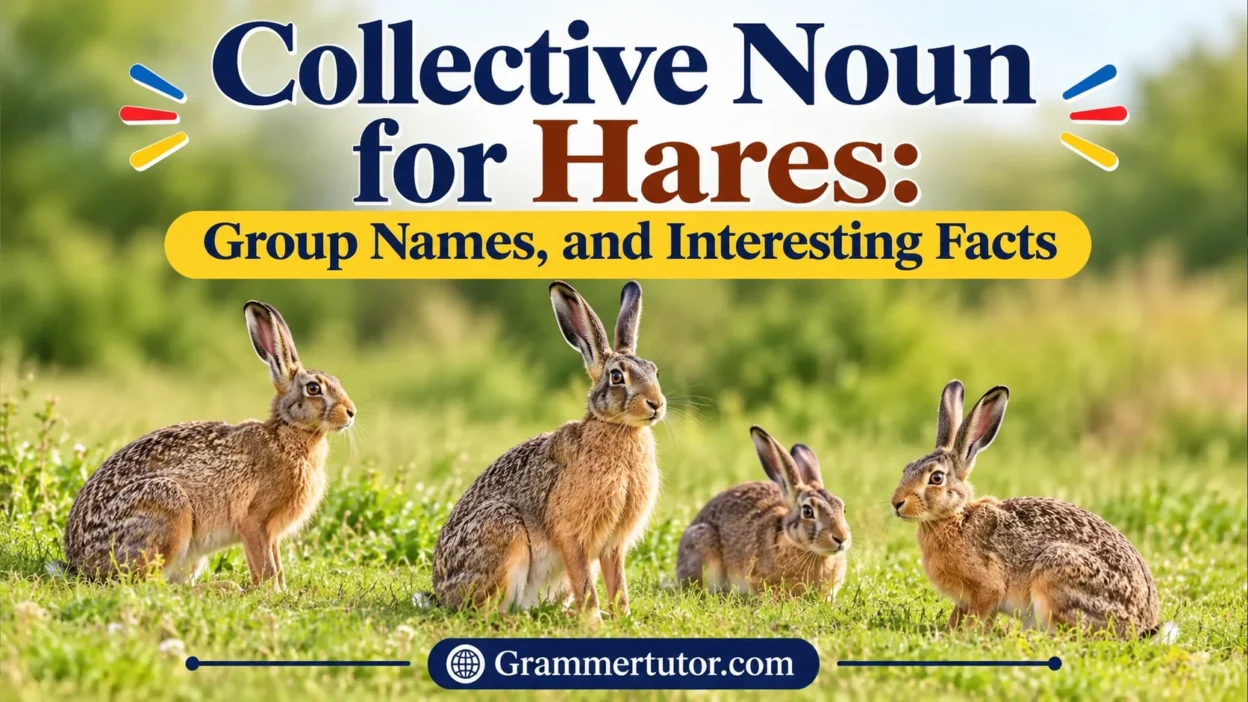
The collective noun for hares is commonly used to describe these swift animals when they appear together in open fields or natural habitats. A drove of hares is a traditional expression, while a group of hares is a simple and familiar way to describe several of them. These terms make wildlife descriptions clearer and help readers understand how English uses special names for animal gatherings.
Hares are known for their long ears, powerful hind legs, and excellent ability to run quickly when danger approaches. Their strong muscles help them move across meadows, grasslands, and quiet countryside areas. They also have excellent hearing, which allows them to notice nearby threats. When several hares gather in one place, observing their movements and natural behaviour can make learning about these fascinating mammals more enjoyable.
Other traditional expressions include a husk of hares, a down of hares, and a warren of hares. Although these names are less common in everyday conversation, they add variety to wildlife vocabulary. From an English-learning perspective, exploring such expressions is a useful way to understand collective nouns and improve descriptive writing. Each term offers another way to discuss hares while making sentences about wildlife more interesting.
Why Are Collective Nouns Used for Hares?
Collective nouns make it easier to describe several animals without repeatedly mentioning each individual. They also give sentences a more natural flow and help readers imagine how wildlife behaves in its natural environment.
Hares are generally less social than many herd-living mammals. They often live independently, although they may gather in suitable feeding areas or during breeding activities. In some situations, several hares can be spotted in the same field, particularly where food and shelter are available.
Different expressions provide different ways to describe these gatherings. Some are traditional collective nouns, while others are general descriptive words. For example, drove is a traditional group expression, whereas group is a straightforward everyday choice.
Learning these terms is useful for students, wildlife enthusiasts, teachers, and anyone interested in improving their English vocabulary.
Seven Collective Nouns for Hares

| Type | Simple Example |
| Drove | A drove of hares crossed the meadow. |
| Husk | A husk of hares rested near the bushes. |
| Down | A down of hares gathered in the field. |
| Warren | A warren of hares occupied the grassy area. |
| Leash | A leash of hares moved through the countryside. |
| Trace | A trace of hares appeared near the hedgerow. |
| Group | A group of hares searched for food. |
Drove of Hares
A drove of hares is a traditional collective noun used to describe several hares together. The word drove is also used for groups of animals being driven or moving in a particular direction.
This expression creates an image of hares travelling across open countryside. Their powerful hind legs allow them to cover considerable distances with quick, bounding movements. When several hares move across a meadow at the same time, the term provides an interesting way to describe the gathering.
Hares are particularly associated with grasslands, agricultural fields, and open habitats. These environments offer suitable feeding opportunities and places where they can detect approaching predators.
Examples of “Drove of Hares”
- A drove of hares raced across the open meadow.
- We spotted a drove of hares near the farmland.
- A drove of hares disappeared behind the tall grass.
- The wildlife photographer captured a drive of hares at sunrise.
- A drove of hares moved towards the distant hedgerow.
- The children watched a drove of hares crossing the field.
- A drove of hares gathered near the grassy hillside.
- The farmer noticed a drove of hares beside the crops.
- A drove of hares bounded across the countryside.
- The drove of hares vanished into the surrounding vegetation.
Husk of Hares
A husk of hares is an unusual traditional expression found in collections of English animal group names. It gives writers an alternative to the familiar word group when describing several hares gathered in one place.
Hares are naturally alert animals that rely on their sharp senses to recognise possible threats. Their long ears can detect sounds from different directions, while their strong legs help them escape quickly when danger approaches. Seeing several hares resting or moving through the same landscape creates an interesting opportunity to use this traditional expression.
Although husk is not a common everyday term, it adds variety to descriptive writing and vocabulary lessons.
Examples of “Husk of Hares”
- A husk of hares appeared near the woodland boundary.
- We observed a husk of hares resting in the meadow.
- A husk of hares moved through the tall vegetation.
- The naturalist photographed a husk of hares in the countryside.
- A husk of hares gathered near the grassy slope.
- The husk of hares disappeared behind the hedgerow.
- A husk of hares crossed the open farmland.
- The children spotted a husk of hares beside the country lane.
- A husk of hares searched the field for food.
- The husk of hares remained still beneath the morning sunlight.
Down of Hares
A down of hares is another uncommon expression associated with traditional collective-noun vocabulary. It can be used as a literary description of several hares occupying the same area.
The word down also has connections with open, rolling grassland landscapes. Such environments provide suitable surroundings for many hare species because they offer feeding opportunities and wide views of approaching danger.
Hares often use shallow depressions in the ground called forms as resting places. These small shelters help them remain concealed among vegetation. When describing several hares resting in an open landscape, this expression can add a distinctive touch to your writing.
Examples of “Down of Hares”
- A down of hares rested across the grassy landscape.
- We noticed a downfall of hares near the rolling hills.
- A down of hares moved through the open countryside.
- The photographer discovered a pile of hares in the meadow.
- A down of hares gathered beneath the warm sunlight.
- The down of hares disappeared into the surrounding grass.
- A down of hares occupied the edge of the pasture.
- The observer watched a hare from a distance.
- A down of hares crossed the countryside before sunset.
- The naturalist recorded a down of hares near the fields.
Warren of Hares
A warren of hares is sometimes suggested as a group expression, but it requires an important distinction. A warren is properly associated with an interconnected system of underground burrows, especially those made by rabbits. Hares generally do not dig and live in extensive burrow systems.
Instead, most hares rest in shallow ground-level depressions known as forms. These provide concealment without the elaborate underground tunnels associated with rabbits.
For this reason, warren is not the best biological term for a gathering of hares. However, understanding the distinction is useful because hares and rabbits are frequently confused.
Examples of “Warren of Hares”
- The writer described a warren of hares in the countryside.
- A warren of hares appeared in the wildlife story.
- The children learned why hares and rabbits use different shelters.
- The naturalist explained that hares rest in shallow forms.
- The countryside guide discussed the difference between a hare and a rabbit.
- A group of hares rested near the grassy boundary.
- The hares remained concealed in their natural resting places.
- The wildlife observer spotted several hares in the meadow.
- The animals moved across the open landscape.
- The countryside provided plenty of natural shelter for the hares.
Leash of Hares
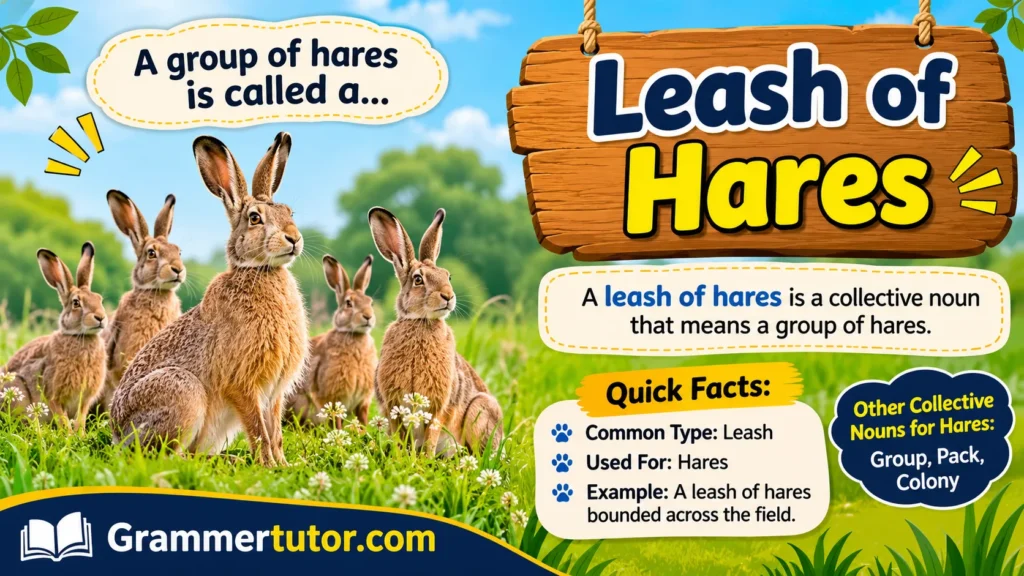
A leash of hares is an uncommon traditional expression that appears in some collections of collective nouns. The word leash is more familiar when describing a restraint used for controlling an animal, but its traditional group-name usage gives it a different meaning.
Hares are independent mammals that usually spend much of their time alone. However, they may come into contact with other hares when searching for food or during the breeding season. Their movements are often quick and unpredictable, making them interesting subjects for wildlife observation.
This expression can be included when exploring unusual English vocabulary, although a group of hares is a clearer choice for everyday communication.
Examples of “Leash of Hares”
- A leash of hares crossed the countryside.
- We spotted a leash of hares near the meadow.
- A leash of hares moved through the grassy field.
- The wildlife enthusiast observed a leash of hares at dawn.
- A leash of hares appeared beside the woodland.
- The leash of hares disappeared behind the bushes.
- A leash of hares rested near the agricultural land.
- The photographer captured a leash of hares in the distance.
- A leash of hares moved towards the open pasture.
- The countryside visitor noticed a leash of hares near the hedgerow.
Trace of Hares
A trace of hares is a less familiar descriptive expression that can be used creatively when discussing signs or sightings of these animals. However, it should not be presented as a universally established collective noun.
The word trace normally means a small indication that something has been present. It can describe footprints, tracks, or other evidence left behind by animals.
Hares often leave noticeable tracks in soft soil, snow, or muddy ground. Their distinctive hopping movements create patterns that wildlife observers can follow to understand where the animals have travelled.
For this reason, trace can be particularly useful in nature writing, although it is more accurate to say a trace of hare tracks when discussing footprints.
Examples of “Trace of Hares”
- The ranger discovered a trace of hare tracks near the meadow.
- A trace of hare footprints appeared in the fresh snow.
- The naturalist followed a trace of hares through the grass.
- We noticed a trace of hare activity beside the woodland.
- A trace of hare tracks crossed the muddy pathway.
- The observer recorded a trace of hares near the hedgerow.
- A trace of footprints led towards the open field.
- The snow revealed a trace of hare movements.
- The photographer found evidence of hares near the bushes.
- The wildlife guide explained how to recognise hare tracks.
Group of Hares
A group of hares is the clearest and most reliable everyday expression for several hares found together. Unlike rare traditional terms, this phrase is immediately understandable and suitable for almost any situation.
Hares are generally solitary animals, although their behaviour changes depending on the season, habitat, and availability of food. During breeding periods, males and females may interact, while several individuals can sometimes be observed feeding in the same agricultural field.
Using a group avoids confusion about uncommon collective-noun expressions. It is especially useful for students, young learners, and people writing factual descriptions about wildlife.
Examples of “Group of Hares”
- A group of hares searched for food in the meadow.
- We watched a group of hares moving across the farmland.
- A group of hares rested near the woodland edge.
- The wildlife photographer followed a group of hares from a distance.
- A group of hares appeared in the open field.
- Several children observed a group of hares near the bushes.
- A group of hares disappeared into the tall grass.
- The naturalist studied a group of hares during the morning.
- A group of hares moved towards the distant hillside.
- The farmer noticed a group of hares near the crops.
Interesting Facts About Hares
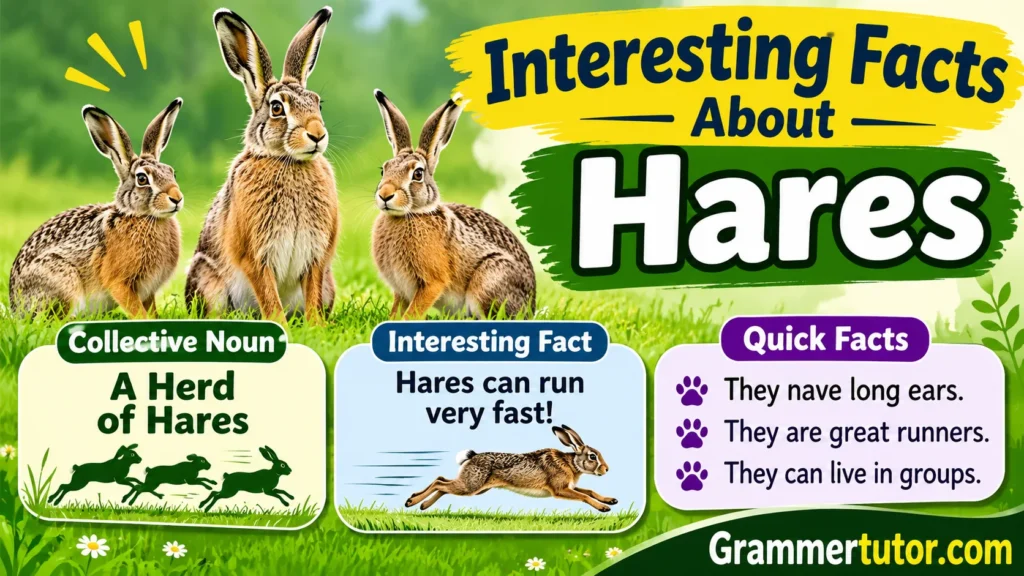
Hares are remarkable mammals belonging to the family Leporidae. They are closely related to rabbits, but their bodies and lifestyles have several important differences. Depending on the species and living conditions, hares can survive for several years in the wild, although many face threats from predators, habitat changes, disease, and human activities. European hares have an average lifespan that can reach around 12 years in some biological records. Their bodies are designed for speed and endurance, making them particularly successful at escaping danger across open landscapes.
One of their most impressive physical characteristics is their powerful hind legs. These long, muscular limbs allow hares to produce enormous leaps and accelerate quickly when threatened. Their large ears provide excellent hearing and help them detect approaching predators. Hares also possess wide-set eyes that provide a broad field of vision, allowing them to notice movement around them. Unlike rabbits, they generally do not construct extensive underground burrows. Instead, they rest in shallow depressions in the ground called forms, where their natural colouring helps them blend into the surroundings.
Their dietary habits are another interesting part of their biology. Hares are herbivores and mainly consume grasses, leaves, herbs, shoots, and other vegetation. Depending on the season, they may also eat agricultural crops, buds, and bark. Their feeding patterns change according to the plants available in their habitats. Like rabbits, hares practise coprophagy, a digestive process in which they consume special soft droppings called caecotrophs. This allows them to absorb additional nutrients from their food.
Hares are generally solitary creatures, although their behaviour becomes more social during the breeding season. European hares are especially famous for their energetic courtship displays, commonly called boxing. During these encounters, a female may strike a pursuing male with her front paws when she is not ready to mate. Baby hares are called leverets, and they are born with fur, open eyes, and the ability to move shortly after birth. Their mothers usually leave them hidden separately and return periodically to feed them. These adaptations help young hares remain less noticeable to predators.
Conclusion
Understanding the collective noun for hares makes it easier to describe these fascinating animals when they appear together. A drove of hares is a traditional group name, while expressions such as husk, down, and warren add variety to English vocabulary. Learning these terms improves your knowledge of collective nouns and helps you write clearer, more interesting sentences about wildlife.
FAQs
Q1. What is the main collective noun for hares?
Down is frequently listed as the principal collective noun for hares. You can use the expression a down of hares when describing several hares together.
Q2. What are some alternative names for a group of hares?
Other traditional expressions include drove, husk, leash, trip, and flick. Their usage varies between collective-noun references, and some are less familiar than others.
Q3. Is a drive of hares grammatically correct?
Yes. A drove of hares is a recognised traditional expression. It is particularly associated with groups of hares moving together or being driven during hunting.
Q4. What does a down of hares mean?
A down of hares refers to a gathering of hares. It is a traditional collective noun and is frequently listed as the main group name for these mammals.
Q5. What is a husk of hares?
A husk of hares is an unusual traditional collective expression. It appears in English vocabulary references as an alternative to down and drove.