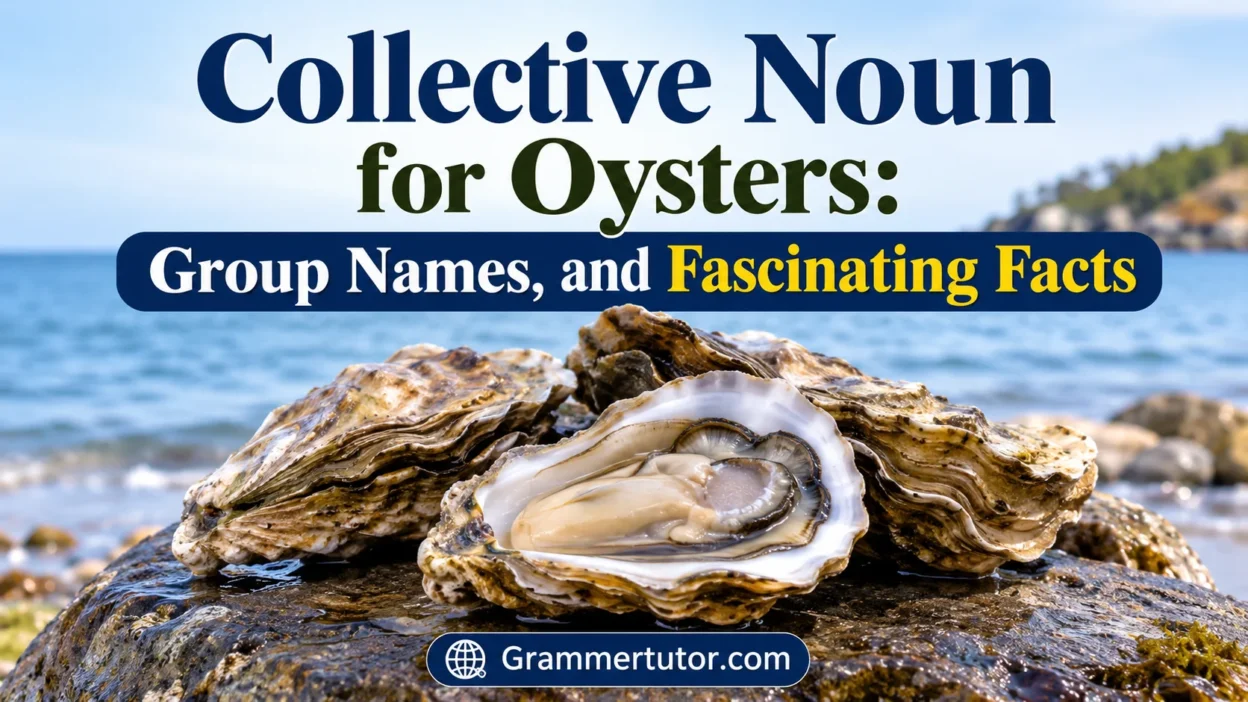
The collective noun for oysters helps describe these marine animals when they grow together in coastal waters, estuaries, and shallow ocean environments. A bed of oysters is a familiar expression for a group of oysters living on an underwater surface. Other terms, such as an oyster reef, a cluster of oysters, and a colony of oysters, describe different types of natural groupings. These shellfish may look motionless, but they attach themselves to suitable surfaces and grow together in aquatic ecosystems. Learning these expressions helps you understand how collective nouns describe groups of living things while improving your English vocabulary.
A bed of oysters usually describes oysters growing together across an area of the seabed. An oyster reef refers to a structure formed as oysters attach to one another and accumulate over time. A cluster of oysters emphasizes a smaller or closely connected group, while a colony of oysters describes oysters living and developing together in the same location. Although these expressions sometimes overlap, each term highlights a different aspect of oyster grouping. For example, you might write, “A bed of oysters covered the rocky seabed,” or “An oyster reef provided shelter for other marine creatures.” Using simple sentence examples makes the meanings easier to understand and helps you choose the right expression when describing marine life.
Oyster groups are important because they contribute to marine biodiversity and support healthy coastal ecosystems. As oysters grow, their natural formations can provide shelter for small fish and other marine organisms. Their feeding habits, physical characteristics, and ecological importance make them interesting subjects for anyone learning about ocean life. Oyster beds and reefs also help explain the relationship between animals and their marine habitats. From a language-learning perspective, connecting each collective noun with a real example makes it easier to remember. When you understand how oysters gather, attach themselves to surfaces, and develop into groups, you can use expressions such as bed, reef, cluster, and colony more accurately in your writing.
Why Are Special Group Names Used for Oysters?
Oysters have a distinctive way of living compared with many other marine animals. Instead of swimming freely through the water, adult oysters usually attach themselves to hard surfaces, such as rocks, shells, and other oysters. Over time, numerous individuals can accumulate in one location, creating dense natural formations.
These arrangements are important because oysters often provide shelter and feeding opportunities for other marine organisms. Their interconnected shells can form complex underwater habitats that support fish, crabs, worms, and other small creatures.
Collective nouns make it easier to describe these natural arrangements without repeatedly referring to individual shellfish. For example, a bed of oysters describes a group occupying a particular underwater area, while a cluster of oysters highlights how closely their shells are positioned.
Learning these expressions is useful for students, writers, marine-life enthusiasts, and anyone interested in improving their descriptive English.
Seven Collective Nouns for Oysters
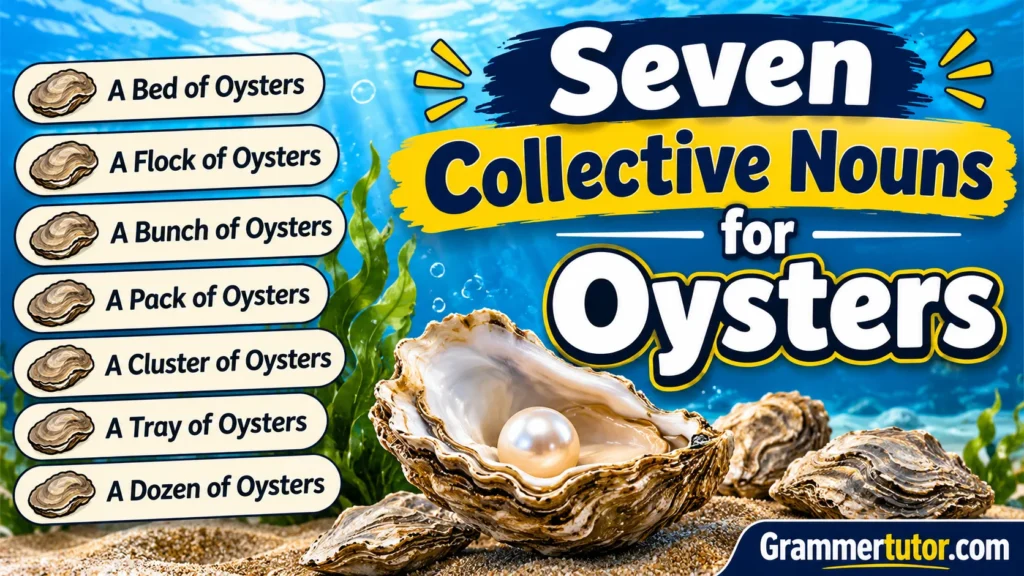
| Type | Simple Example |
| Bed | A bed of oysters covered the seabed. |
| Reef | An oyster reef supported marine life. |
| Cluster | A cluster of oysters grew on the rocks. |
| Colony | A colony of oysters developed in the estuary. |
| Group | A group of oysters remained attached to the surface. |
| Aggregation | An aggregation of oysters formed underwater. |
| Community | A community of oysters occupied the coastal habitat. |
Bed of Oysters
A bed of oysters is the most familiar collective expression used to describe oysters growing together in a particular underwater location. The word bed refers to an area where numerous oysters settle and develop close to one another.
Oyster beds can form in shallow coastal waters, tidal channels, estuaries, and other suitable marine environments. Their development depends on factors such as water quality, salinity, temperature, and the availability of firm surfaces for attachment.
Young oysters, known as spat, settle onto suitable surfaces after their free-swimming larval stage. As they grow, their shells can become attached to neighbouring oysters, gradually creating dense formations.
An oyster bed can provide an important habitat for numerous aquatic organisms. Its shells create small spaces where other creatures can hide, feed, and reproduce.
Examples of “Bed of Oysters”
- A bed of oysters covered the shallow seabed.
- The marine researchers examined a bed of oysters near the coast.
- A bed of oysters developed around the rocky shoreline.
- Fishermen discovered a healthy bed of oysters in the estuary.
- The underwater photograph revealed a bed of oysters.
- A bed of oysters provided shelter for small marine creatures.
- The divers carefully observed a bed of oysters.
- A bed of oysters grew beneath the clear coastal water.
- The conservation team monitored the expanding bed of oysters.
- A bed of oysters occupied the sheltered bay.
Reef of Oysters
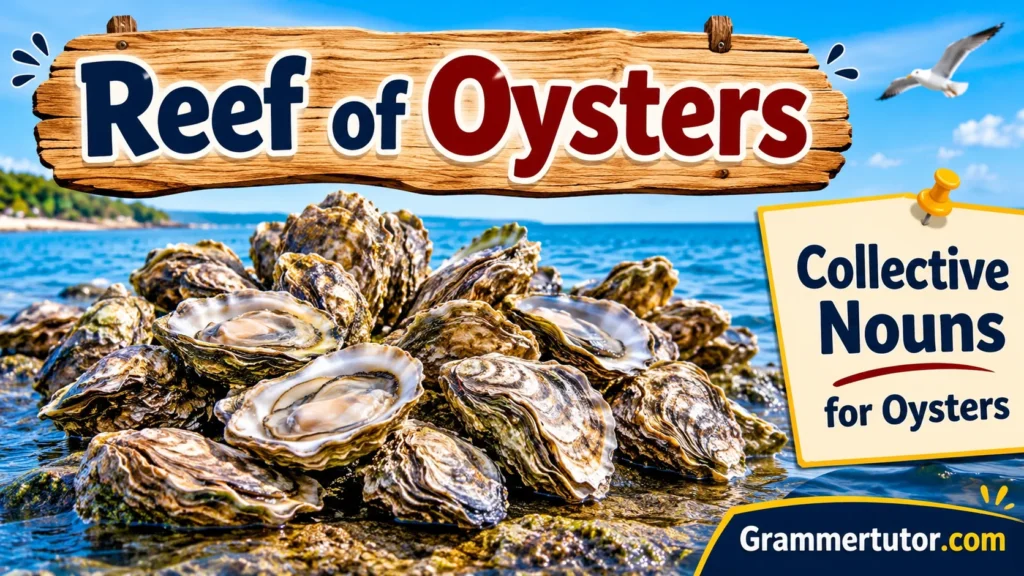
An oyster reef describes a natural or restored underwater structure formed by oysters growing together over time. It is a particularly important expression in marine biology because oyster reefs function as living habitats rather than simply collections of shellfish.
As oysters attach to existing shells, they gradually create complex formations that can rise above the surrounding seabed. These structures provide hiding places, feeding grounds, and breeding areas for various marine species.
Oyster reefs also offer environmental benefits. They can help reduce wave energy, stabilise certain coastal areas, and improve water clarity through the oysters’ natural filter-feeding activity.
The expression is especially useful when discussing the ecological importance of oysters and their role in coastal conservation.
Examples of “Reef of Oysters”
- An oyster reef developed along the sheltered coastline.
- The divers explored an oyster reef beneath the shallow water.
- A healthy oyster reef attracted numerous marine organisms.
- Scientists measured the growth of an oyster reef.
- The restoration project created a new oyster reef.
- Small fish found protection around the oyster reef.
- An oyster reef helped support the coastal ecosystem.
- The marine team surveyed an oyster reef near the estuary.
- A large oyster reef formed over several generations.
- The underwater camera captured a thriving oyster reef.
Cluster of Oysters
A cluster of oysters describes several shellfish growing or resting close together. The word cluster emphasises their close arrangement and is suitable for describing oysters attached to rocks, shells, or other solid surfaces.
Oysters are not usually independent swimmers during adulthood. Instead, they remain attached to suitable surfaces and develop in locations where environmental conditions support their growth.
Clusters can contain oysters of different sizes and ages. Their irregular shells often overlap, producing a rough and uneven surface that can provide shelter for small marine organisms.
This expression is especially useful in general descriptions, educational writing, and observations of marine habitats.
Examples of “Cluster of Oysters”
- A cluster of oysters clung to the submerged rocks.
- We discovered a cluster of oysters beneath the pier.
- A cluster of oysters developed along the wooden structure.
- The photographer captured a cluster of oysters at low tide.
- A cluster of oysters covered part of the coastal rock.
- The researchers collected information about a cluster of oysters.
- A cluster of oysters remained attached to an old shell.
- The tide exposed a cluster of oysters near the shoreline.
- A cluster of oysters provided shelter for tiny crabs.
- The marine biologist examined a cluster of oysters underwater.
Colony of Oysters
A colony of oysters is a descriptive expression for a population of oysters living close together in a shared marine environment. The term colony is often used in biology to describe organisms that occupy the same location and may form closely connected communities.
Oyster colonies develop when young oysters successfully settle in areas with suitable surfaces and environmental conditions. Over time, their growth can produce dense arrangements that become an important part of the surrounding ecosystem.
These colonies may support other marine species by creating protective spaces and increasing habitat complexity. Their presence can also contribute to the ecological health of estuaries and coastal waters.
The expression is particularly helpful when discussing oyster populations, breeding habitats, and marine conservation.
Examples of “Colony of Oysters”
- A colony of oysters developed along the estuary.
- The research team observed a colony of oysters underwater.
- A colony of oysters occupied the sheltered coastal area.
- Marine scientists studied a colony of oysters near the harbour.
- A colony of oysters grew across the submerged surface.
- The conservation project protected a colony of oysters.
- A colony of oysters attracted small fish and crabs.
- The divers discovered a colony of oysters beneath the rocks.
- A colony of oysters survived in the changing coastal environment.
- The marine survey recorded the condition of a colony of oysters.
Group of Oysters
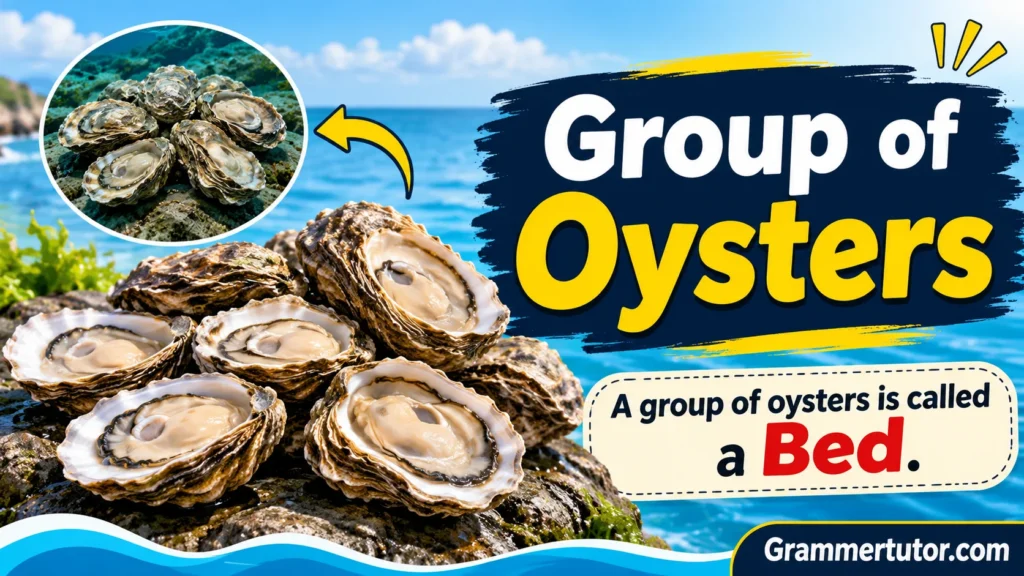
A group of oysters is a straightforward general expression for several oysters found together. Unlike more specialised descriptions, the word group does not suggest a particular arrangement, habitat, or ecological structure.
It can be used when describing oysters in their natural environment, at a seafood market, or during a scientific observation. This makes it one of the easiest expressions for English learners to understand.
For example, oysters may appear together on a rocky surface, inside an underwater habitat, or in containers after harvesting. In each situation, the general word group communicates the basic meaning without requiring specialised vocabulary.
Examples of “Group of Oysters”
- A group of oysters remained attached to the coastal rocks.
- The scientist examined a group of oysters collected for research.
- A group of oysters was visible beneath the shallow water.
- The divers photographed a group of oysters near the reef.
- A group of oysters developed along the harbour wall.
- The students studied a group of oysters during their marine biology lesson.
- A group of oysters survived in the sheltered inlet.
- The fisherman noticed a group of oysters near the shoreline.
- A group of oysters occupied the underwater surface.
- The researchers compared the growth of a group of oysters.
Aggregation of Oysters
An aggregation of oysters describes a collection of individual oysters concentrated within a particular area. The word aggregation is frequently used in scientific and ecological writing to explain how organisms occur together.
This expression is particularly useful when discussing oyster distribution, population density, and habitat formation. Oysters often settle in areas where water movement carries suitable nutrients and where hard surfaces are available for attachment.
As more young oysters settle near established individuals, the population can become increasingly concentrated. Such aggregations may eventually contribute to the formation of larger oyster beds and reefs.
Unlike a casual expression such as group, aggregation sounds more technical and is suitable for research-based descriptions of marine populations.
Examples of “Aggregation of Oysters”
- An aggregation of oysters developed on the underwater rocks.
- Scientists examined an aggregation of oysters near the estuary.
- The survey identified an aggregation of oysters along the coast.
- An aggregation of oysters occupied the shallow marine habitat.
- The researchers recorded the density of an aggregation of oysters.
- An aggregation of oysters formed around the submerged shells.
- The marine study investigated an aggregation of oysters.
- An aggregation of oysters provided a habitat for smaller organisms.
- Divers discovered an aggregation of oysters beneath the pier.
- The environmental team monitored an aggregation of oysters.
Community of Oysters
A community of oysters is a broad descriptive expression for oysters living together within a shared habitat. In ecology, the word community generally refers to different populations of organisms interacting within the same environment.
When discussing oysters, this term can highlight their relationship with neighbouring organisms rather than simply their physical arrangement. Oyster beds and reefs often support mussels, barnacles, crabs, small fish, worms, and other marine species.
These organisms depend on the habitat in different ways. Some use the spaces between oyster shells as hiding places, while others search for food among the reef structures.
The expression is therefore useful when writing about biodiversity, marine ecosystems, and the environmental importance of oyster habitats.
Examples of “Community of Oysters”
- A community of oysters flourished in the coastal waters.
- The marine biologist studied a community of oysters near the bay.
- A community of oysters supported several smaller marine species.
- The researchers observed a community of oysters beneath the surface.
- A community of oysters developed in the protected estuary.
- The conservation programme helped restore a community of oysters.
- A community of oysters occupied the shallow seabed.
- The underwater habitat contained a community of oysters.
- A community of oysters contributed to the local ecosystem.
- Scientists investigated a community of oysters along the shoreline.
Oyster Habitat and Their Way of Living
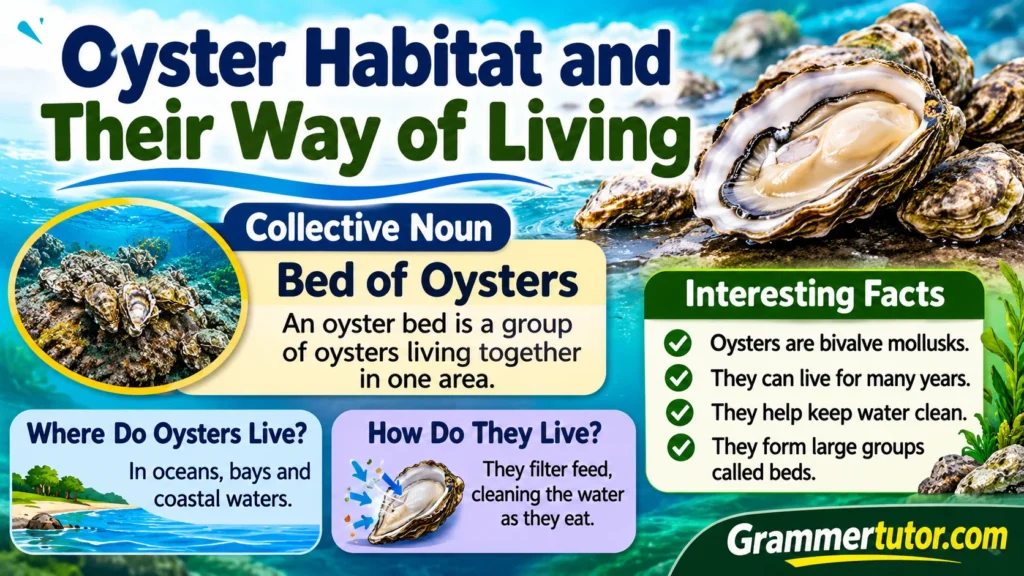
Oysters have a distinctive lifestyle that separates them from many other aquatic animals. Most adult oysters remain attached to hard surfaces rather than moving freely through the water. They commonly inhabit estuaries, bays, tidal flats, and shallow coastal environments where suitable water conditions support their development.
Their shells provide protection from predators and changing environmental conditions. As oysters grow, they may attach to neighbouring shells, creating closely packed formations. These arrangements can become extensive oyster beds that contribute to the structure of underwater habitats.
Oysters also play an important role in maintaining coastal biodiversity. Their reefs provide shelter for fish, crabs, shrimp, worms, and other small creatures. Through their filter-feeding activity, oysters remove suspended particles from the water, including microscopic algae and organic material. This process can improve water clarity under suitable conditions.
Examples of Oyster Habitat and Behaviour
- Adult oysters usually attach themselves to hard surfaces.
- Young oysters settle on suitable underwater materials.
- Oyster reefs provide shelter for small marine animals.
- Many oysters inhabit coastal waters and estuaries.
- Filter feeding helps oysters obtain microscopic food.
- Oyster shells create spaces for other organisms.
- Environmental conditions influence oyster growth.
- Some oyster populations form extensive underwater reefs.
- Oysters contribute to coastal ecosystem biodiversity.
- Marine researchers monitor oyster habitats for conservation purposes.
Interesting Facts About Oysters
Oysters are remarkable marine molluscs belonging to the family Ostreidae. Their lifespan varies considerably between species and environmental conditions, but some oysters can survive for several decades. Certain species may live for more than 20 years when conditions are favourable. Their hard shells consist mainly of calcium carbonate and develop in layers as the animals grow. The shell protects the soft body inside and helps oysters withstand physical pressure and exposure during low tides. One particularly interesting feature is their ability to close their shells tightly using a strong adductor muscle. This muscle helps retain moisture and provides protection against certain predators and environmental changes. Oysters also have a specialised body structure that allows them to remain attached to surfaces throughout most of their adult lives.
Their feeding habits are equally fascinating. Oysters are filter feeders, meaning they obtain food by filtering water through their bodies. They draw water into their shells, pass it over their gills, and collect tiny food particles, including microscopic algae, phytoplankton, and organic matter. Their gills help with both feeding and respiration. Unlike many marine animals, oysters do not actively chase their food. Instead, they depend on water movement to bring suitable nutrients within reach. This feeding process also allows them to remove suspended particles from the surrounding water, making them important contributors to certain coastal ecosystems.
Another unusual characteristic is their reproductive flexibility. Many oyster species can change sex during their lifetimes, although reproductive patterns differ between species. They generally release eggs and sperm into the water, where fertilisation occurs in many species. The resulting larvae remain free-swimming for a period before settling onto a suitable hard surface and developing into young oysters. Some species also produce pearls, although pearl production is much more closely associated with certain pearl oysters than with the common edible oysters. Their ability to create extensive reefs, filter surrounding water, and provide habitats for other marine organisms makes oysters valuable members of marine ecosystems.
Conclusion
Understanding the collective noun for oysters makes it easier to describe how these fascinating marine animals live and grow together. Expressions such as a bed of oysters, an oyster reef, a cluster of oysters, and a colony of oysters help explain their natural groupings and habitats. Each term offers a slightly different way to describe oyster communities. By learning these expressions and using them in everyday sentences, you can improve your English vocabulary while gaining a better understanding of oysters and their important role in marine ecosystems.
FAQs
Q1. What is the most common collective noun for oysters?
A bed of oysters is the most familiar collective expression. It describes oysters growing together across an underwater surface or coastal area.
Q2. What is an oyster reef?
An oyster reef is a natural or restored underwater structure formed by oysters growing together over time. It provides shelter and feeding opportunities for various marine organisms.
Q3. Can a group of oysters be called a cluster?
Yes. A cluster of oysters describes several shellfish positioned closely together, often attached to rocks, shells, or other hard surfaces.
Q4. What is the difference between an oyster bed and an oyster reef?
An oyster bed generally refers to an area containing numerous oysters. An oyster reef describes a more developed physical structure formed by generations of oysters and their accumulated shells.
Q5. Are oysters social animals?
Oysters do not socialise like birds or mammals. However, they commonly grow close together and form dense populations that create shared marine habitats.