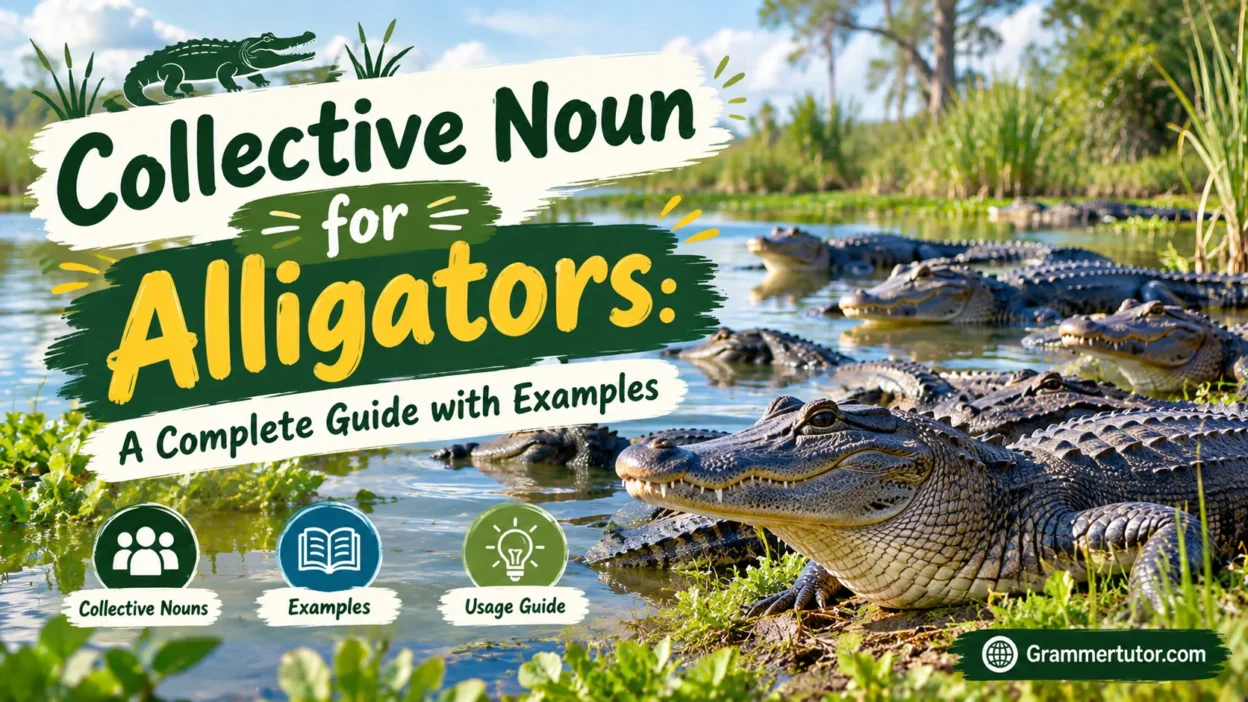
The collective noun for alligators helps describe a group of powerful reptiles that live in wetlands, rivers, lakes, and swamps. These alligators have strong jaws and rough skin, and although they may seem calm, they can become active when they hunt, protect their young, or compete for territory.
When several alligators stay in the same area, English provides special words to describe them as a group. These collective nouns can make sentences shorter, clearer, and more interesting. The most common expression is a congregation of alligators, while descriptive terms such as a bask of alligators and a float of alligators can also appear in wildlife writing.
Each expression can give the reader a slightly different idea about the animals and their activity or setting. A bask of alligators may describe them resting together, while a float of alligators can suit a group gathered in water. The congregation of alligators works as a general group term, making these expressions useful when describing alligators naturally and accurately.
What Is the Collective Noun for Alligators?
The most recognized collective noun for alligators is a congregation.
A congregation of alligators describes a group of alligators gathered together in one place. They may gather near a riverbank, around a waterhole, or in a swamp where food and shelter are available.
Other terms can describe alligators in particular situations:
|
Collective Noun
|
Used For
|
Simple Example
|
| — | — | — |
|
Congregation
|
A group of alligators gathered together
|
A congregation of alligators rested beside the river.
|
|
Bask
|
Alligators lying together in the sun
|
A bask of alligators warmed themselves on the bank.
|
|
Float
|
Alligators moving or resting in water
|
A float of alligators drifted across the lake.
|
|
Nest
|
A group connected with nesting or young alligators
|
The ranger watched a nest of young alligators.
|
|
Gathering
|
A general group of alligators
|
A gathering of alligators appeared near the marsh.
|
Congregation is the best choice when you need a general collective noun. The other expressions are more descriptive and depend on the scene.
A Congregation of Alligators
A congregation of alligators refers to several alligators gathered in the same location. The word congregation usually describes a group of people meeting together, but it can also be used creatively for animals that gather in one place.
Alligators may form a congregation when they search for food, share a warm resting area, or gather near water during dry weather. Young alligators may stay close to one another for protection, while adults often gather where the environment provides enough food and shelter.
This term works well in wildlife articles, nature documentaries, and descriptive writing.
Examples of “A Congregation of Alligators”
- A congregation of alligators rested beside the muddy river.
- We saw a congregation of alligators near the swamp.
- The guide pointed toward a congregation of alligators.
- A large congregation of alligators gathered near the water.
- The photographer captured a congregation of alligators at sunrise.
- A congregation of alligators moved slowly through the marsh.
- The riverbank became home to a congregation of alligators.
- Tourists watched a congregation of alligators from a safe distance.
- A congregation of alligators waited quietly near the reeds.
- The wetland supported a healthy congregation of alligators.
A Bask of Alligators
A bask of alligators describes a group of alligators lying together in the sunshine. Alligators are cold-blooded reptiles, so they depend on outside heat to help regulate their body temperature.
They often climb onto muddy banks, logs, or sandy edges to warm themselves. When many alligators lie in the sun at the same time, the word bask creates a clear picture of their behavior.
This term is especially useful when the group is resting rather than swimming or hunting.
Examples of “A Bask of Alligators”
- A bask of alligators lay quietly on the riverbank.
- We noticed a bask of alligators warming themselves in the sun.
- The bask of alligators remained still during the afternoon.
- A basket of alligators rested on fallen logs.
- The guide showed us a bask of alligators near the lake.
- A bask of alligators opened their jaws while sunbathing.
- The warm weather attracted a bask of alligators.
- A bask of alligators covered the sandy shore.
- The ranger observed a bask of alligators from a distance.
- A bask of alligators slowly returned to the water.
A Float of Alligators
The phrase a float of alligators can describe a group of alligators resting or moving in water. Alligators often keep most of their bodies below the surface, leaving only their eyes, nostrils, and part of their backs visible.
From a distance, a group of floating alligators may look like logs drifting across a pond. This makes float a useful descriptive expression for scenes involving quiet water movement.
It is not as common as congregation, but it can add variety to nature writing.
Examples of “A Float of Alligators”
- A float of alligators moved across the quiet pond.
- We saw a float of alligators near the reeds.
- A float of alligators rested just beneath the water’s surface.
- The boat passed a float of alligators in the marsh.
- A float of alligators appeared like dark logs in the river.
- The float of alligators disappeared when the boat came closer.
- A float of alligators drifted slowly toward the bank.
- The guide warned us about a float of alligators ahead.
- A float of alligators waited silently in the shallow water.
- The photographer recorded a float of alligators at dusk.
A Gathering of Alligators
A gathering of alligators is a general and easy-to-understand expression. It does not describe one special behavior. Instead, it simply tells the reader that several alligators are present together.
This phrase is useful when you do not know whether the animals are basking, swimming, hunting, or resting. It also sounds natural in everyday conversation.
For example, a wildlife worker may say, “There was a gathering of alligators near the lake,” without explaining exactly why they came together.
Examples of “A Gathering of Alligators”
- A gathering of alligators appeared near the wetland.
- The researchers studied a gathering of alligators.
- A gathering of alligators moved toward the water.
- We noticed a gathering of alligators beside the swamp.
- The park protects a large gathering of alligators.
- A gathering of alligators rested under the trees.
- The sudden rain brought a gathering of alligators closer to the lake.
- A gathering of alligators gathered around a shallow pool.
- The ranger counted the animals in the gathering of alligators.
- A gathering of alligators made the riverbank look busy.
A Group of Young Alligators
Young alligators often stay close to one another after hatching. A simple expression such as a group of young alligators is suitable when discussing baby or juvenile alligators.
You may also see descriptive phrases such as a nursery of alligators in wildlife writing, especially when the young remain in a protected area. However, nursery is not the standard general collective noun for alligators.
Mother alligators may protect their young during the early stages of life. The babies often remain together and communicate through sounds, movements, and calls.
Examples of “A Group of Young Alligators”
- A group of young alligators rested near their mother.
- The scientist observed a group of young alligators.
- A group of young alligators moved through the shallow water.
- The nest produced a group of healthy young alligators.
- A group of young alligators stayed close to the riverbank.
- The mother guarded a group of young alligators.
- A group of young alligators hid among the plants.
- The ranger found a group of young alligators near the nest.
- A group of young alligators made soft calling sounds.
- The group of young alligators disappeared into the grass.
How Alligators Behave in Groups
Alligators are not always social in the same way as birds or herd animals, but they may gather when the environment offers useful resources. Water, food, warmth, and safe resting places can bring several alligators into the same area.
During cold weather, alligators may gather in warmer water. In hot weather, they often rest on banks or logs. Young alligators usually remain near their mother, while adult males may become territorial.
Alligators communicate through body movements, sounds, and physical signals. Hatchlings can make calls that help their mother locate them. Adults may hiss, bellow, or slap the water when they feel threatened.
A group of alligators does not always move as one organized unit. Sometimes they simply share the same habitat because it provides the conditions they need.
Interesting Facts About Alligators
Alligators are ancient reptiles with a long evolutionary history. They have survived for millions of years because their bodies are well suited to life in wetlands and freshwater environments.
An adult alligator can live for several decades, especially when it has access to food, water, and a safe habitat. Its powerful tail helps it swim, while its strong legs allow it to move across land.
Alligators have a special feature called a secondary palate. This structure helps them breathe while holding prey in their mouths. Their eyes and nostrils sit high on their heads, allowing them to remain mostly underwater while watching their surroundings.
Their diet changes with age. Young alligators eat insects, small fish, frogs, and other small animals. Larger alligators may eat fish, turtles, birds, snakes, mammals, and other available prey.
Alligators also play an important role in wetland ecosystems. Their nests, trails, and underwater holes can create habitats that benefit other animals during dry periods. By shaping their environment, alligators influence the health and balance of the wetlands where they live.
Why the Correct Collective Noun Matters
Using the correct collective noun makes your writing more accurate and vivid. Instead of repeatedly saying “a group of alligators,” you can choose a phrase that matches the situation.
Use a congregation of alligators when several alligators gather in one place. Choose a bask of alligators when they are lying in the sun. Use float of alligators when they are resting or moving in water.
For school assignments and formal writing, congregation of alligators is the safest main answer. For creative descriptions, the other terms can help readers imagine the scene more clearly.
READ MORE: Collective Noun for Seals: A Complete Guide with Examples
Conclusion
The collective noun for alligators is commonly a congregation of alligators. Other terms, including a bask of alligators and a float of alligators, can also be used in suitable contexts. Knowing these group names makes writing about alligators more precise, natural, and interesting.
FAQs
Q1. What is the collective noun for alligators?
The most common collective noun for alligators is a congregation of alligators.
Q2. What do you call a group of alligators?
A group of alligators can be called a congregation of alligators.
Q3. Is “bask” a collective noun for alligators?
Yes. A bask of alligators is a term used to describe alligators gathered together, especially while resting in the sun.
Q4. Can “float” be used for a group of alligators?
Yes. A float of alligators is another descriptive term that may be used for a group of alligators in or around water.
Q5. What is the most common term for a group of alligators?
A congregation of alligators is generally given as the most common collective term.
Q6. Where do groups of alligators usually live?
Alligators commonly live in wetlands, rivers, lakes, and swamps, where they can find water, food, and suitable shelter.
Q7. Why are collective nouns used for alligators?
Collective nouns provide a shorter and more interesting way to describe a group of alligators in a sentence.
Q8. Are “congregation,” “bask,” and “float” all used for alligators?
Yes. Congregation, bask, and float are terms that can be found in descriptions of groups of alligators, although their usage can depend on context.
Q9. Can alligators become active when they are together?
Yes. Alligators can become active when they hunt, protect their young, or compete for territory.
Q10. How can I use the collective noun in a sentence?
You can write: “A congregation of alligators gathered near the riverbank.” This clearly shows how the collective noun is used in a sentence.