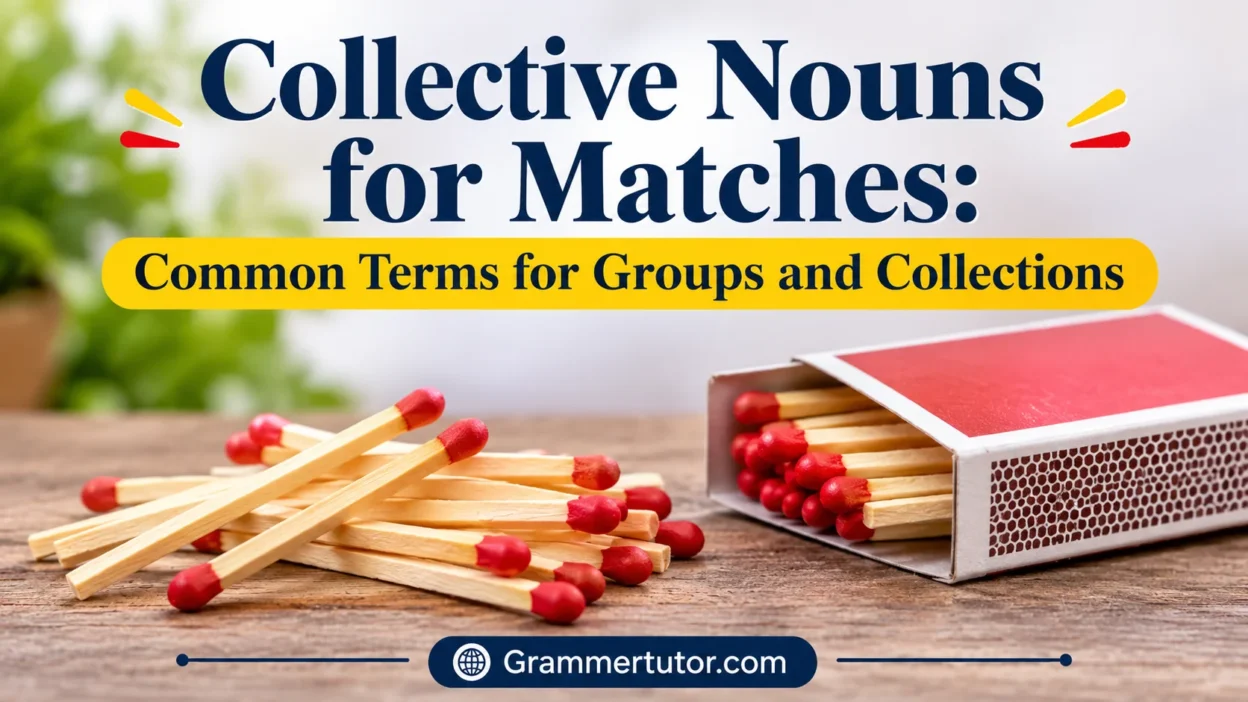
The collective noun for matches depends on how matchsticks are gathered, packed, or presented in everyday situations. A box of matches is perhaps the most familiar expression because it describes several individual matchsticks kept together in one place. However, people also use packets of matches and books of matches when talking about different forms of match packaging. Each expression gives readers a clearer picture of the objects rather than simply mentioning a group of matches. These terms are useful in everyday conversations and help make English descriptions more natural.
Not all matches are kept in the same way. Some are arranged in small containers, while others appear in folded booklets with attached matches. You might also come across vintage matchboxes displayed as part of personal collections or historical exhibits. Expressions describing larger quantities, organized displays, and match collections help explain these situations. When I teach this type of vocabulary, I find that comparing a regular matchbox with an old matchbook makes the differences much easier to understand. It also gives learners practical examples of how collective expressions work in real sentences.
Exploring these expressions is a useful way to improve English vocabulary and sentence construction. Students can learn how to use each phrase through simple examples involving household objects, storage, and everyday activities. Teachers and writers can also introduce interesting details about the matchstick invention, different types of matches, and their manufacturing process. Adding these facts makes the topic more engaging and helps English learners connect new words with familiar objects. With clear examples and practical explanations, understanding how matches are grouped becomes easier and more enjoyable.
Why Do We Need Collective Expressions for Matches?
Matches are usually produced and distributed in groups rather than as individual sticks. They are packed into small containers, arranged in booklets, and transported in larger packages. English uses descriptive noun phrases to explain these different arrangements without mentioning every individual match.
For example, when someone says a box of matches, the listener immediately understands that several matchsticks are stored together in a container. Similarly, a carton of matches suggests a larger quantity prepared for commercial transportation. These expressions make descriptions more specific and help readers understand the context.
Such phrases are especially useful when discussing household products, shopping lists, manufacturing, product displays, and historical collections. Learning them also demonstrates how English combines ordinary nouns to describe groups of related objects.
Common Collective Expressions for Matches
The following table introduces seven expressions that can be used to describe different groups and arrangements of matches.
| Collective Expression | Type or Use | Simple Example |
| Box of matches | Individual matchsticks in a container | A box of matches was in the cupboard. |
| Packet of matches | Matches packed together | She purchased a packet of matches. |
| Book of matches | Matches attached inside a folded booklet | He found a book of matches. |
| Bundle of matches | Several loose matchsticks gathered together | A bundle of matches was collected. |
| Carton of matches | Multiple packages inside a larger container | A carton of matches arrived today. |
| Tray of matches | Matches or match packages arranged on a tray | A tray of matches was displayed. |
| Collection of matches | Different matchboxes or matchbooks gathered together | His collection of matches was valuable. |
Note: These expressions are descriptive group names, not seven universally established grammatical collective nouns.
A Box of Matches
A box of matches is a familiar expression for several matchsticks kept inside a specially designed container. Traditional matchboxes usually have an outer cardboard sleeve and a sliding inner compartment. This design keeps the sticks together and provides a convenient place for storing them.
Most safety matchboxes also have a striking strip on their exterior. Their compact size makes them convenient household products, and they are commonly sold in grocery stores, supermarkets, and general shops. Different manufacturers use distinctive colours, printed designs, and labels to make their matchboxes recognizable.
Examples of “A Box of Matches”
- A box of matches was discovered behind the kitchen cupboard.
- The shopkeeper arranged a box of matches beside the other household products.
- My grandmother kept a box of matches in her old storage cabinet.
- A small box of matches appeared in the emergency supply inventory.
- The manufacturer introduced a new design for its box of matches.
- He noticed a box of matches among the camping equipment.
- Several boxes of matches were delivered to the grocery store.
- The cardboard box of matches carried a printed company logo.
- A box of matches remained unopened inside the cupboard.
- The household shopping list included another box of matches.
A Packet of Matches
A packet of matches refers to a packaged quantity of matchsticks prepared for customers, retailers, or household use. The packet may contain one or more small matchboxes, depending on its packaging and quantity.
Packets are manufactured in different sizes to meet different requirements. Their packaging may include product information, safety instructions, manufacturer details, and decorative designs. This makes the expression particularly relevant to retail shopping and commercial product descriptions.
Examples of “A Packet of Matches”
- A packet of matches appeared on the supermarket shopping receipt.
- The customer selected a packet of matches from the household supplies section.
- The manufacturer printed its product details on the packet of matches.
- Several packets of matches were arranged on the retail display.
- The shop received a new shipment of packets of matches.
- A packet of matches was included in the camping equipment list.
- The retailer checked the packaging of every packet of matches.
- She found a packet of matches inside the shopping basket.
- The supplier added a packet of matches to the order.
- A packet of matches was displayed beside other household products.
A Book of Matches
A book of matches is a small booklet containing several individual matchsticks attached to a foldable cardboard cover. It is commonly known as a matchbook and has a different design from an ordinary matchbox.
Matchbooks became popular as promotional products for restaurants, hotels, and businesses. Their covers often feature advertisements, business names, logos, and colourful illustrations.
Examples of “A Book of Matches”
- A book of matches from an old restaurant attracted the collector’s attention.
- The museum displayed a book of matches from the twentieth century.
- My grandfather preserved a book of matches from his travels.
- The cover of the book of matches featured a traditional illustration.
- Several books of matches were arranged inside a glass cabinet.
- The collector identified the hotel printed on the book of matches.
- A rare book of matches was included in the exhibition.
- The designer created an attractive advertisement for the book of matches.
- She discovered a book of matches inside an antique suitcase.
- The vintage book of matches became an interesting conversation piece.
A Bundle of Matches
A bundle of matches describes several individual matchsticks gathered together in one place. Unlike a box or packet, this expression does not necessarily refer to a manufactured container. It focuses on the arrangement of loose sticks collected as a group.
This phrase can be useful in descriptive writing, product illustrations, and discussions about match production.
Examples of “A Bundle of Matches”
- A bundle of matches was shown in the manufacturing illustration.
- The workers inspected a bundle of matches during production.
- Several bundles of matches were prepared for the packaging process.
- A bundle of matches appeared in the product catalogue.
- The factory recorded each bundle of matches in its inventory.
- A bundle of matches was arranged beside the sample materials.
- The exhibition included an illustration of a bundle of matches.
- The production team examined the quality of the matchsticks.
- A bundle of matches was mentioned in the factory report.
- The designer used a bundle of matches in the educational display.
A Carton of Matches
A carton of matches refers to a larger packaging unit that may contain several smaller boxes or packets of matchsticks.
Cartons help manufacturers and retailers organize their goods before sending them to shops and wholesalers. They are commonly made from cardboard and may include information about the manufacturer, product quantity, and handling requirements. The phrase is therefore more appropriate for describing wholesale supplies than a small household quantity.
Examples of “A Carton of Matches”
- A carton of matches arrived at the wholesale distribution centre.
- The warehouse employee checked the label on the carton of matches.
- The retailer ordered a carton of matches for the store.
- Several cartons of matches were prepared for transportation.
- The supplier included a carton of matches in the delivery.
- A carton of matches was recorded on the warehouse inventory sheet.
- The delivery company transported a carton of matches to the retailer.
- The shopkeeper inspected the carton of matches before opening it.
- A damaged carton of matches was separated from the other products.
- The manufacturer prepared another carton of matches for distribution.
A Tray of Matches
A tray of matches describes matchsticks or match packages arranged together on a flat surface. A tray can be used for displaying packaged products, organizing items, or presenting different matchbox designs in an exhibition.
This expression focuses on the position and arrangement of the objects rather than their packaging. For example, a shopkeeper may arrange several matchboxes on a display tray, while a collector may use a tray to present different vintage designs. It creates a clear visual description for readers.
Examples of “A Tray of Matches”
- A tray of matches was presented in the product exhibition.
- The shopkeeper arranged several matchboxes on a display tray.
- A decorative tray of matches appeared in the antique collection.
- The photographer captured a tray of match products.
- The exhibition included a tray of vintage matchboxes.
- Several trays of packaged matches were prepared for display.
- The designer placed a tray of matches in the product illustration.
- A tray of matches stood beside the household supplies.
- The museum arranged different matchbox designs on a tray.
- Visitors examined the tray of matches during the exhibition.
A Collection of Matches
A collection of matches refers to different match-related items gathered and preserved together. These may include ordinary matchboxes, vintage matchbooks, unusual packaging, and decorative designs from different manufacturers or historical periods.
Examples of “A Collection of Matches”
- His collection of matches included rare designs from different countries.
- The museum displayed a collection of vintage matchbooks.
- A collection of matches was donated to the historical exhibition.
- She organized her collection of matches according to their manufacturing dates.
- The collector discovered an unusual matchbox for his collection.
- A collection of decorative matchbooks attracted several visitors.
- The exhibition presented a collection of historical match packaging.
- My grandfather started a collection of matches many years ago.
- The museum preserved its collection of matches in special display cases.
- Every item in the collection of matches had a different design.
Interesting Facts About Matches
A traditional matchstick consists of a narrow body and a specially prepared head. The body is commonly made from wood or cardboard, while the head contains carefully selected chemical materials that allow ignition under suitable conditions. Safety matches are designed to work with a specially prepared striking surface.
There are several varieties of matches available today. Their printed advertisements and colourful artwork have made vintage matchbooks popular among collectors.
Matchboxes also have cultural and historical value. Their designs often display old company names, advertisements, illustrations, and manufacturing details. Collectors sometimes preserve them to study changes in branding and commercial art. They should always be stored responsibly, away from children, excessive heat, and flammable materials.
Conclusion
Matches may seem like simple household items, but the words used to describe them can add variety and detail to everyday English. Whether you are talking about a box of matches, a packet of matches, or a book of matches, each expression helps readers picture how the matchsticks are kept together. Learning these phrases also builds confidence when writing descriptions or explaining ordinary objects. The next time you pick up a matchbox, notice how a small collection of matchsticks can teach you something useful about English vocabulary.
FAQs
Q1. What is the most common collective expression for matches?
The most common expression is a box of matches. It describes several matchsticks stored together inside a small container.
Q2. Can we use “a packet of matches” in a sentence?
Yes. A packet of matches is a correct and natural expression used to describe matches packaged together for sale or storage.
Q3. What is meant by a book of matches?
A book of matches is a small folded booklet containing individual matchsticks attached to a cardboard cover. It is also called a matchbook.
Q4. What does a bundle of matches describe?
A bundle of matches describes several loose matchsticks gathered together. It does not necessarily refer to a specific retail container.
Q5. What is a carton of matches?
A carton of matches generally refers to a larger shipping package containing several smaller matchboxes or packets.