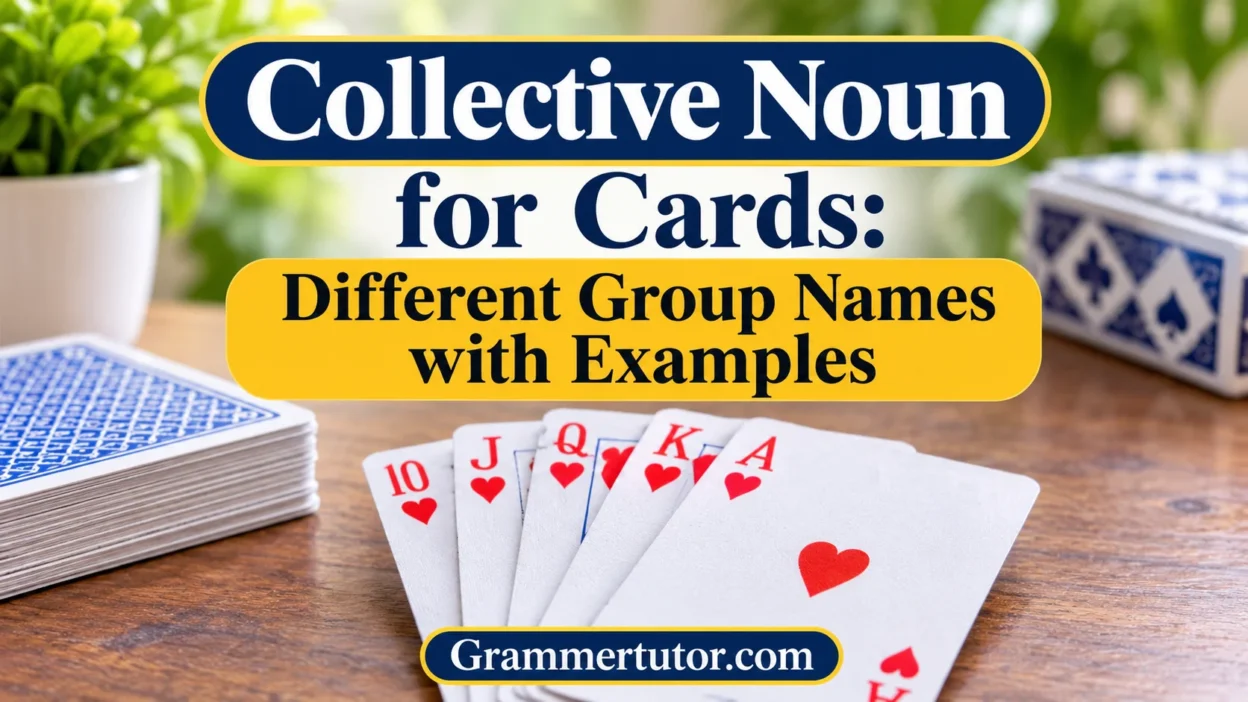
A collective noun for cards describes a group of playing cards as one collection, such as a deck of cards or a pack of cards. In everyday English, cards are common objects found in homes, schools, offices, and shops.
People use them for playing games, sharing information, sending greetings, and identifying themselves. Depending on their different purposes, cards can be arranged into a hand of cards, a stack of cards, or a set of cards. These group expressions make descriptions easier and help explain how several cards are used together. Each expression has a slightly different meaning depending on the situation.
For example, a hand of cards refers to cards held by a player, while a stack of cards describes cards placed in a pile. A set of cards refers to cards that belong together, whereas a pack of cards usually means a complete group. Understanding these different expressions, card arrangements, and collective terminology improves English vocabulary and makes it easier to describe card groups, card collections, and other types of cards.
Why Group Names Are Used for Cards
Cards are often arranged or handled together rather than individually. During a game, players may hold several cards in their hands, while unused cards remain inside a pack or deck. Similarly, greeting cards, business cards, and educational cards can be collected in organized groups.
English uses expressions such as deck, pack, hand, and stack to explain these arrangements. Each word gives readers a better idea of how the cards are being kept or used.
For example, a deck of cards generally describes a complete collection of playing cards, whereas a hand of cards refers to the cards held by one player during a game.
These expressions make written descriptions clearer and help speakers communicate without listing every individual card.
Collective Nouns for Cards
| Collective Noun | Used For | Simple Example |
| Deck | A complete collection of playing cards | A deck of cards was on the table. |
| Pack | Cards kept together for playing | She bought a pack of cards. |
| Hand | Cards held by one player | He received a hand of cards. |
| Stack | Cards placed on top of one another | A stack of cards fell down. |
| Set | Cards belonging to one collection | I purchased a set of cards. |
| Bundle | Several cards tied or gathered together | A bundle of cards was found. |
| Collection | Different cards gathered by someone | His collection of cards was impressive. |
Deck of Cards
A deck of cards is the most familiar expression for a complete collection of playing cards. A standard deck generally contains 52 playing cards divided into four suits: hearts, diamonds, clubs, and spades. Some decks also include jokers.
This expression is commonly used when discussing card games, magic tricks, entertainment, and recreational activities. It describes cards that belong to one complete playing collection.
Examples of “Deck of Cards”
- A deck of cards was lying on the table.
- She purchased a new deck of cards.
- My brother shuffled the deck of cards.
- We played a game with one deck of cards.
- He dropped the deck of cards on the floor.
- The magician held a deck of cards in his hand.
- I found an old deck of cards inside the cupboard.
- They used a deck of cards during the competition.
- She placed the deck of cards beside the notebook.
- Everyone gathered around to play with the deck of cards.
Pack of Cards
A pack of cards refers to a collection of playing cards kept together for games and entertainment. This expression is especially common in British English and is frequently used in everyday conversations.
A pack usually contains the cards needed to play different games. People may keep one in their homes, travel bags, or recreational spaces.
Examples of “Pack of Cards”
- I bought a pack of cards from the shop.
- She placed the pack of cards inside her bag.
- We opened a new pack of cards.
- He carried a pack of cards during the journey.
- The children enjoyed playing with the pack of cards.
- My father gave me a colorful pack of cards.
- A pack of cards was kept inside the drawer.
- She shuffled the pack of cards before playing.
- We needed another pack of cards for the game.
- He brought a pack of cards to the family gathering.
Hand of Cards
A hand of cards describes the cards held by an individual player during a card game. These cards are usually distributed at the beginning of a round or collected during gameplay.
The number of cards in a hand depends on the rules of the particular game. Players use their hands to make decisions, follow instructions, and compete against others.
Examples of “Hand of Cards”
- He received a hand of cards at the beginning.
- She looked carefully at her hand of cards.
- My friend showed me his hand of cards.
- The player held a strong hand of cards.
- I picked up my hand of cards from the table.
- She arranged her hand of cards before playing.
- He was happy with his hand of cards.
- The dealer gave everyone a hand of cards.
- I studied my hand of cards before making a move.
- She played one card from her hand of cards.
Stack of Cards
A stack of cards refers to several cards placed directly on top of one another. These cards may be playing cards, learning cards, greeting cards, or other printed materials.
The word stack focuses on the physical arrangement of the cards. It is useful when describing cards placed neatly together or piled up after use.
Examples of “Stack of Cards”
- A stack of cards was placed on the desk.
- She picked up a stack of cards from the floor.
- He arranged the stack of cards neatly.
- A colorful stack of cards stood beside the computer.
- The children made a tall stack of cards.
- I found a stack of cards inside the box.
- She moved the stack of cards to another table.
- A stack of cards fell during the game.
- He counted every card in the stack.
- The teacher distributed a stack of cards to the students.
Set of Cards
A set of cards describes several cards designed to belong together for a particular purpose. These may include educational flashcards, matching cards, playing cards, or special collectible cards.
The expression emphasizes that the cards form a related collection. For example, a teacher may use a set of alphabet cards to help children recognize letters and improve their reading skills.
Examples of “Set of Cards”
- I purchased a set of cards for learning English.
- She received a beautiful set of cards.
- The teacher prepared a set of cards for the lesson.
- He kept the set of cards inside a small box.
- We used a set of cards to play a matching game.
- My sister collected a set of colorful cards.
- The children enjoyed using the set of cards.
- She arranged the set of cards on the table.
- He gave me a set of cards as a present.
- The complete set of cards was ready for the activity.
Types of Cards and Their Uses
Cards come in different forms, and each variety has its own purpose. Playing cards are commonly used for entertainment, competitions, and traditional games. Greeting cards allow people to express their feelings during birthdays, weddings, holidays, and other special occasions.
Business cards contain professional contact information and help people share their details during meetings and networking events. Flashcards are useful educational materials that help students remember vocabulary, definitions, numbers, and important concepts.
Other varieties include invitation cards, identification cards, membership cards, trading cards, and collectible cards. Their different functions explain why expressions such as deck, pack, stack, and set are useful in everyday English.
Examples of Different Card Types
- Playing cards are used for entertainment and games.
- Greeting cards are exchanged during special occasions.
- Business cards display professional contact details.
- Flashcards help students remember new information.
- Invitation cards announce upcoming events.
- Identification cards provide personal identification.
- Membership cards show belonging to an organization.
- Trading cards are exchanged between collectors.
- Birthday cards carry wishes and messages.
- Educational cards support classroom learning.
Interesting Facts About Cards
Cards have a long and interesting history, with early playing-card traditions developing in Asia before spreading to other parts of the world. Over time, different regions introduced their own designs, symbols, and styles. Modern playing cards commonly feature four suits, including hearts, diamonds, clubs, and spades, with each suit containing numbered cards and face cards. A standard deck usually has 52 cards, although some versions include additional jokers.
One interesting feature of playing cards is their variety of designs. The four suits have different symbols, while face cards traditionally represent kings, queens, and jacks. These illustrations have changed across cultures and historical periods. Modern cards are commonly manufactured using paper or specially coated cardstock, which makes them flexible, durable, and easier to shuffle. Some premium versions are made with plastic materials to improve their resistance to moisture and repeated handling.
Cards are also widely used beyond traditional games. Teachers prepare flashcards to help students learn vocabulary, mathematical facts, and new concepts. Businesses distribute professional cards to exchange contact information, while greeting cards provide a personal way to celebrate important moments. Collectors also preserve rare trading cards because of their artwork, limited availability, and historical significance. These different uses make cards an important part of education, communication, entertainment, and collecting.
Examples of Card Facts
- A standard playing deck usually contains 52 cards.
- Playing cards have four traditional suits.
- Hearts and diamonds are red suits.
- Clubs and spades are black suits.
- Some playing-card collections include jokers.
- Flashcards are useful for educational activities.
- Greeting cards are popular during celebrations.
- Business cards help people exchange contact details.
- Trading cards are popular among collectors.
- Plastic playing cards can offer greater resistance to moisture.
Conclusion
Understanding the collective noun for cards makes it easier to describe groups of cards in everyday English. Expressions such as a deck of cards, pack of cards, hand of cards, stack of cards, and set of cards each have a specific use. Choosing the right expression helps make communication clearer and improves your understanding of collective nouns.
FAQs
Q1. What is the collective noun for cards?
The most common collective expression for playing cards is a deck of cards. It describes a complete collection of playing cards kept together.
Q2. Can I use “pack of cards” instead of “deck of cards”?
Yes. Both expressions are correct. A pack of cards is particularly common in British English, while a deck of cards is widely used in American English.
Q3. What does “hand of cards” mean?
A hand of cards refers to the cards held by one player during a card game. The number of cards depends on the game’s rules.
Q4. Is “stack of cards” a collective noun?
A stack of cards is a group expression describing cards arranged on top of one another. It focuses on their physical arrangement rather than a particular game.
Q5. What is the difference between a deck and a pack of cards?
Both expressions describe a collection of playing cards. Their meanings are very similar, but regional preferences influence which expression people commonly use.