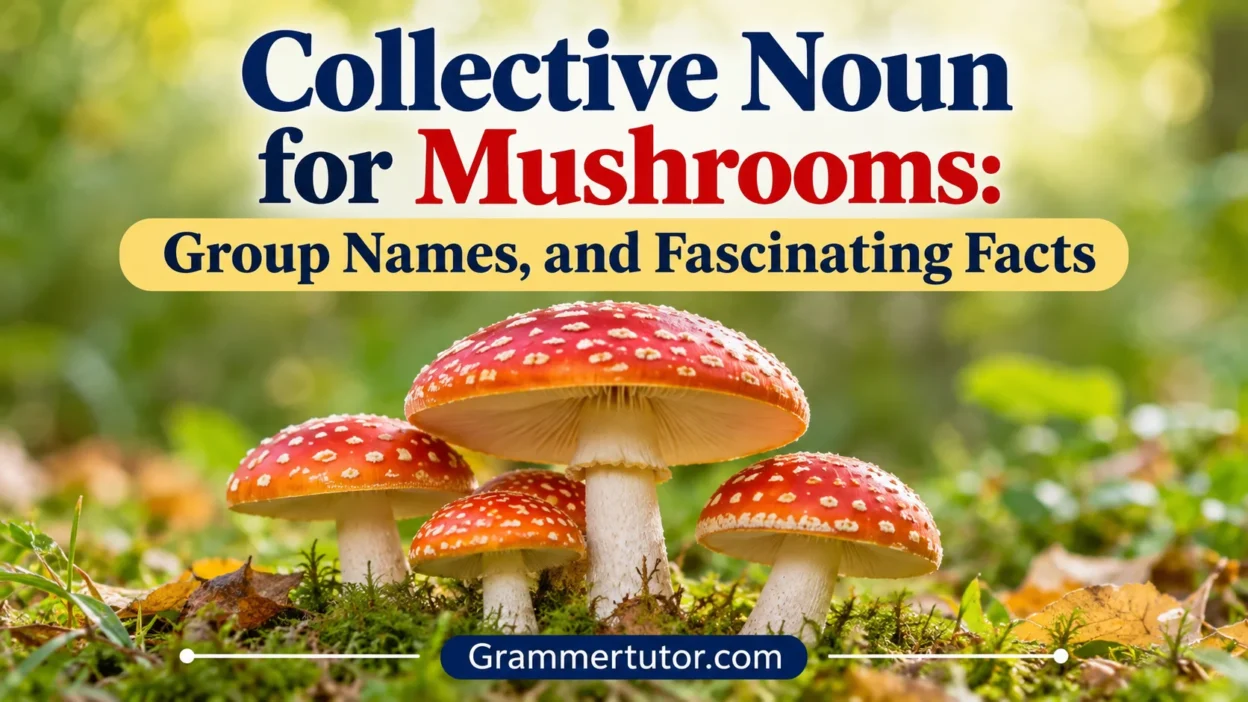
A collective noun for mushrooms helps describe several mushrooms growing together in forests, gardens, and other natural places. These fascinating fungi often appear in groups, making them easy to identify.
Mushrooms can grow close together on fallen trees, beneath fallen leaves, or across patches of soil. A cluster is a useful way to describe this arrangement, but words such as patch, colony, and clump can also explain how mushrooms appear in different locations. Each term gives readers a clearer picture of their growing patterns.
Other expressions, including flush, ring, and bed, describe different ways mushrooms develop and spread. Learning these terms can improve your English vocabulary and help you describe fungi accurately. Whether you enjoy nature, gardening, cooking, or English language learning, understanding these expressions makes describing mushrooms more interesting.
Why Do Mushrooms Have Different Group Names?
Mushrooms often appear in groups because their growth depends on environmental conditions such as moisture, temperature, nutrients, and suitable growing material. When these conditions are favourable, several fruiting bodies may emerge close to one another.
Different group expressions help describe their arrangement. For example, cluster refers to mushrooms growing closely together, while patch describes an area where several mushrooms appear. A fairy ring refers to a roughly circular arrangement that develops as certain fungi spread underground.
These terms are useful in different situations. Gardeners may use them when discussing mushroom growth in lawns, while nature enthusiasts can use them to describe fungi discovered during woodland walks.
It’s also important to understand that mushrooms are only the visible reproductive structures of fungi. Much of the organism exists underground or inside its growing material as a network of fine threads called mycelium.
Seven Collective Nouns for Mushrooms
| Type | Simple Example |
| Cluster | A cluster of mushrooms grew beside the tree. |
| Patch | A patch of mushrooms appeared in the garden. |
| Colony | A colony of mushrooms developed on the woodland floor. |
| Clump | A clump of mushrooms emerged from the damp soil. |
| Flush | A flush of mushrooms appeared after the rain. |
| Ring | A ring of mushrooms surrounded the grassy area. |
| Bed | A bed of mushrooms covered the decaying wood. |
Cluster of Mushrooms
A cluster of mushrooms describes several individual mushrooms growing close to one another in a concentrated area. It is one of the most natural and widely understood expressions for describing multiple mushrooms. You may encounter clusters on tree stumps, fallen branches, damp soil, and decaying leaves.
Certain mushroom species naturally produce several fruiting bodies from the same underlying mycelium. This creates a close arrangement in which their stems and caps appear side by side. Oyster mushrooms, for example, frequently develop in overlapping clusters on dead or dying wood.
The expression is particularly useful for describing mushrooms that emerge from a shared growing location. It also works well in everyday writing because readers can easily imagine their arrangement.
Examples of “Cluster of Mushrooms”
- A cluster of mushrooms appeared beside the fallen oak.
- The woodland photographer discovered a cluster of mushrooms beneath the leaves.
- A cluster of mushrooms covered the decaying branch.
- Several children noticed a cluster of mushrooms near the garden fence.
- A cluster of mushrooms emerged after several days of rainfall.
- The botanist examined a cluster of mushrooms growing on an old stump.
- A cluster of mushrooms decorated the damp forest floor.
- We found a beautiful cluster of mushrooms beneath the pine trees.
Patch of Mushrooms
A patch of mushrooms refers to an area where several mushrooms grow within a relatively small space. Unlike a cluster, which suggests close physical grouping, a patch focuses more on the location occupied by the mushrooms.
You might notice a patch of mushrooms in a grassy lawn, beneath a hedge, or across a woodland clearing. These growth patterns often develop when underground fungal networks have access to suitable nutrients and moisture.
The word patch is especially useful when mushrooms are scattered across a particular section of ground rather than attached closely to one another. It is a simple expression that works naturally in gardening discussions, nature descriptions, and educational writing.
Examples of “Patch of Mushrooms”
- A patch of mushrooms appeared beside the garden pathway.
- We discovered a patch of mushrooms beneath the shaded hedge.
- The children carefully observed a patch of mushrooms in the meadow.
- A patch of mushrooms spread across the damp lawn.
- The gardener noticed a patch of mushrooms near the compost heap.
- Several small caps covered the patch of mushrooms.
- A patch of mushrooms developed around the old tree roots.
- Rainfall encouraged a fresh patch of mushrooms to emerge.
Colony of Mushrooms
A colony of mushrooms describes a collection of fungal growths occupying the same general area. The word colony is commonly used in biology to describe organisms living or developing together in a particular location.
Mushrooms can appear in colonies when their underground mycelial networks spread through suitable soil, wood, or other organic materials. These networks absorb nutrients and produce visible fruiting bodies when environmental conditions support reproduction.
One interesting feature of fungal colonies is that the visible mushrooms may represent only a small portion of the organism. The larger fungal network can extend through the material beneath the surface, connecting different fruiting bodies through microscopic threads.
This expression is useful when discussing fungal development from a biological perspective.
Examples of “Colony of Mushrooms”
- A colony of mushrooms developed around the decaying tree trunk.
- The researcher photographed a colony of mushrooms in the forest.
- A colony of mushrooms occupied the shaded woodland floor.
- We noticed a colony of mushrooms growing beneath the old logs.
- The damp environment supported a colony of mushrooms.
- A colony of mushrooms appeared near the composting leaves.
- The naturalist studied a colony of mushrooms after rainfall.
- A colony of mushrooms covered the moist section of the garden.
Clump of Mushrooms
A clump of mushrooms describes several fruiting bodies growing tightly together in a small space. It is a convenient descriptive expression when individual mushrooms appear crowded or partially overlapping.
Clumps commonly develop on decaying wood, tree roots, and nutrient-rich ground. Some fungal species produce fruiting bodies so close together that their stems seem to emerge from almost the same point.
This word creates a clear visual impression of compact growth. It is especially helpful when describing mushrooms with short stems and closely arranged caps.
A clump can contain just a few mushrooms or a much larger collection, depending on the species and growing conditions.
Examples of “Clump of Mushrooms”
- A clump of mushrooms emerged from the rotting stump.
- The woodland floor contained a clump of pale mushrooms.
- We spotted a clump of mushrooms near the stream.
- A clump of mushrooms grew around the exposed tree roots.
- The photographer captured a clump of mushrooms in the morning light.
- A clump of mushrooms appeared beneath the thick vegetation.
- The gardener removed the decaying wood surrounding the clump of mushrooms.
- Several brown caps formed a clump of mushrooms beside the pathway.
Flush of Mushrooms
A flush of mushrooms refers to a sudden appearance of numerous mushroom fruiting bodies over a relatively short period. This expression is particularly common in mushroom cultivation and discussions about fungal growth.
A flush often occurs when environmental conditions become favourable. Rainfall, adequate humidity, suitable temperatures, and available nutrients can encourage fungi to produce visible mushrooms. After a period of favourable conditions, several fruiting bodies may emerge almost simultaneously.
Unlike cluster or clump, this term emphasises the timing and abundance of mushroom production. Mushroom growers often monitor flushes because they indicate when cultivated fungi are ready for harvesting.
Different species produce fruiting bodies at different intervals, so the timing and number of flushes can vary considerably.
Examples of “Flush of Mushrooms”
- A flush of mushrooms appeared following the heavy rainfall.
- The mushroom farmer harvested a fresh flush of mushrooms.
- A sudden flush of mushrooms covered the prepared growing beds.
- Warm conditions encouraged another flush of mushrooms.
- The woodland experienced a remarkable flush of mushrooms during autumn.
- A flush of mushrooms emerged from the moist growing material.
- The cultivator recorded the latest flush of mushrooms.
- A healthy flush of mushrooms developed inside the growing room.
Ring of Mushrooms
A ring of mushrooms describes mushrooms growing in a roughly circular arrangement. This natural formation is widely known as a fairy ring and can be seen in grasslands, lawns, and woodland clearings.
Fairy rings develop when certain fungi expand outward through the soil. As the underground mycelium grows, it may produce mushrooms around the outer edge of the expanding network. Over time, this can create a visible circular pattern.
Some fairy rings appear as neat circles, while others develop into incomplete arcs or irregular shapes. Their appearance depends on the fungal species, soil conditions, vegetation, and surrounding environment.
The expression is especially useful when describing the distinctive geometric patterns produced by some fungi.
Examples of “Ring of Mushrooms”
- A ring of mushrooms appeared across the village lawn.
- The children discovered a fairy ring beneath the old trees.
- A ring of mushrooms surrounded a small grassy clearing.
- The naturalist photographed a circular ring of mushrooms.
- A ring of mushrooms developed after the autumn showers.
- The woodland path passed beside a ring of mushrooms.
- A ring of mushrooms formed around the centre of the meadow.
- The unusual ring of mushrooms attracted the attention of visitors.
Bed of Mushrooms
A bed of mushrooms describes an area containing a large number of mushrooms growing together. The word bed is also used in gardening and cultivation to identify a prepared growing area for plants or fungi.
Mushroom growers commonly prepare beds or growing containers using suitable organic materials and carefully controlled environmental conditions. Depending on the cultivation method, these growing areas may support numerous fruiting bodies.
In natural environments, the expression can also describe a broad section of ground covered with mushrooms. It is particularly useful when writing about abundant fungal growth across woodland floors or decaying vegetation.
Although bed is not a specialized scientific collective noun, it provides an understandable description of a mushroom-covered area.
Examples of “Bed of Mushrooms”
- A bed of mushrooms covered the shaded woodland floor.
- The farmer prepared a bed of mushrooms inside the growing house.
- A bed of mushrooms developed on the decomposing organic material.
- We discovered a bed of mushrooms near the forest entrance.
- The cultivator watered the mushroom bed carefully.
- A bed of mushrooms appeared beneath the large branches.
- The moist environment supported a bed of mushrooms.
- A beautiful bed of mushrooms brightened the woodland clearing.
How Mushrooms Grow and Develop in Nature
Mushrooms follow a different growth process from ordinary garden plants. They belong to the kingdom Fungi and develop from microscopic reproductive structures called spores. When a spore lands in a suitable environment, it may germinate and produce thin, thread-like structures known as hyphae. These threads spread through soil, wood, or other organic materials and eventually form an interconnected network called mycelium.
The mycelium is responsible for absorbing nutrients and supporting fungal growth. When moisture, temperature, and other environmental conditions become favourable, the network can produce visible mushrooms. These structures emerge above the growing surface and release spores that help the fungus reproduce.
Different species prefer different habitats. Some grow on fallen trees, others develop in grassy areas, and certain varieties appear around living tree roots. Their growth patterns can produce circular formations, compact clusters, scattered patches, or large colonies.
Examples of Mushroom Growth Patterns
- Oyster mushrooms develop on decaying wood.
- Some woodland fungi emerge beneath fallen leaves.
- Certain species produce circular formations in grassy areas.
- Underground mycelium spreads through nutrient-rich materials.
- Mushrooms release spores from their reproductive structures.
- Some fungi develop around the roots of living trees.
- Moist conditions can encourage new fruiting bodies.
- Different species prefer particular environmental conditions.
Interesting Facts About Mushrooms
Mushrooms have several remarkable biological characteristics that make them different from plants and animals. They belong to the kingdom Fungi, and their visible caps and stems are actually reproductive structures rather than the entire organism. The main body of many fungi consists of an underground or hidden network called mycelium. This network can survive for years, and some fungal organisms remain alive for decades or even centuries under suitable conditions. However, individual mushroom fruiting bodies may last only a few days or weeks, depending on the species and environment. One particularly interesting example is the honey fungus, some colonies of which can spread across enormous areas through their underground mycelial networks.
Another unusual feature is their physical structure. Mushroom cell walls contain chitin, a substance also found in the outer skeletons of insects and other arthropods. Unlike green plants, mushrooms do not contain chlorophyll and cannot produce their own food through photosynthesis. Their caps often contain gills, pores, or other spore-producing surfaces. These structures release microscopic spores that travel through air, water, or other natural means. Some mushrooms also produce distinctive colours, shapes, textures, and smells that help distinguish different species. Their stems and caps vary considerably, ranging from tiny delicate structures to large fruiting bodies weighing several kilograms.
Their dietary habits are equally fascinating because mushrooms obtain nutrients differently from plants. Many species are saprotrophic, meaning they absorb nutrients from dead and decomposing organic matter such as fallen leaves, dead wood, and other plant material. Others form beneficial partnerships with living plants through a relationship called mycorrhiza, in which fungal networks exchange nutrients with plant roots. Certain fungi are parasitic and obtain nourishment from living organisms, sometimes causing disease. Mushrooms play an important ecological role by helping recycle nutrients and break down organic materials. Some edible varieties, including button mushrooms, oyster mushrooms, and shiitake, are also widely cultivated for human consumption. However, not every mushroom is safe to eat, as some wild species contain dangerous toxins.
Conclusion
Understanding the collective noun for mushrooms makes it easier to describe how these fascinating fungi grow in nature. Although cluster is the most useful expression, words such as patch, colony, clump, flush, ring, and bed can describe different growing arrangements. Learning these terms expands your vocabulary and helps you communicate more clearly when writing or talking about mushrooms.
FAQs
Q1. What is the collective noun for mushrooms?
Cluster is one of the most commonly used expressions for several mushrooms growing close together. Other descriptive terms include patch, colony, clump, flush, ring, and bed.
Q2. What do you call a group of mushrooms growing together?
A group of mushrooms growing close together is generally called a cluster of mushrooms. The expression describes several fruiting bodies emerging within the same small area.
Q3. Is a patch of mushrooms a correct expression?
Yes. A patch of mushrooms is a natural descriptive expression for several mushrooms growing across a particular area of soil, grass, or woodland.
Q4. What is a fairy ring of mushrooms?
A fairy ring is a roughly circular formation of mushrooms that develops when certain fungal networks spread outward through the ground. The mushrooms often appear around the outer edge of the growing mycelium.
Q5. What does a flush of mushrooms mean?
A flush of mushrooms refers to numerous fruiting bodies appearing within a relatively short period. It commonly occurs when moisture, temperature, and other growing conditions become favourable.
Q6. Are mushrooms plants or animals?
Mushrooms are neither plants nor animals. They belong to a separate biological kingdom called Fungi. They obtain nutrients by absorbing organic substances from their surroundings rather than producing food through photosynthesis.